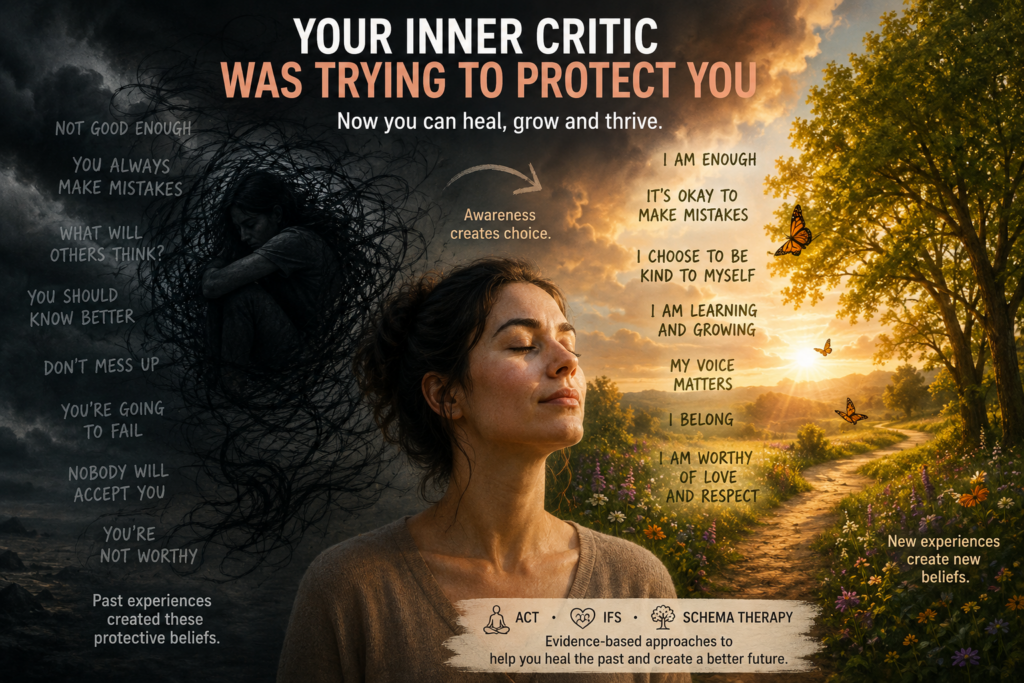
What makes you insecure and how to build confidence
Low self-confidence often develops from early experiences and core beliefs that shape how we see ourselves. Learn how CBT, ACT, and IFS therapy in Ontario can help rebuild confidence by addressing underlying schemas and improving self-worth.
Why Low Self-Confidence Develops and How Therapy in Ontario Can Help You Rebuild It
Low self-confidence is one of the most common reasons people seek therapy for anxiety, depression, and relationship difficulties in Ontario. While it can feel like a personal flaw, chronic insecurity is usually not about a lack of ability or character. Instead, it is often the result of long-standing patterns formed early in life—shaped by relationships, repeated experiences, and internalized beliefs about worth, competence, and belonging.
Understanding where low confidence comes from is the first step in changing it. Evidence-based therapies such as Cognitive Behavioural Therapy (CBT), Acceptance and Commitment Therapy (ACT), and Internal Family Systems (IFS) all offer effective pathways for rebuilding self-trust and strengthening a more stable sense of self.
How Early Experiences Shape Self-Confidence
Self-confidence does not develop in isolation. It forms through repeated interactions with caregivers, peers, teachers, and later relationships. When early environments are supportive, consistent, and emotionally attuned, individuals tend to develop a sense of competence and internal security. When they are critical, inconsistent, neglectful, or emotionally invalidating, the developing mind often adapts by forming protective beliefs.
These beliefs are not conscious choices—they are survival strategies.
For example, a child who is frequently criticised may internalize beliefs such as “I am not good enough,” while a child whose emotional needs are dismissed may learn “My needs don’t matter” or “I am too much.” Over time, these experiences shape what cognitive therapy refers to as core schemas—deeply held cognitive and emotional frameworks that filter how we interpret ourselves and the world.
Research in schema theory has consistently shown that early maladaptive schemas are strongly associated with anxiety, low self-esteem, emotional distress, and difficulties in interpersonal functioning (Young, Klosko, & Weishaar, 2003). Once established, these schemas tend to persist into adulthood unless actively addressed in therapy.
Core Schemas and the Internal Voice of Insecurity
Core schemas act like internal templates. They influence how we interpret success, failure, relationships, and even neutral events. Someone with a “defectiveness” schema may dismiss compliments as mistakes or assume others would reject them if they were truly known. Someone with an “unrelenting standards” schema may feel chronically inadequate despite high achievement.
These patterns are reinforced by cognitive biases such as selective attention to mistakes and discounting positive feedback. Beck’s cognitive model of depression and anxiety highlights how automatic thoughts arise from underlying beliefs, shaping emotional responses and behaviour in self-perpetuating cycles (Beck, 2011).
This is why low self-confidence often feels so persistent. It is not just a thought—it is an entire system of interpretation.
How CBT Helps Rebuild Self-Confidence
Cognitive Behavioural Therapy (CBT) directly targets the link between thoughts, emotions, and behaviour. In the context of low self-confidence, CBT helps individuals identify distorted automatic thoughts such as “I will fail,” “I am not competent,” or “People will think I’m stupid.”
Once identified, these thoughts are tested against evidence rather than accepted as truth. Over time, this helps weaken rigid core beliefs and build more balanced thinking patterns.
CBT also uses behavioural experiments, which are particularly important for confidence. Instead of waiting to “feel confident,” clients test predictions through action—such as speaking up in a meeting, trying something new, or tolerating small risks. When feared outcomes do not occur, the brain updates its beliefs.
Meta-analytic research shows CBT is highly effective for improving self-esteem and reducing symptoms of anxiety and depression, both of which are closely tied to confidence issues (Hoffman et al., 2012). Importantly, CBT does not simply “positive think”—it restructures the underlying belief system through evidence-based learning.
ACT: Building Confidence Through Psychological Flexibility
Acceptance and Commitment Therapy (ACT) approaches self-confidence from a different angle. Rather than directly challenging thoughts, ACT focuses on changing the relationship with thoughts.
Many individuals with low confidence become entangled with internal narratives such as “I am not good enough.” ACT teaches cognitive defusion—learning to see thoughts as mental events rather than facts. For example, instead of “I am not good enough,” the thought becomes “I am having the thought that I am not good enough.”
This shift reduces the power of internal criticism.
ACT also emphasises values-based living. Confidence is reframed not as a prerequisite for action, but as something that often grows through action aligned with personal values. Research has shown that ACT interventions improve psychological flexibility and reduce experiential avoidance, both of which are associated with increased self-esteem and resilience (Hayes et al., 2006).
In practice, this means a person does not wait to feel confident before engaging in meaningful life steps. Instead, they act in alignment with what matters to them, even while discomfort is present.
IFS: Understanding the Inner System Behind Low Confidence
Internal Family Systems (IFS) offers a different but complementary perspective. Rather than viewing low confidence as a single problem, IFS conceptualizes the mind as made up of “parts,” each with its own role and intention.
In individuals with low self-confidence, there is often a critical part that constantly evaluates and judges, and a protective part that avoids risk or vulnerability. Beneath these parts is typically a more vulnerable “exiled” part that carries early emotional pain, shame, or feelings of inadequacy.
IFS therapy helps individuals develop a relationship with these parts rather than being controlled by them. The goal is not to eliminate the inner critic, but to understand its protective function and reduce its extreme influence.
Clinical research on IFS is growing, and early studies suggest it is effective in reducing symptoms of anxiety and depression while improving self-compassion and emotional regulation (Schwartz & Sweezy, 2019). Many people report that this approach feels less adversarial than traditional cognitive methods because it fosters curiosity rather than self-judgement.
Why These Patterns Feel So Resistant to Change
One of the most frustrating aspects of low self-confidence is how “sticky” it feels. Even when someone logically knows they are capable or valued, the emotional belief persists.
This is because schemas are stored not just cognitively but emotionally and somatically. They are reinforced through repetition, emotional memory, and avoidance patterns. Avoiding challenges may temporarily reduce anxiety, but it also prevents corrective experiences that could disconfirm the belief.
Neuroscience research suggests that deeply ingrained emotional learning requires experiential updating rather than intellectual insight alone. This is why therapy approaches that include behavioural activation, emotional processing, and experiential work tend to be more effective than insight alone or support.
Integrating CBT, ACT, and IFS in Therapy
In practice, these approaches are often most powerful when integrated.
CBT helps identify and restructure distorted thinking patterns. ACT helps reduce struggle with internal experiences and promotes values-based action. IFS helps access and heal deeper emotional layers that maintain self-critical patterns.
Together, they create a multi-level approach:
* CBT addresses conscious thought patterns
* ACT shifts the relationship with thoughts and emotions
* IFS works with deeper emotional systems and self-protective parts
This combination supports not only improved confidence, but also greater emotional resilience and self-understanding.
Moving Toward More Stable Self-Confidence
Building self-confidence is not about becoming flawless, outgoing, or unaffected by doubt. It is about developing a more stable internal foundation that is less dependent on approval, performance, or external validation.
When core schemas soften, cognitive flexibility increases, and internal systems become more integrated, individuals often experience a gradual but meaningful shift: they begin to trust themselves more, even when uncertainty is present.
Low self-confidence can feel deeply personal, but it is also highly treatable. With the right therapeutic support, these patterns can change in ways that are both practical and enduring.
If you recognize yourself in these patterns, we invite you to CONTACT US today. We are available across Ontario and can help you understand these long-standing patterns and build a more confident, grounded sense of self.
References
Beck, J. S. (2011). Cognitive behavior therapy: Basics and beyond (2nd ed.). Guilford Press.
Hayes, S. C., Luoma, J. B., Bond, F. W., Masuda, A., & Lillis, J. (2006). Acceptance and commitment therapy: Model, processes and outcomes. Behaviour Research and Therapy, 44(1), 1–25.
Hoffman, S. G., Asnaani, A., Vonk, I. J. J., Sawyer, A. T., & Fang, A. (2012). The efficacy of cognitive behavioral therapy: A review of meta-analyses. Cognitive Therapy and Research, 36(5), 427–440.
Young, J. E., Klosko, J. S., & Weishaar, M. E. (2003). Schema therapy: A practitioner’s guide. Guilford Press.
Schwartz, R. C., & Sweezy, M. (2019). Internal family systems therapy. Guilford Press.
Prepared by Dr. Jennifer Barbera, PhD, Registered Psychologist
Dr. Jennifer Barbera PhD, C. Psych is a licensed psychologist with over 25 years of counselling experience. She has extensive clinical expertise supporting individuals and couples with anxiety, trauma, depression, addiction, and relationship challenges. Her work combines evidence-based approaches with practical strategies to help clients build resilience and improve well-being.