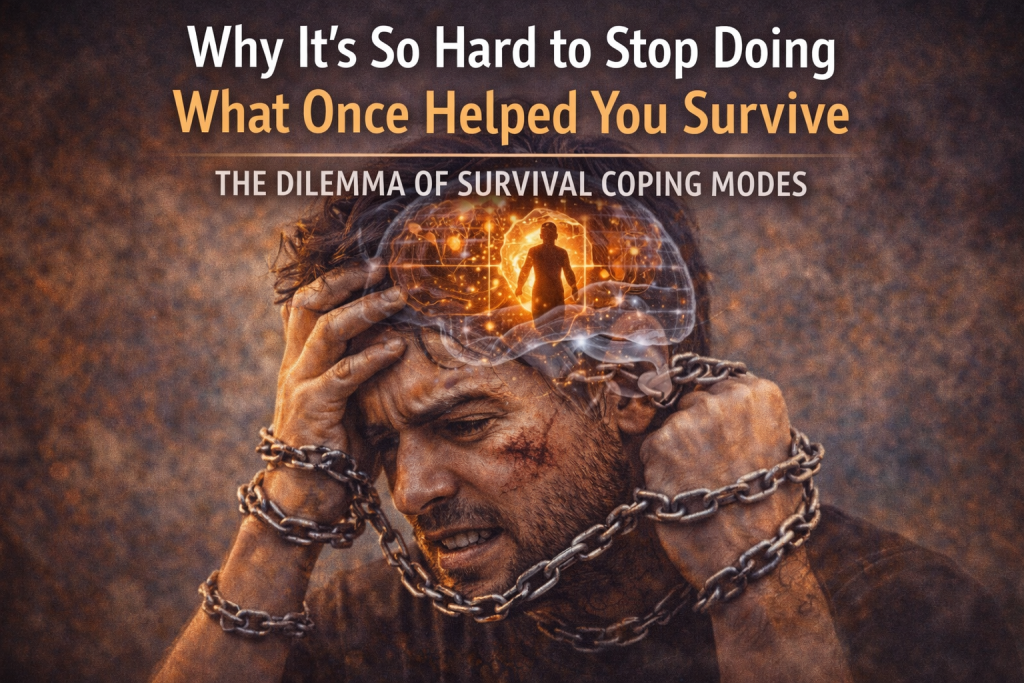
Why the Nervous System Locks in Survival Coping Modes
When needs go unmet, the nervous system treats survival coping modes as non-negotiable. Learn why old patterns persist despite insight or effort.
When Survival Becomes Non-Negotiable:
Why the Nervous System Locks in Old Coping Modes
The nervous system is not designed to optimize happiness or growth.
It is designed to prevent danger.
When a child grows up with sustained unmet needs, chronic unpredictability, or punishment for trying new ways of responding, the nervous system learns a powerful rule: some strategies are not optional—they are required for survival.
Over time, these strategies solidify into coping modes that feel rigid, automatic, and non-negotiable.
How Modes Become “Locked In”
Early in life, the nervous system experiments. It tests different responses—expression, withdrawal, compliance, protest—to see what reduces threat and preserves connection. When a particular mode reliably prevents harm, it is reinforced.
But when alternative responses such as trying to express one’s needs are met with punishment, rejection, or increased danger, the system stops experimenting.
The message encoded is simple and absolute: Deviating from this mode is unsafe.
At that point, the mode is no longer just a preference—it becomes a rule of survival.
Why Insight Alone Cannot Shift These Patterns
Because these modes were encoded under conditions of real dependency and threat, they are stored in procedural and autonomic memory, not as beliefs that can be reasoned with.
From the nervous system’s perspective:
• Trying a new response once led to pain
• Repeating the old one reduced risk
• Therefore, the old mode must remain in place
Any attempt to shift out of it—even in adulthood—can trigger alarm, anxiety, or collapse, not because the change is wrong, but because it violates a deeply learned survival contract.
The Cost of Treating Survival as Non-Negotiable
What once protected the system now limits it.
Non-negotiable modes can lead to:
• Chronic hypervigilance or anxiety
• Over-dependence or emotional shutdown
• Rigid control or relentless self-pressure
• Difficulty tolerating uncertainty, closeness, or autonomy
Yet the nervous system is not “stuck.” It is conservative or very cautious.
How Change Actually Becomes Possible
The nervous system does not release non-negotiable strategies through force or insight. It releases them when it experiences repeated evidence that:
• Needs can be met without punishment
• Boundaries do not lead to abandonment
• New responses do not increase danger
Only then does the system revise the rule from “this is required to survive” to “this is optional now.”
A Reframe That Matters
These modes are not resistance.
They are loyalty to survival.
Healing begins not by challenging them, but by understanding why the nervous system refuses to negotiate with what once kept it alive.
And when survival is no longer at stake, flexibility and Self-leadership becomes possible.
Approaches such as IFS, schema therapy and coherence therapy focus on helping old programs or parts of self to shift out of survival mode.
Contact us if you would like to identify your core schemas, increase your flexibility and lead yourself in a new way.
References
Edwards, D. J. A. (2022). Using schema modes for case conceptualization in schema therapy: An applied clinical approach. Frontiers in Psychology.
Salgó E, Bajzát B, Unoka Z. Schema modes and their associations with emotion regulation, mindfulness, and self-compassion among patients with personality disorders. Borderline Personal Disord Emot Dysregul. 2021 Jun 10;8(1):19
Prepared by Dr. Jennifer Barbera, PhD, Registered Psychologist
Dr. Jennifer Barbera PhD, C. Psych is a licensed psychologist with over 25 years of counselling experience. She has extensive clinical expertise supporting individuals and couples with anxiety, trauma, depression, addiction, and relationship challenges. Her work combines evidence-based approaches with practical strategies to help clients build resilience and improve well-being.