How to Change Yourself (Your Blueprint) By Shifting Your Schemas
Early Maladaptive Schemas as the Human Operating System:
Early maladaptive schemas act as the brain’s code, shaping perception, emotions, and behaviour. Learn how these patterns form and why they persist.
How the Mind’s Original Code Shapes Perception, Emotion, and Behaviour
Long before conscious thought, deliberate choice, or self-reflection, the human mind is already running a program. This program determines what we notice, what we fear, how we attach, what we expect from others, and how we respond under stress. In schema therapy, this program is called early maladaptive schemas—but limiting them to pathology understates their role.
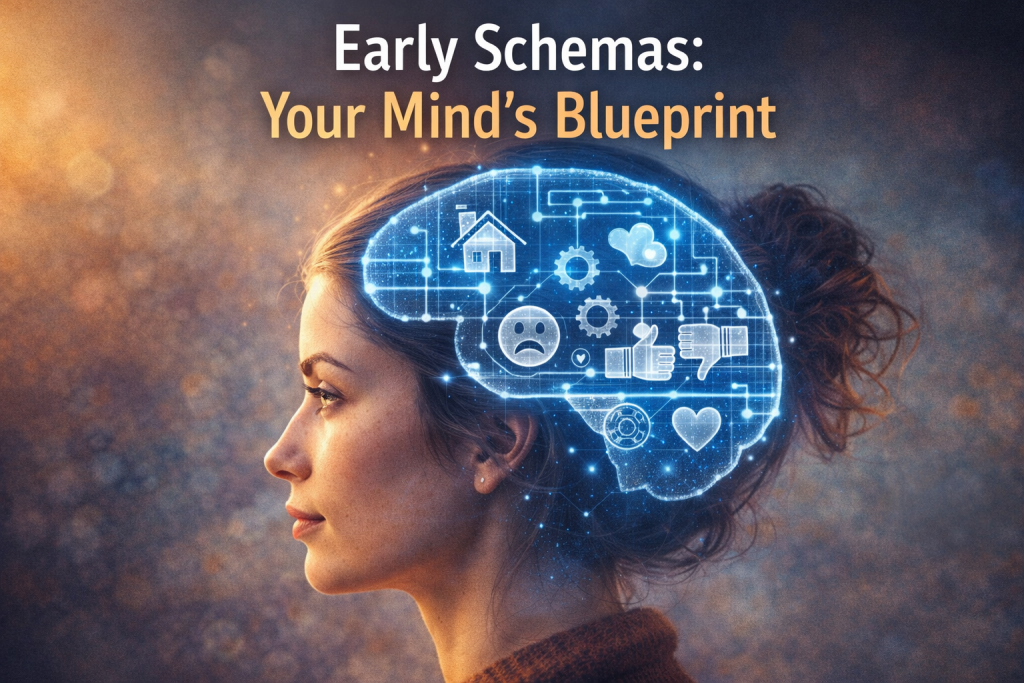
Early maladaptive schemas are not simply “negative beliefs.” They are the foundational blueprint of the human system—the original code written through early experience that organizes perception, emotion, motivation, and behaviour across the lifespan.
Schemas as the Mind’s First Architecture
Schemas form at the intersection of temperament, attachment, and repeated relational experience. They develop before language and cognition are fully online, which means they are not stored primarily as thoughts, but as patterns:
• Patterns of expectation
• Patterns of emotional response
• Patterns of physiological activation
• Patterns of interpersonal strategy
Once formed, schemas function as organizing principles—the way the nervous system decides what matters, what is dangerous, and what actions are required to maintain safety or connection.
In this sense, schemas are not content. They are structure.
The Blueprint Function: How Schemas Run the Human Program
A schema determines, automatically and instantly:
1. What You Perceive
Schemas act as filters on reality. Two people can encounter the same event and experience entirely different emotional worlds because their schemas are selecting and amplifying different data.
A person with an Abandonment schema perceives distance as danger.
A person with a Defectiveness schema perceives neutrality as rejection.
The schema decides what is salient before conscious interpretation occurs.
2. Which Parts of Self Activate
Schemas directly trigger parts—subsystems of the personality organized around survival, attachment, and regulation.
A Vulnerability to Harm schema activates hypervigilant, scanning parts.
A Dependence schema activates reassurance-seeking or collapse parts.
An Unrelenting Standards schema activates driving, pressuring, critical parts.
These parts are not chosen. They are deployed, just as a program launches subroutines when certain conditions are met.
3. What Emotions Are Generated
Emotion follows schema activation, not the other way around.
Fear, anxiety, shame, anger, or emptiness arise because the schema has already evaluated the situation as unsafe, threatening, or confirming of a core belief. The emotional response is the system’s way of mobilizing action consistent with the schema’s worldview.
4. Which Behaviours Make Sense
Once a schema is active, certain behaviours feel inevitable and others feel impossible.
Avoidance, submission, control, perfectionism, withdrawal, people-pleasing, or aggression are not random traits. They are logical outputs of a particular program trying to keep the system safe.
From inside the schema, the behaviour feels necessary—even moral.
Why the System Resists Change
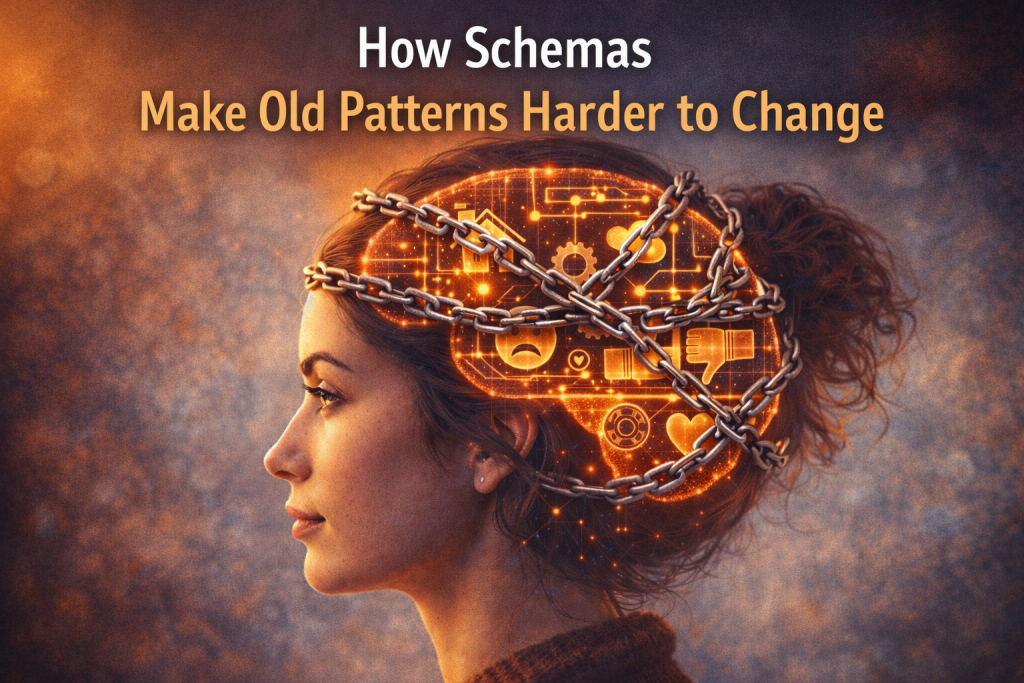
Schemas persist not because they are true, but because they are predictive.
The nervous system prioritizes predictability over accuracy. A schema that reliably predicts pain, rejection, or danger is still preferable to uncertainty. In this way, schemas function like conservative algorithms: they would rather issue a false alarm than miss a real threat.
This is why insight alone rarely produces change. You cannot talk a system out of the code it uses to survive.
Maladaptive Does Not Mean Malfunctioning
The term “maladaptive” can be misleading. These schemas were adaptive at the time they formed in response to an unmet need. They represented the best available strategy in a particular developmental environment.
The problem is not that the program exists—it is that the program is running in a context for which it was not designed.
Adult relationships, environments, and capacities no longer match the conditions under which the schema was written.
Healing as a Software Update, Not a Deletion
Change does not come from erasing schemas. It comes from:
• Making the program visible
• Reducing its dominance
• Installing new regulatory and relational experiences
In parts-based and schema-informed work, healing involves strengthening a central, integrative self—a regulating system capable of noticing schema activation without being run by it.
This allows the person to experience:
• “A part of me feels unsafe” rather than “I am unsafe”
• “This is an old prediction” rather than “This is reality”
The original program can be healed and updated through experiential work that focuses on meeting previously unmet needs.
A New Paradigm: Schemas as Human Design, Not Disorder
Seen this way, early maladaptive schemas are not flaws in character or cognition. They are the inevitable consequence of a developing nervous system adapting to its environment.
They explain:
• Why change is hard even when motivation is high
• Why people repeat patterns they consciously reject
• Why compassion is not optional, but essential, in healing
Schemas are the code beneath personality, the silent architecture beneath choice.
Understanding them is not about fixing what is broken—it is about learning how the system was built.
Final Reflection
You are not failing to override your patterns. You are running the program that was written when your system first learned how to survive. And once a program can be observed, it can be updated.
If you would like help to better understand your core schemas or emotional programs and work on ways to shift or change old patterns that no longer serve you, contact us today.
References:
Bach, B., Lockwood, G., & Young, J. E. (2018). A new look at the schema therapy model: Organization and role of early maladaptive schemas. Cognitive Behaviour Therapy, 47(4), 328–349
Taylor, C. D. J., Bee, P., & Haddock, G. (2017). Does schema therapy change schemas and symptoms? A systematic review across mental health disorders. Psychology and Psychotherapy: Theory, Research and Practice, 90(3), 456–479.
Prepared by Dr. Jennifer Barbera, PhD, Registered Psychologist
Dr. Jennifer Barbera PhD, C. Psych is a licensed psychologist with over 25 years of counselling experience. She has extensive clinical expertise supporting individuals and couples with anxiety, trauma, depression, addiction, and relationship challenges. Her work combines evidence-based approaches with practical strategies to help clients build resilience and improve well-being.