What Is Self-Relationship and How to Improve It
The Most Important Relationship You Will Ever Have Is the Relationship with Yourself
We spend much of our lives investing in relationships with partners, children, family members, friends, and colleagues. We strive to communicate better, resolve conflict more effectively, and become more supportive of those around us. Yet there is one relationship that quietly shapes every other interaction we have—the relationship we have with ourselves.
The way you speak to yourself after making a mistake, how you respond to emotional pain, whether you believe you are worthy of love and respect, and how you care for yourself during difficult times all create the lens through which you experience the world. This inner relationship becomes the foundation of your emotional well-being, psychological resilience, and the quality of every external relationship.
The encouraging news is that your relationship with yourself is not fixed. Regardless of your childhood, past experiences, or current struggles, it can be strengthened. Modern psychology has moved beyond simply managing symptoms toward helping people develop a healthier internal relationship. Approaches such as Internal Family Systems (IFS), Acceptance and Commitment Therapy (ACT), and self-compassion training offer powerful, evidence-based ways to transform how you relate to yourself.
The Relationship That Shapes Everything Else
Imagine carrying around an internal narrator that comments on everything you do. For some people, that voice is encouraging:
“That was difficult, but you handled it well.”
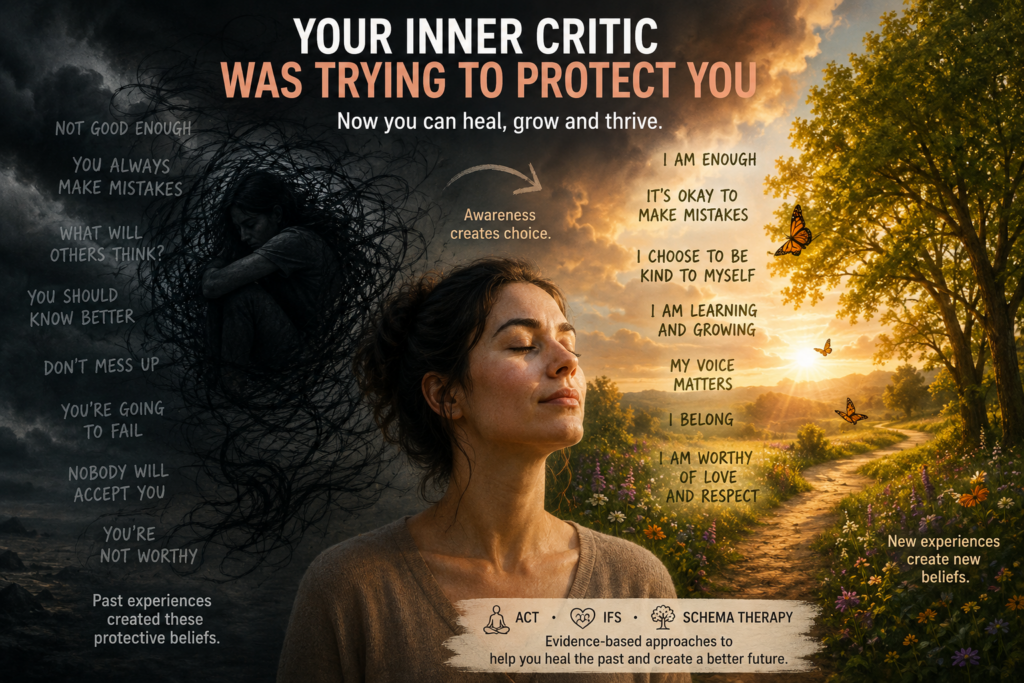
For others, it is relentlessly critical:
“You always mess things up.”
“You’re not good enough.”
“People will eventually see you’re a failure.”
Over time, these internal messages become so familiar that we stop noticing them. Yet they profoundly influence our emotions, behaviour, and relationships.
When your inner world is dominated by criticism, shame, or fear, those experiences often spill into your interactions with others. You may become overly sensitive to rejection, seek constant reassurance, struggle with boundaries, avoid vulnerability, or become excessively self-sacrificing.
Conversely, when your relationship with yourself is characterized by curiosity, kindness, and acceptance, you become more emotionally regulated, resilient, and authentic in your relationships.
Research consistently demonstrates that self-compassion is associated with lower levels of anxiety, depression, and stress while promoting greater emotional well-being, resilience, and relationship satisfaction (Neff & Germer, 2013).
Simply put, the way you treat yourself teaches you how to experience life.
We Learn How to Relate to Ourselves
Few people consciously decide to become their own harshest critic.
Instead, our internal relationship develops gradually through repeated experiences.
Children who grow up with emotional warmth, validation, and consistent caregiving often internalize those experiences. They learn:
“My feelings matter.”
“Mistakes are opportunities to learn.”
“I am worthy of care.”
Others may grow up in environments marked by criticism, unpredictability, neglect, perfectionism, or emotional invalidation. They often internalize very different beliefs:
“I have to earn love.”
“If I make mistakes, I’ll be rejected.”
“My needs are a burden.”
These beliefs eventually become automatic patterns of thinking that continue long after childhood has ended.
The good news is that the brain remains capable of change throughout adulthood. Through repeated corrective emotional experiences, people can develop entirely new ways of relating to themselves.
Why Self-Relationship Is the Foundation of Mental Health
Many emotional difficulties are maintained not only by painful experiences themselves, but by how we respond internally to those experiences.
For example, imagine feeling anxious before giving a presentation.
One internal response might be:
“Of course you’re anxious. Anyone would be. Let’s take a breath and do our best.”
Another might sound like:
“You’re pathetic. Everyone else can do this. Don’t embarrass yourself.”
The external situation hasn’t changed.
The internal relationship has.
The second response adds a second layer of suffering—judgment, shame, and self-attack—which often intensifies anxiety rather than reducing it.
Psychological flexibility—the ability to experience difficult thoughts and emotions without becoming overwhelmed by them—is one of the strongest predictors of emotional health (Hayes et al., 2006).
Developing a healthier relationship with yourself increases this flexibility.
Internal Family Systems: Befriending Your Inner World
One of the most innovative developments in psychotherapy is Internal Family Systems (IFS), developed by Richard Schwartz.
IFS proposes that our minds are naturally made up of different “parts,” each with its own role and purpose.
Some parts strive for perfection.
Some become highly critical.
Others avoid difficult emotions.
Some become overwhelmed by fear, sadness, or shame.
Importantly, IFS does not view these parts as pathological. Instead, every part is trying to protect us in some way.
For example, your inner critic may not actually hate you.
It may believe that constant criticism is the only way to keep you from failing or being rejected.
Instead of trying to silence these parts, IFS helps people approach them with curiosity and compassion.
Over time, protective parts begin to relax because they no longer have to work so hard.
People often discover that beneath years of self-criticism lies an authentic, compassionate core self capable of leading with calmness, confidence, and wisdom.
Rather than becoming someone new, IFS helps you reconnect with who you’ve always been underneath your protective patterns.
ACT: Learning to Stop Fighting Yourself
Acceptance and Commitment Therapy (ACT) offers another powerful way to improve your relationship with yourself.
Many people spend enormous amounts of energy trying to eliminate uncomfortable thoughts and emotions.
They tell themselves:
“I shouldn’t feel anxious.”
“I need to stop thinking this.”
“What’s wrong with me?”
Ironically, the harder we fight our internal experiences, the stronger they often become.
ACT teaches a radically different approach.
Instead of attempting to eliminate painful thoughts, ACT helps people change their relationship with those thoughts.
Rather than believing every self-critical thought, people learn to observe them with distance:
“I’m noticing the thought that I’m not good enough.”
This small shift reduces the power of negative thinking.
ACT also emphasizes living according to personal values rather than emotional comfort.
You don’t have to feel confident before acting courageously.
You don’t have to eliminate self-doubt before pursuing meaningful goals.
Over time, taking values-based action builds genuine confidence rooted in experience rather than perfection.
The Power of Self-Compassion
Many people mistakenly believe that being kind to themselves will make them lazy or complacent.
Research suggests the opposite.
Self-compassion involves treating yourself with the same understanding, patience, and encouragement you would naturally offer someone you love.
Kristin Neff describes self-compassion as consisting of three core components:
* Self-kindness instead of self-judgment.
* Recognition of our common humanity instead of isolation.
* Mindful awareness rather than over-identification with painful emotions (Neff, 2003).
People high in self-compassion tend to recover more quickly from setbacks, experience less anxiety, demonstrate greater motivation after failure, and show healthier emotional regulation.
Self-compassion is not making excuses.
It is replacing unnecessary self-punishment with constructive self-support.
Therapy Provides the Relationship That Helps Build a New One
One of the most valuable aspects of therapy is not simply learning coping skills.
It is experiencing a new kind of relationship.
A skilled therapist provides consistent curiosity, compassion, acceptance, and accountability. Over time, clients often begin internalizing these experiences.
The therapist’s voice gradually becomes their own.
The harsh inner critic softens.
Self-understanding grows.
Emotional resilience strengthens.
What once required external support increasingly becomes an internal capacity.
Therapy becomes less about fixing yourself and more about developing a healthier relationship with yourself.
That relationship continues long after therapy ends.
A Healthier Relationship With Yourself Changes Everything
Improving your relationship with yourself doesn’t mean you’ll never struggle again.
Life will still include disappointment, uncertainty, grief, and failure.
What changes is how you meet those experiences.
Instead of becoming your own harshest enemy, you become your greatest source of stability.
Instead of fighting yourself, you begin working with yourself.
Instead of believing every critical thought, you learn to respond with wisdom and compassion.
When your internal relationship becomes safer, calmer, and more accepting, every other relationship benefits. You become less reactive, more authentic, more resilient, and more capable of giving and receiving love.
A Better Way Forward
If you find yourself trapped in cycles of self-criticism, perfectionism, anxiety, or emotional overwhelm, you don’t have to navigate them alone. The relationship you have with yourself can be strengthened, and that process often begins with the support of a skilled therapist.
Through evidence-based approaches such as Internal Family Systems (IFS), Acceptance and Commitment Therapy (ACT), and self-compassion training, it is possible to quiet the inner critic, develop lasting emotional resilience, and build a healthier foundation for every relationship in your life. Contact us today to begin creating the most important relationship you will ever have—the one with yourself.
References
Hayes, S. C., Luoma, J. B., Bond, F. W., Masuda, A., & Lillis, J. (2006). Acceptance and Commitment Therapy: Model, processes and outcomes. Behaviour Research and Therapy, 44(1), 1–25.
Neff, K. D. (2003). Self-compassion: An alternative conceptualization of a healthy attitude toward oneself. Self and Identity, 2(2), 85–101.
Neff, K. D., & Germer, C. K. (2013). A pilot study and randomized controlled trial of the Mindful Self-Compassion program. Journal of Clinical Psychology, 69(1), 28–44.
Prepared by Dr. Jennifer Barbera, PhD, Registered Psychologist
Dr. Jennifer Barbera PhD, C. Psych is a licensed psychologist with over 25 years of counselling experience. She has extensive clinical expertise supporting individuals and couples with anxiety, trauma, depression, addiction, and relationship challenges. Her work combines evidence-based approaches with practical strategies to help clients build resilience and improve well-being.