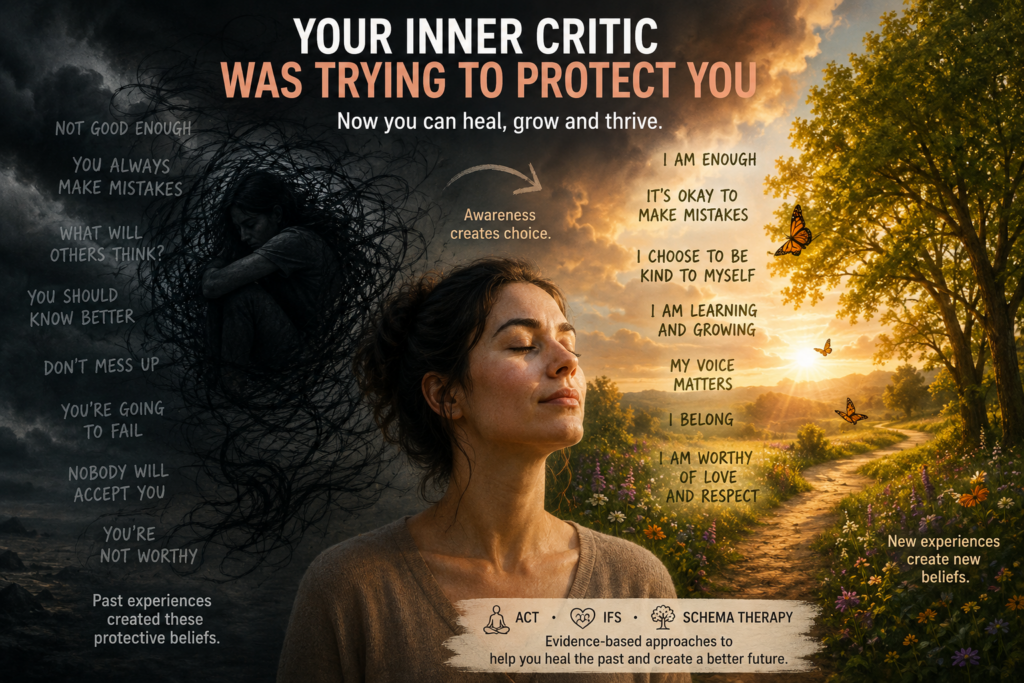
How to find therapy for low self-esteem in Hamilton & across Ontario
Learn how low self-esteem develops and how to find effective therapy in Hamilton, Ontario or online using CBT, ACT, schema therapy, and IFS.
What Is Low Self-Esteem?
Low self-esteem is a persistent pattern of viewing yourself as inadequate, unworthy, or fundamentally flawed. It goes beyond occasional self-doubt and becomes a lens through which you interpret your abilities, relationships, and future.
People with low self-esteem often hold global beliefs such as “I’m not good enough” or “I will fail no matter what I do.” These beliefs are not simply thoughts—they shape behaviour, emotional responses, and decision-making. Over time, they can limit opportunities, reinforce avoidance, and contribute to anxiety or depression.
How Low Self-Esteem Develops
Low self-esteem typically develops through a combination of early experiences and learned patterns of thinking.
From a cognitive perspective, repeated experiences of criticism, rejection, neglect, or unrealistic expectations can lead to the formation of core beliefs about the self (Fennell, 1997). These beliefs become internalized and operate automatically, often outside of conscious awareness.
Schema therapy expands on this by identifying early maladaptive schemas, which are deeply rooted emotional and cognitive patterns formed in childhood. Two of the most relevant schemas for low self-esteem are:
* Defectiveness/Shame Schema: The belief that you are fundamentally flawed and would be rejected if others truly knew you
* Failure Schema: The belief that you are inadequate, incompetent, or destined to fail
Once established, these schemas influence how you interpret experiences. Positive feedback may be dismissed, while perceived mistakes are amplified, reinforcing the original belief system.
Why Low Self-Esteem Persists
Low self-esteem is not maintained by a lack of effort—it is maintained by patterns that feel protective but are ultimately unhelpful.
Common maintaining patterns include:
* Avoiding challenges to prevent failure
* Overcompensating through perfectionism or overachievement
* Engaging in harsh self-criticism
* Seeking excessive reassurance from others
Research shows that self-criticism, in particular, is strongly associated with depression, anxiety, and reduced motivation, making it harder—not easier—to change (Kannan & Levitt, 2013).
These patterns create a cycle: negative beliefs drive behaviours that reinforce those same beliefs.
Evidence-Based Therapies That Improve Self-esteem
Low self-esteem is highly treatable when addressed with structured, evidence-based approaches. At Dr. Barbera C. Psych and Associates, therapy is grounded in methods that target both the surface-level thoughts and the deeper emotional patterns underlying self-esteem difficulties.
The Role of Self-Compassion in Healing Self-Esteem
An often overlooked but highly effective approach to improving low self-esteem is self-compassion training.
Self-compassion involves treating yourself with kindness, recognizing that struggle is part of being human, and responding to difficulties with balanced awareness rather than harsh judgment (Neff, 2003). For individuals with low self-esteem, this directly counteracts the tendency toward self-criticism and shame.
Research shows that self-compassion is associated with greater emotional resilience, reduced anxiety and depression, and more stable self-worth that is not dependent on constant achievement or external validation (Neff & Germer, 2013). Instead of trying to “prove” your worth, self-compassion helps you relate to yourself in a more supportive and sustainable way.
In therapy, self-compassion training may include:
- Learning to notice and soften self-critical thoughts
- Practising supportive and balanced self-talk
- Developing emotional regulation through mindfulness
- Building an internal “supportive voice” rather than a punitive one
Importantly, self-compassion does not mean lowering standards or becoming passive. It creates the psychological safety needed to take responsibility, learn from mistakes, and move forward with greater clarity and consistency.
Cognitive Behavioural Therapy (CBT)
CBT focuses on identifying and restructuring unhelpful thought patterns and behaviours.
Clients learn to:
* Challenge negative core beliefs
* Test assumptions through real-world experiences
* Develop more balanced and realistic self-evaluations
CBT has strong empirical support for improving self-esteem and reducing associated symptoms such as anxiety and depression (Fennell, 1997).
Acceptance and Commitment Therapy (ACT)
ACT helps individuals change their relationship with self-critical thoughts rather than trying to eliminate them.
This approach emphasizes:
* Psychological flexibility
* Values clarification
* Committed action despite self-doubt
Instead of waiting to feel confident, clients learn to move forward in alignment with what matters most.
Schema Therapy
Schema therapy targets the deeper origins of low self-esteem.
It helps clients:
* Identify longstanding schemas such as defectiveness/shame and failure
* Understand how these patterns developed
* Heal emotional wounds and build a healthier internal dialogue
Schema therapy is particularly effective for individuals with chronic or deeply ingrained self-esteem difficulties (Taylor et al., 2017).
Internal Family Systems (IFS)
IFS views the mind as made up of different “parts,” including critical, protective, and vulnerable aspects.
Rather than fighting self-criticism, clients learn to:
* Understand the role of their inner critic
* Reduce internal conflict
* Develop a more compassionate and integrated sense of self
This approach can be especially powerful for individuals who feel “stuck” in self-critical cycles.
Finding Therapy in Hamilton and Online
If you are seeking therapy in Hamilton, Ontario, or virtually across the province, you have access to high-quality, evidence-based care.
Working with Dr. Barbera C. Psych and associates, clients can access both in-person and online therapy tailored to their needs. Online therapy, in particular, has become a highly effective and accessible option, allowing individuals to receive support from the comfort of their own space while maintaining flexibility in scheduling.
When looking for a therapist, it is important to consider:
* Their experience with low self-esteem and related concerns
* The therapeutic approaches they use (e.g., CBT, ACT, schema therapy, IFS)
* Whether you feel comfortable and understood during initial interactions
The therapeutic relationship itself is one of the strongest predictors of positive outcomes.
A More Effective Way Forward
Many people with low self-esteem believe they need to become more confident before they can take meaningful steps in life.
In reality, confidence is built through action—not before it.
Therapy helps you shift from self-criticism to self-understanding, from avoidance to engagement, and from rigid negative beliefs to more flexible and accurate self-perceptions.
You do not need to “fix” yourself first. You need a process that supports change in a structured, sustainable way to help you move forward in a more positive way.
If you are ready to begin that process, we invite you to CONTACT US today to explore how therapy can help you build a more grounded, confident, and self-supportive way of living.
References
Fennell, M. J. V. (1997). Low self-esteem: A cognitive perspective. Behavioural and Cognitive Psychotherapy, 25(1), 1–26.
Kannan, D., & Levitt, H. M. (2013). A review of client self-criticism in psychotherapy. Journal of Psychotherapy Integration, 23(2), 166–178.
Taylor, C. D. J., Bee, P., & Haddock, G. (2017). Does schema therapy change schemas and symptoms? A systematic review across mental health disorders. Psychology and Psychotherapy: Theory, Research and Practice, 90(3), 456–479.
Young, J. E., Klosko, J. S., & Weishaar, M. E. (2003). Schema therapy: A practitioner’s guide. New York, NY: Guilford Press.
Hayes, S. C., Strosahl, K. D., & Wilson, K. G. (2012). Acceptance and commitment therapy: The process and practice of mindful change. New York, NY: Guilford Press.
Beck, A. T. (1976). Cognitive therapy and the emotional disorders. New York, NY: International Universities Press.
Schwartz, R. C. (1995). Internal family systems therapy. New York, NY: Guilford Press.
Prepared by Dr. Jennifer Barbera, PhD, Registered Psychologist
Dr. Jennifer Barbera PhD, C. Psych is a licensed psychologist with over 25 years of counselling experience. She has extensive clinical expertise supporting individuals and couples with anxiety, trauma, depression, addiction, and relationship challenges. Her work combines evidence-based approaches with practical strategies to help clients build resilience and improve well-being.