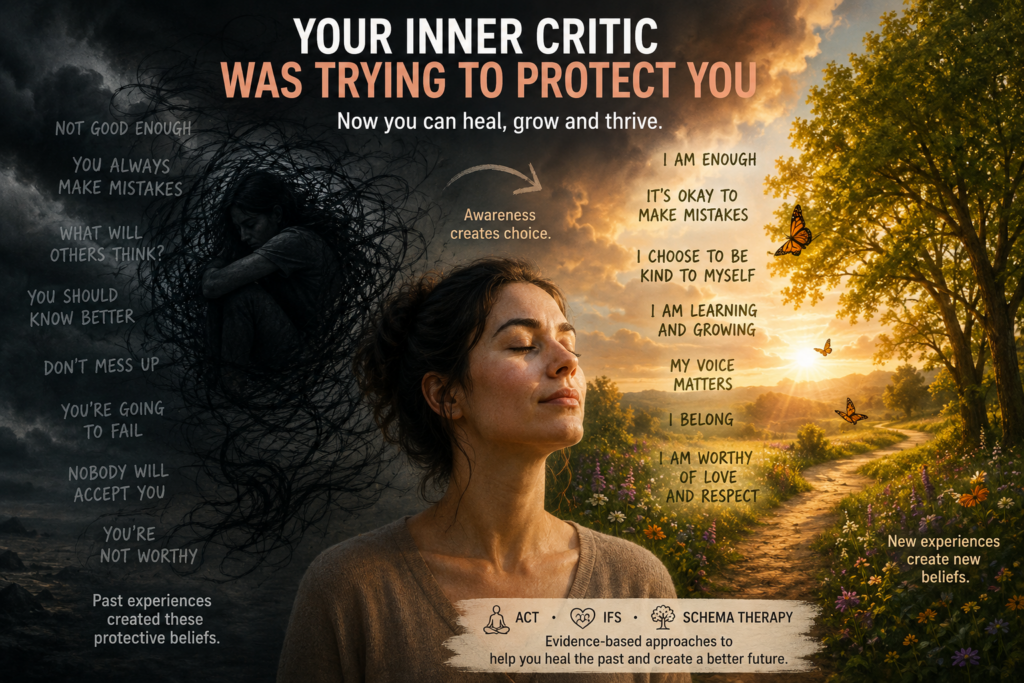
What creates an inner critic and how to heal
Why Your Inner Critic Thinks It’s Protecting You: How the Brain Learns to Predict Danger and How Healing Is Possible
“Don’t make a mistake.” “You’re going to embarrass yourself.” “You should have done better.”
For many people, these thoughts are so familiar that they feel like facts rather than opinions. An unrelenting inner critic can seem like an enemy, constantly pointing out flaws, questioning decisions, and warning of failure. Yet, from a psychological perspective, this harsh internal voice rarely develops without reason.
Modern neuroscience suggests that the brain is fundamentally a prediction machine. Rather than simply reacting to the world, it constantly anticipates what is likely to happen next in order to keep us safe. When someone grows up in an environment where mistakes were met with criticism, shame, punishment, or emotional withdrawal, their brain learns that making mistakes is dangerous. Over time, the mind adapts by developing a highly vigilant inner critic whose job is to identify potential errors before anyone else can.
Ironically, the very system that evolved to protect us often becomes one of the greatest sources of anxiety, self-doubt, and low self-esteem. Fortunately, therapies such as Acceptance and Commitment Therapy (ACT), Internal Family Systems (IFS), and Schema Therapy offer compassionate and evidence-based ways to understand and heal these protective patterns.
Your Brain Was Designed to Predict, Not Just React
For many years, scientists viewed the brain as primarily reacting to information from the outside world. More recent neuroscience paints a different picture. Rather than passively responding to events, the brain is constantly making predictions about what will happen next based on previous experiences (Clark, 2013).
This process, often called predictive processing, allows us to navigate the world efficiently. Instead of analysing every situation from scratch, the brain continuously asks:
* What is likely to happen?
* Is there danger?
* What should I do to stay safe?
From an evolutionary perspective, this makes perfect sense. Our ancestors who anticipated danger were more likely to survive than those who waited until threats appeared.
The brain therefore becomes exceptionally skilled at recognizing patterns and creating schema maps. Once it identifies a recurring relationship—such as “loud noises predict danger” or “touching fire causes pain”—it begins preparing us before the event even occurs.
Most of these predictions are enormously helpful. However, emotional experiences are also stored as patterns and some of these pattern predictions or schemas become inflexible.
When Mistakes Become Associated with Danger
Imagine a child who repeatedly hears:
“What’s wrong with you?”
“Why can’t you do anything right?”
“Don’t embarrass me.”
Or perhaps mistakes were met with punishment, ridicule, rejection, or silent treatment.
To an adult, these experiences may seem unpleasant. To a developing child’s nervous system, however, they represent something much larger: threats to safety, connection, and belonging.
Children depend entirely upon caregivers. Because attachment is essential for survival, the child’s brain naturally learns to predict situations that might jeopardize acceptance.
Eventually, the prediction becomes:
Mistakes lead to pain.
Once this pattern is established, the brain does not wait until criticism actually occurs. Instead, it attempts to prevent criticism altogether.
Enter the inner critic.
The Inner Critic Is Trying to Protect You
Although it rarely feels compassionate, the inner critic usually begins as an adaptive protective strategy.
Its logic sounds something like this:
“If I notice every possible mistake first, maybe nobody else will.”
“If I push you hard enough, you won’t fail.”
“If you become perfect, you’ll finally be safe.”
From an Internal Family Systems perspective, this critical voice can be understood as a manager part—a protective part of the personality that works tirelessly to prevent emotional pain (Schwartz & Sweezy, 2020).
Managers attempt to control life by promoting perfectionism, excessive preparation, people-pleasing, overachievement, and relentless self-monitoring.
Although their methods are exhausting, their intentions are protective.
Rather than asking, “Why am I so hard on myself?” IFS invites a different question:
“What is this critical part trying to prevent?”
Very often, the answer is emotional injury, shame, rejection, or humiliation that occurred much earlier in life.
Why Self-Criticism Creates More Anxiety
Many people believe self-criticism motivates improvement.
Research suggests otherwise.
Harsh self-criticism is associated with greater anxiety, depression, perfectionism, and psychological distress rather than increased resilience (Ehret et al., 2015).
The reason is surprisingly simple.
Each critical thought activates the brain’s threat detection systems.
Instead of feeling encouraged, the nervous system interprets self-criticism as evidence that danger is present. Stress hormones increase. Muscle tension rises. Attention narrows. Confidence decreases.
Ironically, this heightened state often impairs concentration and performance, increasing the likelihood of mistakes—the very outcome the inner critic hoped to prevent.
The cycle becomes self-reinforcing:
Past criticism → stronger predictions of danger → increased inner criticism → heightened anxiety → reduced confidence → greater fear of mistakes.
Over time, individuals may begin avoiding opportunities, second-guessing decisions, seeking constant reassurance, or striving for impossible perfection.
How Negative Schemas Keep the Cycle Alive
Schema Therapy explains that repeated childhood experiences gradually become deeply held beliefs about ourselves and others (Young et al., 2003).
Someone repeatedly criticized may develop schemas such as:
* I am defective.
* Nothing I do is good enough.
* People will reject me if I fail.
* I must meet impossibly high standards.
Once established, schemas influence perception.
The brain begins selectively noticing information that confirms these beliefs while overlooking evidence that contradicts them.
A minor mistake at work may suddenly feel like proof of being incompetent.
Constructive feedback becomes interpreted as rejection.
A compliment is dismissed as someone “just being nice.”
These aren’t objective facts—they are predictions filtered through old learning.
ACT: Learning to Step Back from the Inner Critic
Acceptance and Commitment Therapy offers a powerful alternative.
Rather than arguing with every critical thought, ACT teaches psychological flexibility (Hayes et al., 2012).
One of ACT’s central skills is cognitive defusion—learning to observe thoughts instead of automatically believing them.
Instead of thinking:
“I’m going to fail.”
A person learns to notice:
“I’m having the thought that I’m going to fail.”
This subtle shift creates psychological distance.
The goal is not to eliminate self-critical thoughts. The brain will likely continue generating predictions based on old learning.
Instead, ACT teaches that thoughts are mental events—not necessarily accurate reflections of reality.
Clients also reconnect with their personal values.
Rather than allowing fear to dictate behaviour, they begin asking:
“What kind of person do I want to be?”
Even when anxiety remains present, values can become a more reliable guide than fear.
IFS: Thanking the Protector Instead of Fighting It
Internal Family Systems takes an especially compassionate approach.
Instead of trying to silence the inner critic, IFS encourages curiosity.
The therapist helps clients understand that every protective part developed for a reason.
The critical manager often carries impossible responsibility:
“If I stop criticizing you, you’ll be hurt again.”
As trust develops within the person’s internal system, the protector gradually realizes that the vulnerable younger parts no longer face the same dangers they once did.
Rather than fighting the critic, healing comes through appreciation, understanding, and helping it adopt healthier protective roles.
Schema Therapy: Updating Old Predictions
Schema Therapy helps clients recognize that many deeply held beliefs were understandable adaptations to childhood environments but no longer accurately represent present-day reality.
Through cognitive techniques, experiential exercises, imagery rescripting, behavioural experiments, and corrective emotional experiences within therapy, old schemas gradually become less dominant.
As new experiences accumulate, the brain begins updating its predictions.
Instead of automatically expecting criticism, it slowly learns:
“People can accept me even when I’m imperfect.”
“Mistakes help me learn.”
“My worth is not determined by flawless performance.”
In essence, therapy helps the brain build new predictive models that are more accurate, flexible, and compassionate.
Healing Is About Teaching Your Brain That the Danger Has Passed
If you struggle with a harsh inner critic, it does not mean something is wrong with you.
In many cases, it means your brain learned exceptionally well.
It recognized patterns from earlier experiences and developed sophisticated strategies to reduce emotional pain.
The difficulty is that protective strategies designed for childhood often continue operating long after the original danger has disappeared.
Healing is not about becoming careless or eliminating standards.
It is about teaching your nervous system that making mistakes no longer threatens your safety, your worth, or your belonging.
As your brain updates its predictions through new experiences, self-compassion gradually replaces self-criticism. Confidence grows not because you become perfect, but because you no longer believe perfection is required to be accepted.
Your inner critic may have been trying to protect you all along—but it does not have to work so hard anymore.
Contact us today to learn how evidence-based approaches such as Acceptance and Commitment Therapy, Internal Family Systems, and Schema Therapy can help you quiet your inner critic, build lasting self-confidence, and create a healthier relationship with yourself.
References
Clark, A. (2013). Whatever next? Predictive brains, situated agents, and the future of cognitive science. Behavioral and Brain Sciences, 36(3), 181–204.
Ehret, A. M., Joormann, J., & Berking, M. (2015). Examining risk and resilience factors for depression: The role of self-criticism and self-compassion. Cognition and Emotion, 29(8), 1496–1504.
Hayes, S. C., Strosahl, K. D., & Wilson, K. G. (2012). Acceptance and commitment therapy: The process and practice of mindful change (2nd ed.). Guilford Press.
Schwartz, R. C., & Sweezy, M. (2020). Internal Family Systems therapy (2nd ed.). Guilford Press.
Young, J. E., Klosko, J. S., & Weishaar, M. E. (2003). Schema therapy: A practitioner’s guide. Guilford Press.
Prepared by Dr. Jennifer Barbera, PhD, Registered Psychologist
Dr. Jennifer Barbera PhD, C. Psych is a licensed psychologist with over 25 years of counselling experience. She has extensive clinical expertise supporting individuals and couples with anxiety, trauma, depression, addiction, and relationship challenges. Her work combines evidence-based approaches with practical strategies to help clients build resilience and improve well-being.