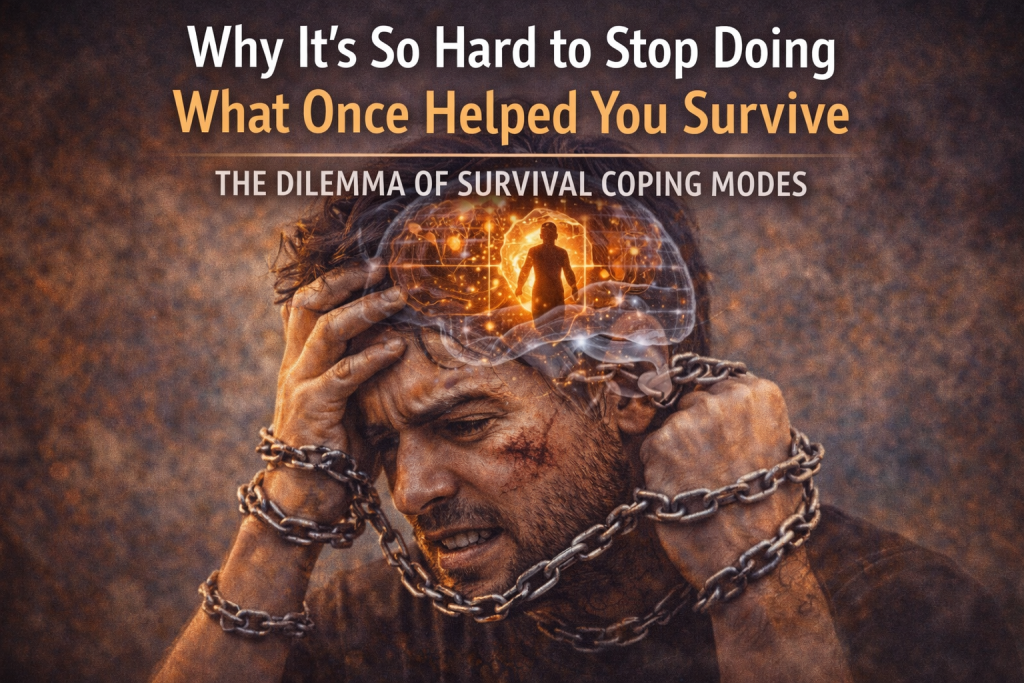
How to Change Your Life By Changing your Schemas
Schemas are often talked about as abstract psychological structures, but in real life they feel much more ordinary—and much more powerful.
They don’t feel like “schemas.”
They feel like you.
Like the way you automatically assume things will go wrong.
Or the way you push through exhaustion because stopping feels unsafe.
Or the way you tell yourself you’ll focus on relationships later, after work slows down, even though “later” never quite comes.
In psychology, schemas are understood as deep cognitive-emotional blueprints that shape perception, emotion, and behaviour (Beck, 1979; Young, Klosko, & Weishaar, 2003). But in lived experience, they are better understood as an invisible script that decides what matters, what gets noticed, and what you do next—often before you even realize there was a choice.
The pattern you don’t notice you’re repeating
Imagine this as a familiar kind of day.
You wake up already slightly behind. Your mind immediately scans the day:
* What needs to get done?
* What might go wrong?
* What can’t be dropped?
There’s a quiet sense that if you don’t stay on top of everything, something will slip. You feel a lingering sense of anxiety.
So you move fast.
You answer messages while eating. You tell yourself you’ll slow down later. You skip the walk because there isn’t time. You push through the afternoon with caffeine and pressure.
And by evening, you finally have space—but you’re too drained to use it well. So you scroll, or numb out, or mentally rehearse tomorrow’s tasks instead of resting.
Nothing dramatic happened. But something subtle did:
You reinforced a schema that says:
“My worth and safety depend on constant effort and vigilance.”
And because that pattern has repeated for years, it feels like reality—not a pattern.
The part that keeps it stuck
What makes schemas so persistent is that they work short-term.
That’s the trap.
* Overworking reduces anxiety about falling behind
* Avoiding difficult conversations reduces immediate discomfort
* Staying busy prevents you from feeling uncertainty or emptiness
So the brain learns:
“This works. Do it again.”
Even if, long term, it leads to exhaustion, disconnection, or dissatisfaction.
This is why research on habit formation emphasizes repetition in stable contexts—not insight—as the mechanism of change (Lally et al., 2010). The brain updates through evidence, not intention alone.
A different version of the same person
Now imagine the same person—but with one small shift in direction.
Not a life overhaul. Not a personality change.
Just a quiet decision that something else matters too.
They realize, maybe for the first time in a grounded way, that they don’t actually want their life to be organized entirely around urgency or doing.
They want:
* to feel healthier in their body
* to have relationships that aren’t always postponed
* to experience days that aren’t just endurance tests
* to actually be present in their own life, not just managing it
This is where values come in—not as abstract ideas, but as priorities that start to compete with old patterns.
So instead of asking:
“What do I need to get done next?”
They begin asking:
“What would I do today if health, connection, and presence actually mattered as much as productivity?”
What change looks like in real life (and why it feels messy)
The first changes are small enough that they almost feel insignificant.
* Walking for 10 minutes after work instead of immediately opening the laptop again
* Sending the message you’ve been delaying instead of refining it endlessly in your head
* Eating without multitasking once in the day
* Leaving work slightly unfinished on purpose to protect the evening
And importantly, none of this feels naturally rewarding at first.
In fact, it often feels wrong.
Because the old schema is still active:
“If I slow down, I’ll fall behind.”
“If I don’t push, things will slip.”
“If I don’t stay on top of everything, I’m not safe.”
So the nervous system protests.
This is where most people misinterpret the process. They think discomfort means the change is incorrect.
But psychologically, it often means the opposite: you are interrupting a well-rehearsed system.
Extinction research shows that old learned patterns weaken when they are no longer reinforced, but they can temporarily reappear, especially under stress or familiar triggers (Bouton, 2004). That return doesn’t mean failure—it means the system is still updating.
The turning point isn’t dramatic.
At some point, something subtle happens.
Not a breakthrough. Not a revelation.
Just a quiet moment where something different occurs and… nothing collapses.
You leave work on time.
And the world continues.
You don’t catch up on everything.
And nothing essential breaks.
You take the walk.
And the discomfort passes.
You have the conversation you were avoiding.
And it’s not as catastrophic as your mind predicted.
These moments begin to accumulate.
And slowly, your brain starts revising the old assumption:
“Maybe I don’t have to operate at full urgency to stay safe.”
That is schema change—not insight, but lived contradiction repeated over time.
Why this matters more than motivation
Motivation is unstable. Schemas are structural.
If your internal blueprint says:
* urgency = safety
* achievement = worth
* avoidance = relief
Then motivation alone cannot override that system consistently.
But if your daily behaviour begins to consistently reflect a different set of priorities—health, connection, presence—then the blueprint itself begins to shift.
This is what Acceptance and Commitment Therapy emphasizes: values-based action as the mechanism of long-term psychological flexibility (Hayes et al., 2006).
The core reframe
You don’t change schemas by fighting them directly.
You change them by building a life that quietly stops feeding them.
And that begins with a simple but confronting question:
If your actions today reflected what actually matters to you—not what your stress system defaults to—what would be different?
Not everything changes at once.
But over time, the repeated answer to that question becomes your new operating system.
Not because you forced it.
But because you lived it enough times that it became believable.
You don’t have to keep repeating the same patterns. CONTACT US today and take the first step toward real change.
References
Beck, A. T. (1979). Cognitive therapy of depression. Guilford Press.
Bouton, M. E. (2004). Context and behavioral processes in extinction. Learning & Memory, 11(5), 485–494.
Hayes, S. C., Luoma, J. B., Bond, F. W., Masuda, A., & Lillis, J. (2006). Acceptance and commitment therapy: Model, processes and outcomes. Behaviour Research and Therapy, 44(1), 1–25.
Lally, P., van Jaarsveld, C. H. M., Potts, H. W. W., & Wardle, J. (2010). How are habits formed: Modelling habit formation in the real world. European Journal of Social Psychology, 40(6), 998–1009.
Young, J. E., Klosko, J. S., & Weishaar, M. E. (2003). Schema therapy: A practitioner’s guide. Guilford Press.
Prepared by:
Dr. Jennifer Barbera PhD, C. Psych who is a licensed psychologist with over 25 years of counselling experience. She has extensive clinical expertise supporting individuals and couples with anxiety, trauma, depression, addiction, and relationship challenges. Her work combines evidence-based approaches with practical strategies to help clients build resilience and improve well-being.