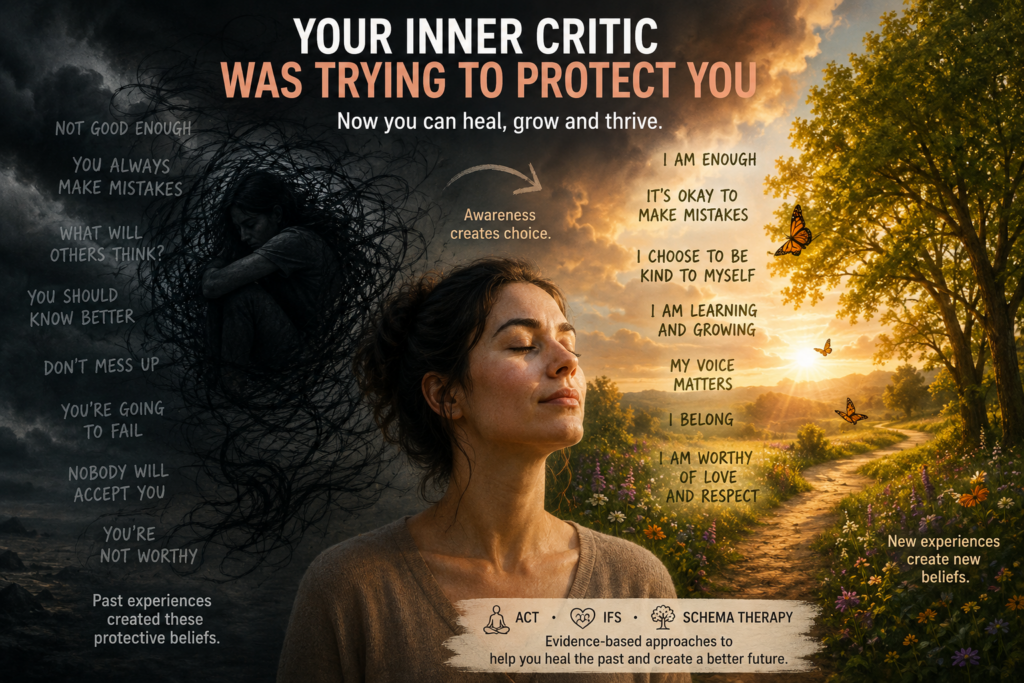
How to improve success and well-being through self-compassion
Learn how developing self-compassion can improve resilience, reduce procrastination, and support meaningful, values-driven behaviour change. Research repeatedly supports the benefits of self-compassion and shows that fears of becoming “lazy” or not true.
What Is Self-Compassion?
Self-compassion is the practice of treating yourself with the same care, understanding, and encouragement that you would offer to someone you deeply care about. According to Neff (2003), it involves three core components: 1) self-kindness, 2) common humanity, and 3) mindful awareness. Rather than ignoring mistakes or weaknesses, self-compassion allows you to acknowledge them without harsh judgment.
This is not about letting yourself off the hook or lowering standards. It is about creating the emotional conditions that actually support growth, resilience, and sustained effort. Research consistently shows that individuals high in self-compassion demonstrate greater psychological well-being, motivation, and emotional regulation (Neff & Germer, 2013).
Self-Reflection vs. Self-Criticism
A common misconception is that self-criticism is necessary for improvement. Many people believe that if they are not hard on themselves, they will become complacent or unmotivated. The evidence suggests the opposite.
Self-reflection is a constructive process. It involves evaluating your behaviour, understanding what worked or didn’t, and identifying how to move forward in alignment with your goals. It is grounded in curiosity and learning.
Self-criticism, on the other hand, is punitive. It often involves global, negative judgments such as “I’m lazy” or “I always fail.” This type of thinking activates threat responses in the brain, increasing stress and avoidance behaviours (Gilbert, 2009). Instead of promoting change, it often fuels procrastination and discouragement.
If your inner voice sounds like a harsh critic rather than a supportive coach, it is likely working against you.
Why Blame Isn’t Required for Change
Another deeply ingrained belief is that personal responsibility requires self-blame. In reality, these are not the same thing.
You can take responsibility for your actions without attacking your identity. For example, saying “I avoided this task and need to approach it differently tomorrow” is very different from saying “I’m useless and can’t get anything done”, or “I’m an idiot for not doing this sooner”.
Self-blame tends to trap people in cycles of shame and avoidance. In contrast, self-compassion promotes accountability by making it safer to face mistakes directly. When you are not overwhelmed by self-judgment, you are more likely to take meaningful corrective action (Breines & Chen, 2012).
This distinction is especially important when addressing procrastination. Reducing procrastination is not about being harder on yourself—it is about creating a mindset where you can approach tasks with clarity, intention, and emotional steadiness.
The Parenting Analogy: Finding the Right Balance
A helpful way to understand self-compassion is through a parenting lens.
Imagine two extremes:
On one side, there is passive permissiveness. A parent who never sets limits, avoids discomfort, and allows a child to do whatever they want may unintentionally hinder the child’s development. There is little structure, accountability, or guidance.
On the other side, there is harsh and punitive parenting. This approach relies on criticism, shame, and rigid expectations. While it may produce short-term compliance, it often damages self-esteem, increases anxiety, and undermines long-term growth.
Neither extreme is effective.
The most beneficial parenting style is balanced: warm, supportive, and firm when needed. It combines compassion with clear expectations and guidance.
This is exactly the stance you want to take with yourself.
Being self-compassionate does not mean ignoring responsibilities or avoiding effort. It means supporting yourself while also holding yourself accountable in a constructive way. It is the difference between saying, “You’re a failure, get it together,” and “This didn’t go as planned—what’s the next step, and how can I support myself in taking it?”
Acting in Alignment with Your Values
Sustainable change comes from aligning your actions with what truly matters to you—not from fear or self-criticism.
Self-compassion creates the emotional space needed to reflect honestly, clarify your values, and take committed action. This approach is closely aligned with principles from Acceptance and Commitment Therapy (ACT), which emphasize values-driven behaviour over avoidance or self-judgment (Hayes et al., 2012).
Here’s what that can look like in practice:
* Self-reflect: What happened? What got in the way?
* Take responsibility: What part of this is within my control?
* Reconnect with values: Why does this matter to me?
* Set intentions: What is one meaningful step I can take?
* Follow through with support: How can I encourage myself as I do this?
Notice what is missing: there is no need for harsh criticism. Accountability and compassion can—and should—coexist.
Building Self-Compassion in Daily Life
Developing self-compassion is a skill, not a personality trait. It can be strengthened over time with consistent practice.
Start by paying attention to your internal dialogue. When you notice self-critical thoughts, pause and ask: Would I speak this way to someone I care about? If the answer is no, adjust your tone.
You can also practise brief self-compassion exercises, such as placing a hand over your chest and acknowledging, “This is difficult, and I can respond with kindness.” While simple, these practices help shift your nervous system out of threat mode and into a more regulated state.
Over time, this shift can significantly improve how you cope with stress, setbacks, and challenges.
A Different Way Forward
If you have spent years relying on self-criticism, shifting to self-compassion may feel unfamiliar at first. That does not mean it is ineffective—it means you are learning a new way of relating to yourself.
The reality is that growth is far more sustainable when it is supported by encouragement rather than fear or criticism.
And if you are looking for guidance in building this skill and applying it to your daily life, we invite you to CONTACT US today to begin developing a more supportive, resilient way of approaching yourself and your goals. This could be one of the most important things you ever do for yourself.
References
Breines, J. G., & Chen, S. (2012). Self-compassion increases self-improvement motivation. Personality and Social Psychology Bulletin, 38(9), 1133–1143.
Gilbert, P. (2009). The compassionate mind. London, UK: Constable.
Hayes, S. C., Strosahl, K. D., & Wilson, K. G. (2012). Acceptance and commitment therapy: The process and practice of mindful change (2nd ed.). New York, NY: Guilford Press.
Neff, K. D. (2003). Self-compassion: An alternative conceptualization of a healthy attitude toward oneself. Self and Identity, 2(2), 85–101.
Neff, K. D., & Germer, C. K. (2013). A pilot study and randomized controlled trial of the mindful self‐compassion program. Journal of Clinical Psychology, 69(1), 28–44.
Prepared by Dr. Jennifer Barbera, PhD, Registered Psychologist
Dr. Jennifer Barbera PhD, C. Psych is a licensed psychologist with over 25 years of counselling experience. She has extensive clinical expertise supporting individuals and couples with anxiety, trauma, depression, addiction, and relationship challenges. Her work combines evidence-based approaches with practical strategies to help clients build resilience and improve well-being.