How to Find Therapy for Trauma Related Numbness and Detachment in Ontario
Trauma does not only create fear or anxiety—it can also lead to the opposite experience: emotional numbness and detachment. Many people living with post-traumatic stress describe feeling cut off from their emotions, disconnected from others, or as though they are simply “going through the motions” of life.
These experiences can be confusing and distressing. They often lead people to wonder whether something is fundamentally wrong with them or whether they have lost their ability to feel. In reality, emotional numbness is a well-documented and central feature of trauma-related conditions, particularly PTSD, and it reflects changes in how the nervous system is functioning—not a permanent loss of emotional capacity.
Understanding Emotional Numbness and Detachment in PTSD
Emotional numbness refers to a reduced ability to feel emotions—both negative and positive. Detachment involves a sense of distance from others, from oneself, or from the surrounding world.
These experiences are not rare in PTSD. In fact, emotional numbing has long been considered a core feature of the condition and is closely tied to overall symptom severity and functional impairment (Litz & Gray, 2002; ).
People may notice:
* Feeling “flat” or emotionally muted
* Difficulty experiencing joy, love, or excitement
* Reduced emotional responsiveness, even in meaningful situations
* A sense of being disconnected from others or from one’s own body
This is not simply avoidance or disinterest. It is a physiological and psychological response shaped by trauma.
Why Trauma Leads to Emotional Numbness
At first glance, numbness seems like the opposite of trauma-related distress. But it is better understood as part of the same system.
Trauma overwhelms the nervous system. When emotional intensity becomes too high—fear, helplessness, or pain—the system adapts by dampening emotional experience altogether.
This response can be protective.
Rather than remaining in a constant state of overwhelming distress, the system “turns down the volume” on emotions. However, this does not selectively remove only painful emotions—it reduces access to all emotions.
Research suggests that emotional numbing is associated with measurable changes in brain functioning, including reduced activation in areas like the amygdala, which plays a key role in processing emotional and threat-related stimuli (Korem et al., 2022; ).
This helps explain why individuals may feel both less reactive to distress and less able to experience positive emotional engagement.
The Role of PTSD Symptom Clusters
Emotional numbness and detachment are most closely associated with the PTSD symptom cluster known as negative alterations in cognition and mood. However, they are also deeply connected to other clusters.
Avoidance plays a key role. When individuals repeatedly avoid distressing thoughts, feelings, or reminders, the emotional system becomes increasingly restricted. Over time, this can generalize into broader emotional shutdown.
Hyperarousal also contributes. When the nervous system is frequently in a state of heightened alertness, it may alternate between overwhelm and shutdown. Numbness can function as a counterbalance to chronic activation.
Intrusion symptoms, such as flashbacks or intrusive memories, can further reinforce this pattern. When emotional intensity spikes unpredictably, the system may respond by suppressing emotional engagement more broadly.
This interaction between clusters helps explain why numbness can feel persistent and difficult to shift.
How Detachment Affects Relationships and Connection
One of the most painful aspects of trauma-related numbness is its impact on connection.
People often report:
* Feeling distant or disconnected in relationships
* Difficulty accessing feelings of love or closeness
* A sense of being “separate” from others, even when physically present
Emerging research suggests that detachment is not just one symptom among many—it may play a central role in how PTSD symptoms are interconnected and maintained over time (Boehme et al., 2025; ).
When emotional engagement is reduced, it becomes harder to experience the reinforcing aspects of relationships. This can lead to withdrawal, which in turn increases isolation and maintains symptoms.
Importantly, this does not mean the capacity for connection is gone. It means the system is currently organized around protection rather than engagement.
Why Supportive Therapy Alone Is Often Not Enough
Supportive therapy—providing empathy, validation, and a space to talk—is important, but it often does not directly shift emotional numbness.
Why? Because numbness is not just a cognitive or emotional issue. It is rooted in:
* Nervous system regulation
* Learned patterns of avoidance
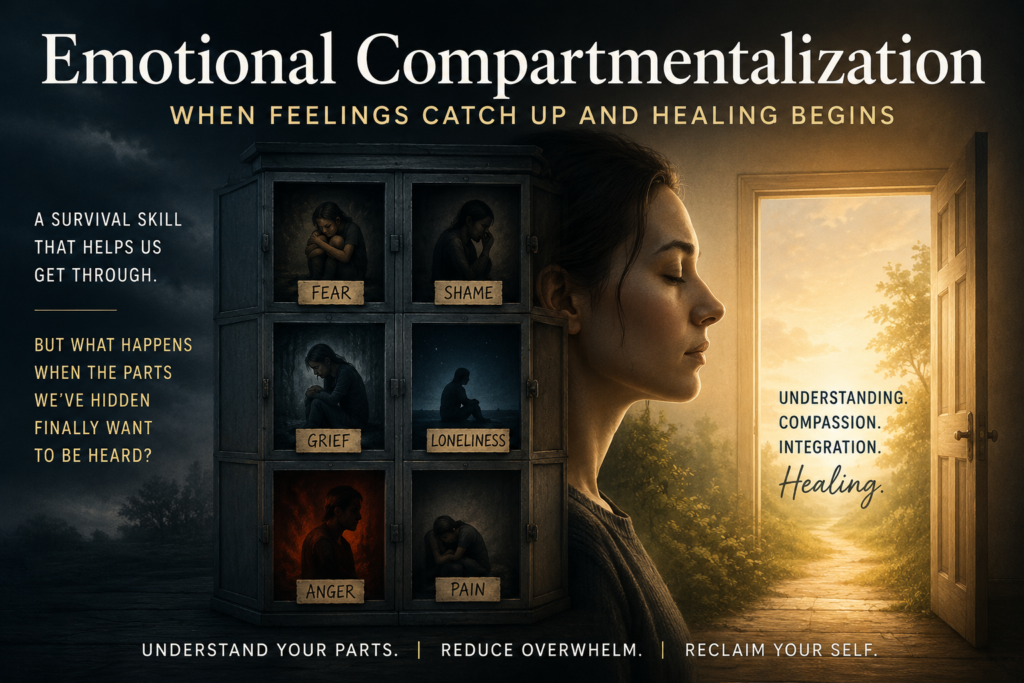
* Protective parts of the self that suppress emotional experience
If these mechanisms are not directly addressed, individuals may understand their experiences intellectually but still feel emotionally disconnected.
This is why targeted, evidence-based approaches are essential.
How CBT, ACT, and IFS Can Help
An integrative approach using Cognitive Behavioural Therapy (CBT), Acceptance and Commitment Therapy (ACT), and Internal Family Systems (IFS) can be particularly effective in addressing emotional numbness and detachment.
CBT focuses on behavioural patterns that maintain symptoms. In the context of numbness, this often involves reducing avoidance and gradually increasing engagement with meaningful activities and emotional experiences. This helps “retrain” the system to tolerate and re-access emotional states.
ACT complements this by shifting how individuals relate to internal experiences. Rather than trying to force emotions to return, ACT helps reduce struggle and avoidance, allowing emotional experience to emerge more naturally over time.
IFS works at an experiential level by addressing the protective parts of the system responsible for emotional shutdown.
In many individuals, there is a part that suppresses emotional experience to prevent overwhelm. This part may have developed during or after trauma as a way of coping.
IFS helps individuals:
* Identify and understand this protective part
* Build trust with it rather than trying to override it
* Help it update its role based on current safety
As this part begins to feel less burdened or fearful of unresolved exiles (parts that contain trauma material), emotional access can gradually return.
Reversing Emotional Numbness
Recovery from emotional numbness is not about forcing yourself to feel. In fact, pushing too hard often reinforces shutdown.
Instead, recovery involves:
* Gently reducing avoidance
* Increasing safe emotional engagement
* Regulating the nervous system
* Working directly with protective patterns
Over time, many people notice subtle changes first—moments of connection, brief emotional responses, or a sense of warmth returning. These moments often expand with continued therapeutic work.
Therapy Options in Hamilton and Across Ontario
In Hamilton and across Ontario, therapy is available both in person and online. Working with a clinician who understands trauma at both a psychological and physiological level is key.
Approaches that integrate behavioural strategies, acceptance-based work, and parts-based therapy are particularly well-suited for addressing emotional numbness and detachment. CONTACT US today for more information or to book an appointment.
Moving Toward Reconnection
Emotional numbness can feel like a permanent loss—but it is not.
It is a protective response that made sense at one point in time. With the right therapeutic support, the system can learn that it is safe to feel again.
Connection, emotion, and engagement are not gone—they are simply out of reach for now.
Contact Us Today
If you are experiencing emotional numbness, detachment, or difficulty feeling connected due to trauma or PTSD, specialized therapy can help you begin to reconnect with yourself and others.
At Dr. Barbera C. Psych & Associates, we offer integrative, evidence-informed therapy in Hamilton and online across Ontario, designed to address the underlying mechanisms of trauma.
CONTACT US today to book a consultation and take the first step toward restoring emotional connection and vitality.
References
Boehme, B. A. E., Ebrahimi, O. V., Carleton, R. N., & Asmundson, G. J. G. (2025). Feeling detached: The central role of detachment in a network study of posttraumatic stress symptoms. European Journal of Trauma & Dissociation.
Korem, N., Duek, O., Ben-Zion, Z., Kaczkurkin, A. N., Lissek, S., Orederu, T., Schiller, D., & Levy, I. (2022). Emotional numbing in PTSD is associated with lower amygdala reactivity to pain. Neuropsychopharmacology, 47, 1913–1921.
Litz, B. T., & Gray, M. J. (2002). Emotional numbing in posttraumatic stress disorder: Current and future research directions. Australian & New Zealand Journal of Psychiatry, 36(2), 198–204.
Nawijn, L., van Zuiden, M., Frijling, J. L., Koch, S. B. J., Veltman, D. J., & Olff, M. (2015). Reward functioning in PTSD: A systematic review exploring the mechanisms underlying anhedonia. Neuroscience & Biobehavioral Reviews, 51, 189–204.
Prepared by Dr. Jennifer Barbera, PhD, Registered Psychologist
Dr. Jennifer Barbera PhD, C. Psych is a licensed psychologist with over 25 years of counselling experience. She has extensive clinical expertise supporting individuals and couples with anxiety, trauma, depression, addiction, and relationship challenges. Her work combines evidence-based approaches with practical strategies to help clients build resilience and improve well-being.