How to Get an ADHD Assessment in Hamilton & Ontario
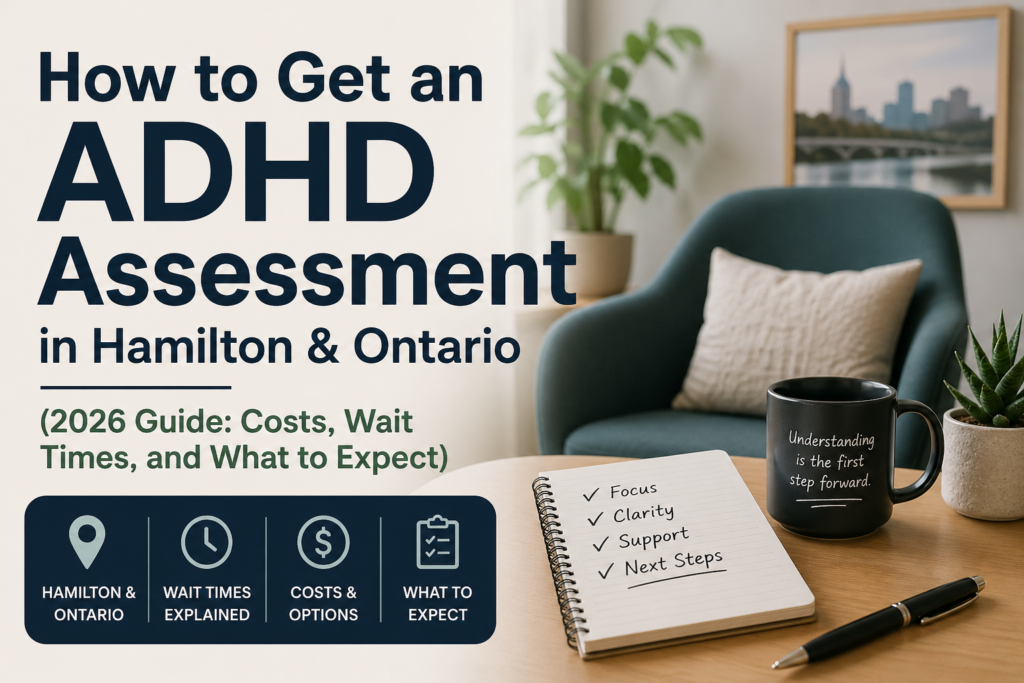
How to Get an ADHD Assessment in Hamilton & Ontario (2026 Guide: Costs, Wait Times, and What to Expect)
If you’ve been wondering whether your struggles with focus, procrastination, or follow-through might be ADHD, you’re not alone. Many adults and adolescents across Hamilton and Ontario reach a point where coping strategies are no longer enough—and they want clearer answers. This guide walks you through exactly how to get an ADHD assessment, what the process looks like, and how to take the next step with confidence.
Signs You Might Need an ADHD Assessment
ADHD isn’t just about being distracted. In clinical practice, what matters most is how symptoms interfere with daily functioning.
You might consider an assessment if you notice patterns like:
* Starting tasks but rarely finishing them, even when they’re important
* Chronic procrastination that affects work, school, or home life
* Difficulty organizing tasks, managing time, or prioritizing
* Emotional overwhelm, irritability, or low frustration tolerance
* Forgetfulness that impacts relationships or responsibilities
For example, you might be someone who performs well under pressure but constantly relies on last-minute effort to meet deadlines. Or you may feel mentally “busy” all the time, yet struggle to translate that into consistent productivity. These patterns often reflect executive functioning challenges commonly associated with ADHD (Barkley, 2015).
Research suggests that ADHD in adults is strongly linked to impairments in occupational functioning, emotional regulation, and quality of life—not just attention alone (Kessler et al., 2006). To learn more see our previous blog post ADHD in Adults: Symptoms, and practical strategies that actually help.
How ADHD Assessment Works in Ontario
A comprehensive ADHD assessment is more than a checklist. It’s a structured, evidence-based process designed to understand both symptoms and their real-world impact.
A typical assessment includes:
* A detailed clinical interview covering current concerns and developmental history
* Standardized questionnaires assessing attention, executive functioning, and related symptoms
* Exploration of other factors such as anxiety, trauma, or mood difficulties
* Collateral information when available (e.g., past report cards, partner input)
The goal is not just to determine whether ADHD is present, but to clarify how symptoms affect your functioning across different areas of life.
Clinicians also assess for overlapping or alternative explanations, since conditions like anxiety or depression can mimic or co-occur with ADHD (Adler et al., 2017). This step is essential for accurate diagnosis and effective recommendations. This is why it’s important not to opt for a quick assessment (e.g., an assessment done in under two hours is likely to overlook critical information that could actually change the diagnostic outcome, especially when someone has a trauma history or mood and anxiety symptoms that mimic ADHD symptoms).
To learn more about differentiating ADHD from anxiety see our previous blog post ADHD vs Anxiety: Why they feel the same (how to tell the difference). To learn more about differentiating ADHD from stress or lifestyle factors see Do I have ADHD or am I just burnt out? How modern life affects focus and executive functioning.
ADHD Assessment Options in Hamilton & Ontario
There are several pathways to getting assessed, depending on your needs, timeline, and budget.
Family Doctor Referral (OHIP-covered)
You can start by speaking with your family doctor, who may refer you to a specialist such as a psychiatrist. While this option is publicly funded, wait times can be very long—often over a year, and some family doctors will not refer someone to a psychiatrist for this purpose.
Private Assessment with a Psychologist
Many people choose to work with a registered psychologist for a more timely and comprehensive or thorough evaluation. This route typically offers shorter wait times and a detailed report with tailored recommendations. Services are usually covered by extended health benefit plans. At Dr. Barbera C. Psych & Associates there is often no wait time for an ADHD assessment.
Online ADHD Assessments Across Ontario
Virtual assessments have become increasingly common and are appropriate for some adults or adolescents. These allow you to access qualified professionals from anywhere in Ontario without needing to travel.
For someone balancing work, family, and other responsibilities, online assessment can make the process significantly more accessible without compromising quality as long as you select a practice that follows the exact same steps (e.g., obtaining collateral information, obtaining a developmental history, screening for a full range of mood and anxiety symptoms, standardized testing etc). Again, a practice that claims to conduct an ADHD assessment in an hour or two will not be as thorough and may miss important details.
Cost of ADHD Assessment in Ontario
Private ADHD assessments in Ontario typically range from $800 to $3,000, depending on the depth of the evaluation and the provider’s qualifications.
Some extended health benefits plans may cover all or part of the cost when services are provided by a registered psychologist or a clinician working directing under a psychologist while completing their years of supervised clinician work . It’s worth checking your coverage in advance.
While the cost can feel significant, many clients view the assessment as an investment in clarity—especially when it leads to targeted strategies, workplace accommodations, or appropriate treatment.
In Dr. Barbera & Associate’s practice, the cost of an ADHD assessment is usually 2-4 assessment appointments (depending on complexity or number of symptoms endorsed), a standardized measure, an additional 1-2 hours for review of materials and to complete a summary report, and a feedback session (approximately $800 to $1360).
Wait Times
Wait times are often one of the biggest factors influencing people’s decisions.
* Public system: several months to years
* Private services: often in days or weeks
It’s common to hear from individuals who spent years wondering if they had ADHD before seeking a private assessment simply to get answers sooner. That shift—from uncertainty to clarity—can be a turning point. CONTACT US today to request an appointment.
Online ADHD Assessments in Ontario
A frequent question is whether online ADHD assessments are legitimate. The answer is yes—when conducted by a qualified, registered professional using a comprehensive process.
Online assessments are particularly well-suited for:
* Adults or older adolescents with clear, longstanding symptoms
* Individuals in smaller communities with limited local access
* Busy professionals or parents needing flexibility
The key is ensuring the assessment includes a thorough clinical interview and standardized measures, rather than a quick screening alone. Research supports the reliability of structured ADHD evaluations when conducted using validated tools and clinical expertise (Adler et al., 2017).
What to Look for in an ADHD Assessment Provider
Not all assessments are the same. Choosing the right provider can make a significant difference in the quality and usefulness of your results.
Look for:
* A registered psychologist or appropriately trained clinician
* A comprehensive assessment process (not just a brief screening)
* Clear focus on functional impairment—not just symptoms
* A report that includes some practical recommendations
For example, instead of simply stating “difficulty with focus,” a strong report will describe how attention challenges affect your ability to complete tasks reliably, manage deadlines, or sustain effort over time. This level of detail is especially important if you are seeking workplace or academic accommodations.
Taking the Next Step
Deciding to pursue an ADHD assessment can feel like a big step—but it’s often a relief to move from uncertainty to understanding.
Many people describe finally having a framework that explains lifelong patterns: why certain tasks feel harder, why motivation fluctuates, or why traditional productivity strategies haven’t worked.
From there, the path forward becomes clearer—whether that includes therapy, coaching, workplace supports, or other interventions shown to improve functioning and well-being (Safren et al., 2010).
If you’re ready to explore whether ADHD may be part of your experience, the next step is simple: reach out, ask questions, and gather the information you need to make an informed decision.
CONTACT US today to learn more about ADHD assessment options in Hamilton or online across Ontario, and take the first step toward clarity and meaningful change.
References
Adler, L. A., Shaw, D. M., Spencer, T. J., Newcorn, J. H., Hammerness, P., Sitt, D. J., & Faraone, S. V. (2017). Preliminary examination of the reliability and concurrent validity of the Adult ADHD Self-Report Scale (ASRS) to rate ADHD symptoms in adolescents. Journal of Attention Disorders, 21(9), 764–772.
Barkley, R. A. (2015). Attention-deficit hyperactivity disorder: A handbook for diagnosis and treatment (4th ed.). New York, NY: Guilford Press.
Kessler, R. C., Adler, L., Barkley, R., Biederman, J., Conners, C. K., Demler, O., … Zaslavsky, A. M. (2006). The prevalence and correlates of adult ADHD in the United States. American Journal of Psychiatry, 163(4), 716–723.
Safren, S. A., Sprich, S., Mimiaga, M. J., Surman, C., Knouse, L., Groves, M., & Otto, M. W. (2010). Cognitive behavioural therapy vs relaxation with educational support for medication-treated adults with ADHD and persistent symptoms: A randomized controlled trial. JAMA, 304(8), 875–880.
Prepared by:
Dr. Jennifer Barbera PhD, C. Psych who is a licensed psychologist with over 25 years of counselling experience. She has extensive clinical expertise supporting individuals and couples with anxiety, trauma, depression, addiction, and relationship challenges. Her work combines evidence-based approaches with practical strategies to help clients build resilience and improve well-being.