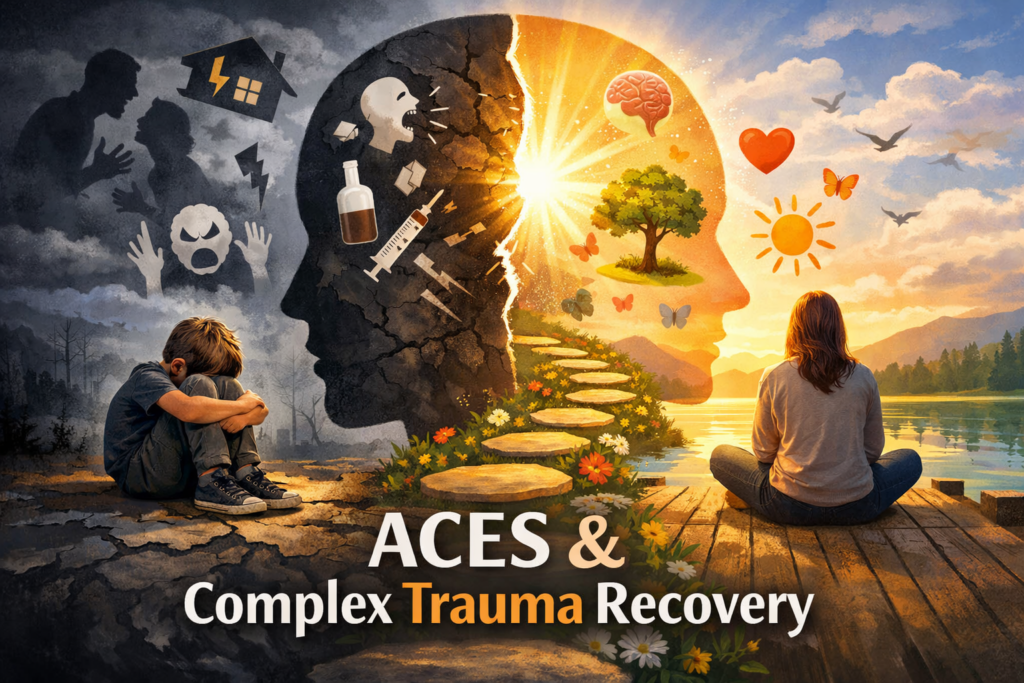
Complex Trauma: The Role of ACEs and Schemas
Understanding trauma requires more than identifying symptoms—it requires asking a different question. As the book What Happened to You? powerfully reframes it: “What happened to you?” rather than “What’s wrong with you?” (Perry & Winfrey, 2021).
This shift is at the heart of modern trauma-informed care. Adverse Childhood Experiences (ACEs) provide a structured way of understanding early adversity, while schema theory helps explain how those experiences become internalized patterns that shape thoughts, emotions, and relationships. Together, they offer a clinically meaningful framework for understanding and treating complex trauma.
What Are ACEs and How Do They Relate to Complex Trauma?
Adverse Childhood Experiences (ACEs) refer to potentially traumatic events that occur before the age of 18, including abuse, neglect, and household dysfunction (Felitti et al., 1998). These experiences are not rare—and importantly, they tend to cluster and accumulate.
While a single adverse event can be impactful, repeated or chronic exposure to adversity—particularly in the context of caregiving relationships—is more likely to contribute to what is often referred to as complex trauma.
Complex trauma differs from single-incident trauma in that it involves:
• Ongoing exposure to stress or threat
• Interpersonal harm (e.g., caregivers or attachment figures)
• Developmental disruption across emotional, relational, and neurological systems
As Bruce Perry explains, “The brain is shaped by the experiences it has, especially early in life” (Perry & Winfrey, 2021). When those early experiences are characterised by unpredictability, fear, or emotional absence, the developing brain adapts accordingly—often in ways that prioritize survival over connection, regulation, and reflection.
The ACE Questionnaire: A Snapshot of Early Risk
The ACE framework identifies 10 categories of adversity:
Abuse
1. Emotional abuse
2. Physical abuse
3. Sexual abuse
Neglect
4. Emotional neglect
5. Physical neglect
Household Dysfunction
6. Mother treated violently
7. Household substance use
8. Household mental illness
9. Parental separation or divorce
10. Incarcerated household member
Each category reflects an environment that may undermine a child’s sense of safety, stability, or worth. However, the ACE score itself is not the full story. Two individuals with the same score may have very different outcomes depending on protective factors, temperament, and relational experiences.
This is where deeper clinical formulation becomes essential.
From Early Experiences to Internal Patterns: The Role of Schemas
ACEs tell us what happened, schema theory helps us understand how those experiences were encoded and carried forward.
Early maladaptive schemas are deeply ingrained patterns of thinking, feeling, and relating that develop when core emotional needs are not met in childhood. These needs include safety, connection, autonomy, and validation.
For example:
• A child who experiences emotional neglect may develop a schema of emotional deprivation (“My needs won’t be met”)
• A child exposed to inconsistent caregiving may develop an abandonment schema (“People will leave me”)
• A child who is criticized or shamed may develop a defectiveness schema (“There is something wrong with me”)
These schemas are not just beliefs—they are lived emotional realities that shape how individuals interpret and respond to the world.
Dr. Perry highlights that repeated early experiences create predictable patterns in how individuals respond to stress, noting that “patterned, repetitive experiences… shape the way the brain works” (Perry & Winfrey, 2021). Schema theory aligns closely with this neurodevelopmental perspective, offering a psychological map of these patterns.
How ACEs and Schemas Interact in Complex Trauma
When ACEs are chronic and relational in nature, they do more than create isolated symptoms—they shape identity, expectations, and relational patterns.
This interaction often leads to:
• Persistent emotional dysregulation
• Negative self-concept
• Difficulty trusting others
• Sensitivity to rejection or perceived threat
• Re-enactment of familiar relational patterns
For instance, someone with a history of emotional neglect may not only feel disconnected from others, but may also unknowingly choose relationships that reinforce that experience. Without understanding the underlying schema, this can be misinterpreted as poor decision-making rather than a predictable pattern rooted in early experience.
In this way, ACEs provide the developmental context, while schemas explain the ongoing internal experience.
Why This Matters for Effective Trauma Therapy
If therapy focuses only on surface-level symptoms—such as anxiety, depression, or relationship conflict—it risks missing the underlying structure that maintains those difficulties.
Understanding ACEs and schemas allows therapy to move from symptom management to deeper, more effective intervention.
This includes:
• Identifying the origins of current patterns
• Linking emotional responses to past experiences
• Working directly with entrenched beliefs and expectations
• Building new emotional and relational experiences
As Perry emphasises, healing occurs through experience, not just insight. He notes that “relationships are the agents of change” (Perry & Winfrey, 2021). This is critical—especially in complex trauma, where the original wounds often occurred in relational contexts.
Schema therapy and other trauma-informed approaches explicitly integrate this principle by using the therapeutic relationship as a corrective emotional experience, alongside structured interventions.
Moving Beyond “What’s Wrong” to “What Happened”
One of the most important clinical shifts in trauma work is moving away from pathologizing language.
Behaviours that may appear maladaptive—such as emotional withdrawal, hypervigilance, or avoidance—are often understandable adaptations to earlier environments.
For example:
• Hypervigilance may reflect a nervous system trained to detect threat
• Emotional numbing may reflect a learned strategy to cope with overwhelm
• People-pleasing may reflect an early need to maintain safety in relationships
When viewed through the lens of ACEs and schemas, these responses make sense. They are not random—they are patterned, meaningful, and often protective.
This perspective fosters both clinical accuracy and compassion, which are essential for effective therapy.
The Role of Assessment in Trauma-Informed Care
This is why assessing early adverse experiences is a critical part of effective psychological care.
In our practice, we include ACEs as part of a broader intake and assessment process. This is not about assigning a score—it is about understanding context.
A comprehensive assessment allows us to:
• Identify relevant developmental experiences
• Understand schema patterns and relational dynamics
• Tailor interventions to the individual’s history
• Avoid overly symptom-focused or mismatched treatment approaches
Without this level of understanding, therapy can remain surface-level and less effective. With it, therapy becomes more targeted, relationally attuned, and capable of addressing the root causes of distress.
From Insight to Change
Understanding ACEs and schemas is not the end goal—it is the foundation for change.
Effective trauma therapy involves:
• Increasing awareness of patterns
• Developing emotional regulation skills
• Challenging and reshaping maladaptive schemas
• Creating new relational experiences
• Building a more coherent and compassionate sense of self
While early experiences shape development, they do not define a person’s future. The brain remains capable of change, and new experiences—particularly safe, attuned relationships—can support meaningful healing over time. CONTACT US today to start your healing journey.
References
Anda, R. F., Felitti, V. J., Bremner, J. D., Walker, J. D., Whitfield, C., Perry, B. D., Dube, S. R., & Giles, W. H. (2006). The enduring effects of abuse and related adverse experiences in childhood. European Archives of Psychiatry and Clinical Neuroscience, 256(3), 174–186.
Chapman, D. P., Whitfield, C. L., Felitti, V. J., Dube, S. R., Edwards, V. J., & Anda, R. F. (2004). Adverse childhood experiences and the risk of depressive disorders in adulthood. Journal of Affective Disorders, 82(2), 217–225.
Felitti, V. J., Anda, R. F., Nordenberg, D., Williamson, D. F., Spitz, A. M., Edwards, V., Koss, M. P., & Marks, J. S. (1998). Relationship of childhood abuse and household dysfunction to many of the leading causes of death in adults. American Journal of Preventive Medicine, 14(4), 245–258.
Hughes, K., Bellis, M. A., Hardcastle, K. A., Sethi, D., Butchart, A., Mikton, C., Jones, L., & Dunne, M. P. (2017). The effect of multiple adverse childhood experiences on health: A systematic review and meta-analysis. The Lancet Public Health, 2(8), e356–e366.
Perry, B. D., & Winfrey, O. (2021). What happened to you? Conversations on trauma, resilience, and healing. Flatiron Books.
Prepared by Dr. Jennifer Barbera, PhD, Registered Psychologist
Dr. Jennifer Barbera PhD, C. Psych is a licensed psychologist with over 25 years of counselling experience. She has extensive clinical expertise supporting individuals and couples with anxiety, trauma, depression, addiction, and relationship challenges. Her work combines evidence-based approaches with practical strategies to help clients build resilience and improve well-being.