How to Find EMDR Therapy in Ontario for Trauma Recovery
If you are searching for EMDR therapy in Ontario, you are likely looking for more than a general explanation—you want to understand how it actually works and whether it can help with the kind of distress you are experiencing.
Eye Movement Desensitization and Reprocessing (EMDR) is a structured, evidence-based therapy designed to help people process unresolved traumatic or distressing experiences. While it is often associated with eye movements or tapping, the real mechanism behind EMDR is much more grounded in cognitive science and how memory functions in the brain.
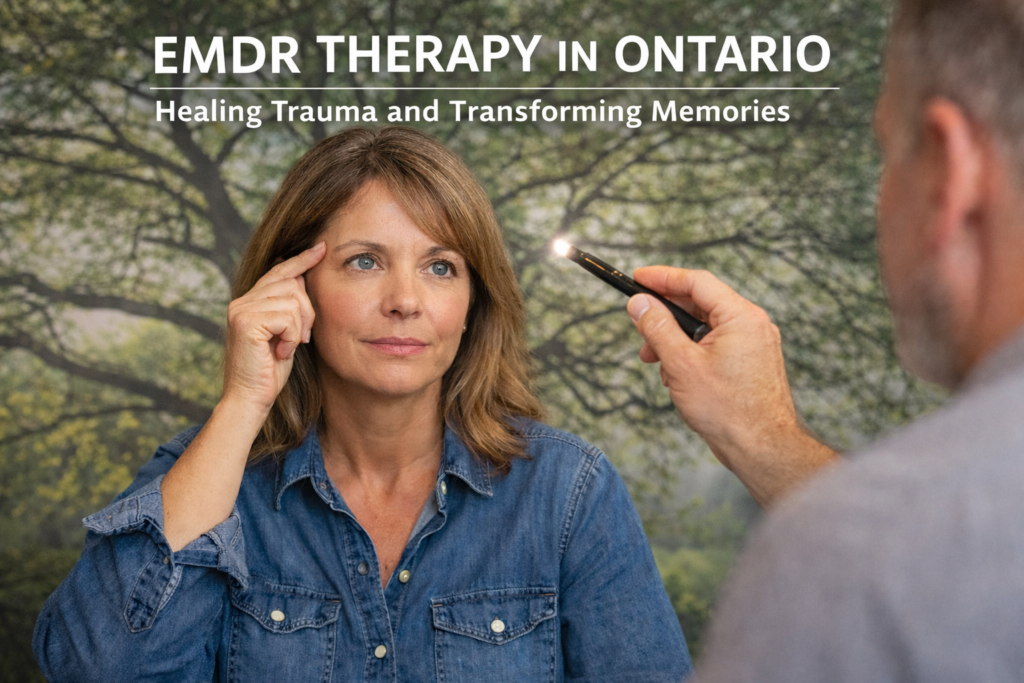
At its core, EMDR works by activating a distressing memory while simultaneously engaging your working memory. This is typically done through bilateral stimulation such as guided eye movements, tapping, or alternating sounds. While this may seem simple, it has a powerful effect to heal intrusion symptoms: working memory has limited capacity, so when it is divided between recalling a painful memory and tracking an external task, the memory itself becomes less vivid and less emotionally intense.
Research consistently shows that this process reduces the clarity and emotional charge of distressing memories (van den Hout & Engelhard, 2012). Instead of feeling like the experience is happening again in the present moment, the memory begins to shift into something more distant and manageable—something that happened in the past rather than something that is still unfolding.
This matters because trauma is not stored like a typical memory. When overwhelming experiences occur without enough support, they are often encoded in a fragmented, sensory-based way. These memories are closely tied to the brain’s threat system and can be triggered easily, leading to strong emotional and physical reactions that feel out of proportion to the current situation (Brewin, 2014).
EMDR helps change how these memories are stored. By recalling them under conditions where working memory is taxed, the brain is less able to maintain their intensity. This opens the door to a process called reconsolidation, where the memory becomes temporarily flexible and can be updated with new information—such as present-day safety, perspective, and adaptive beliefs (Lane et al., 2015).
Over time, clients often notice that the memory shifts in important ways. The images become less sharp, the emotional response decreases, and new insights or meanings begin to emerge. What once felt overwhelming and immediate becomes more like a coherent story—integrated into your life rather than dominating it.
For those seeking EMDR therapy in Ontario, it is important to understand that bilateral stimulation alone is not what creates change. The effectiveness of EMDR depends on how it is delivered. A well-trained clinician will carefully pace the process, ensure that you remain within a tolerable level of emotional activation, and help you stay grounded in the present while accessing the past. Ideally they will draw on other therapeutic approaches such as IFS (Internal Family Systems) to help someone stay in their window of tolerance and more effectively process.
There is also strong evidence that the specific form of bilateral stimulation is less important than the working memory load it creates. Studies have shown that other dual-attention tasks—such as counting or visuospatial exercises—can produce similar reductions in emotional intensity (Engelhard et al., 2010). This reinforces the idea that EMDR works by engaging cognitive resources in a way that softens the impact of distressing memories.
In practice, this means that effective EMDR therapy in Ontario is not just about following a protocol. It requires clinical skill, attunement, and an understanding of how to work with the nervous system in real time. When these elements come together, EMDR can be a highly effective approach for trauma, anxiety, and distressing life experiences that continue to feel unresolved.
If you have been feeling stuck with memories that still carry a strong emotional charge, EMDR therapy may help you process them in a way that feels manageable and meaningful. You do not have to continue reliving the past in the same way.
EMDR is not a plug-and-play technique—it is a highly specialized, structured therapy that requires substantial training, supervision, and clinical judgement to deliver safely and effectively.
While many clinicians list EMDR among their services, the depth and quality of their training can vary widely. Some have completed comprehensive, certification-level programs with approved trainers and ongoing consultation; others may have only brief exposure—or none at all within a recognized training framework. That difference matters. EMDR involves deliberately activating distressing material, and without the skill to track regulation, pace the process, and maintain a client’s sense of safety, it can become overwhelming, ineffective or even harmful.
One common red flag is a clinician who explains EMDR as simply “mimicking REM sleep to reprocess memories.” That explanation is appealing, but it is not supported by current evidence. The more accurate understanding is that EMDR works by taxing working memory while a distressing memory is held in awareness, reducing its vividness and emotional intensity, and allowing it to be reconsolidated in a context of present safety within an attuned therapeutic connection. In other words, it is not the eye movements alone that heal—it is the combination of precise clinical application, nervous system regulation, and a highly skilled therapeutic relationship.
Several of our clinicians offer EMDR therapy in Ontario within a supportive, individualized framework that prioritizes safety, pacing, and lasting change. If you are ready to explore whether EMDR is right for you, CONTACT US today to learn more about our services and how we can support your recovery.
References
Brewin, C. R. (2014). Episodic memory, perceptual memory, and their interaction: Foundations for a theory of posttraumatic stress disorder. Psychological Bulletin, 140(1), 69–97.
Engelhard, I. M., van den Hout, M. A., & Smeets, M. A. M. (2010). Taxing working memory reduces vividness and emotional intensity of images about the future. Journal of Behaviour Therapy and Experimental Psychiatry, 41(3), 227–231.
Lane, R. D., Ryan, L., Nadel, L., & Greenberg, L. (2015). Memory reconsolidation, emotional arousal, and the process of change in psychotherapy. Behavioural and Brain Sciences, 38, e1.
van den Hout, M. A., & Engelhard, I. M. (2012). How does EMDR work? Journal of Experimental Psychopathology, 3(5), 724–738.
Prepared by Dr. Jennifer Barbera, PhD, Registered Psychologist
Dr. Jennifer Barbera PhD, C. Psych is a licensed psychologist with over 25 years of counselling experience. She has extensive clinical expertise supporting individuals and couples with anxiety, trauma, depression, addiction, and relationship challenges. Her work combines evidence-based approaches with practical strategies to help clients build resilience and improve well-being.