How to Finally Get Unstuck With Schema Psychological Assessment in Ontario
Schema Therapy Assessment in Hamilton and Online Across Ontario:
Many people arrive in therapy with a frustrating question: “Why do I keep reacting this way, even when I know what I should do differently?” You might notice patterns such as low self-worth or imposter syndrome, difficulty asserting yourself, fear of abandonment, perfectionism, burnout, or ongoing procrastination. Even with insight, these patterns can feel persistent and confusing.
Schema assessment offers a deeper and more precise way of understanding these experiences. Rather than focusing only on symptoms or surface behaviours, it helps uncover the underlying emotional patterns that drive them. For many, this becomes the turning point in getting unstuck.
What Are Early Maladaptive Schemas?
In schema therapy, early maladaptive schemas are enduring patterns of thoughts, emotions, and beliefs that develop when core emotional needs are not adequately met in childhood or adolescence. These schemas shape how individuals see themselves, others, and the world. While they often begin as adaptive responses to early environments, they can become rigid and self-defeating over time (Young, Klosko, & Weishaar, 2003; Thimm, 2022).
Research shows that early maladaptive schemas are associated with a wide range of psychological concerns, including anxiety, depression, and personality-related patterns (Bach, Lockwood, & Young, 2018). Understanding these schemas helps explain why emotional reactions can feel intense, automatic, or difficult to change.
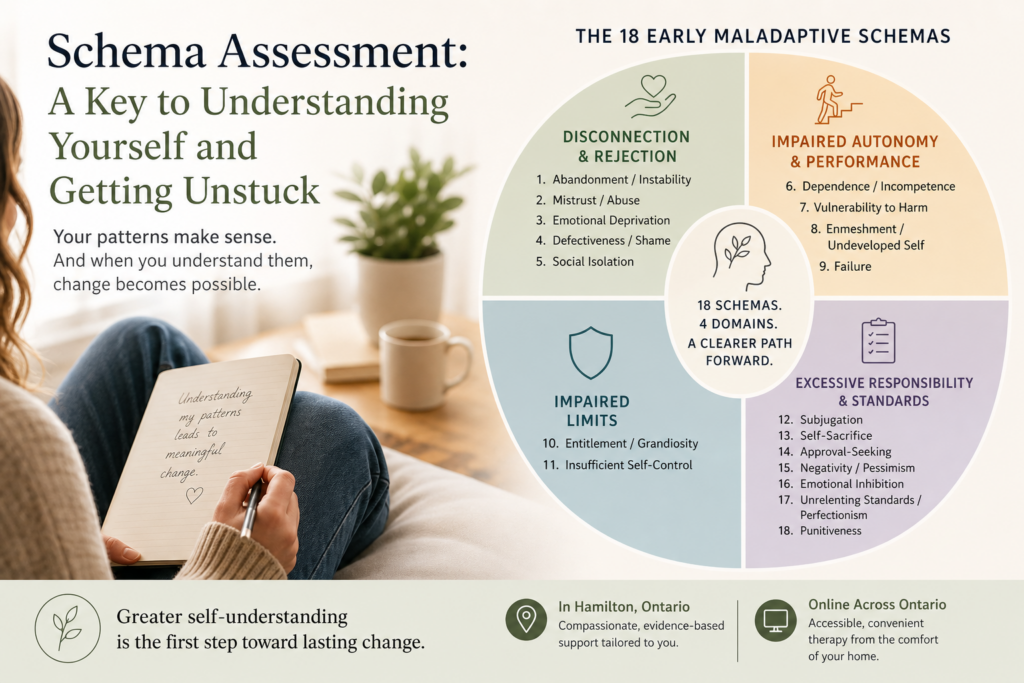
The 18 Early Maladaptive Schemas
Schema therapy identifies 18 core patterns, but what matters most is how they show up in real life. When people review their schema assessment results, they often say some version of, “That’s exactly how I feel, I just didn’t have words for it before.”
Disconnection and Rejection
This group of schemas centres on a deep expectation that emotional needs won’t be met in a consistent or safe way:
Abandonment / Instability often shows up as a strong fear of people leaving. You might feel anxious if someone doesn’t respond to a message, or find yourself needing frequent reassurance in relationships.
Mistrust / Abuse can lead to scanning for signs of being hurt, misled, or taken advantage of. Even when others are kind, it may feel difficult to fully let your guard down leading to ongoing hypervigilance.
Emotional Deprivation is often quieter but deeply impactful. It can feel like, “No one really understands me,” or “I have to meet my own emotional needs because others won’t.” This may prevent you from getting emotionally close to others,
Defectiveness / Shame tends to sound like an internal belief that something is fundamentally wrong with you. Even with success or positive feedback, it can feel like you’re just hiding your flaws. This belief leads to ongoing low self-worth and an increased vulnerability to depression.
Social Isolation creates a sense of not quite belonging. You may feel different from others or like you’re on the outside looking in, even in social situations.
Impaired Autonomy and Performance
These schemas relate to confidence, independence, and feeling capable in the world.
Dependence / Incompetence can look like second-guessing decisions or needing reassurance for things others seem to handle easily. This leads to chronic self-doubt.
Vulnerability to Harm often shows up as persistent worry about things going wrong—health concerns, accidents, or worst-case scenarios that feel hard to shake.
Enmeshment / Undeveloped Self can feel like losing yourself in relationships. You might struggle to know what you want or feel overly responsible for others’ emotions.
Failure often involves a belief that you are falling behind or will never succeed, even when there is evidence that you are capable. This leads to imposter syndrome.
Impaired Limits
This domain focuses on boundaries and self-regulation, and it can show up in very different ways.
Entitlement / Grandiosity may look like frustration when things don’t go your way or a sense that expectations or rules shouldn’t apply in the same way to you.
Insufficient Self-Control is often experienced as difficulty with follow-through. This might include procrastination, avoiding discomfort, or feeling overwhelmed by tasks that require sustained effort.
Excessive Responsibility and Standards
This is one of the most commonly endorsed domains, especially among high-functioning individuals who appear outwardly capable but feel significant internal pressure.
Subjugation involves putting others’ needs or opinions ahead of your own to avoid conflict or rejection, even when it costs you. See our previous post on this schema.
Self-Sacrifice shows up as consistently taking care of others while neglecting yourself, often leading to exhaustion or resentment. See our previous post on this schema.
Approval-Seeking can make your sense of worth feel tied to how others perceive you, making criticism or disapproval especially difficult.
Negativity / Pessimism involves a tendency to focus on what could go wrong, even when things are going well.
Emotional Inhibition can make it hard to express feelings openly. Others may see you as composed, while internally you feel restricted or disconnected.
Unrelenting Standards drives a constant push to do more and be better, often with little sense of satisfaction or permission to rest leading to perfectionism.
Punitiveness shows up as harsh self-criticism. Mistakes feel unacceptable, and there may be a strong internal voice that believes you should be punished rather than understood.
How These Schemas Work Together
Most people don’t have just one schema. Instead, they have a pattern of several that interact with each other. For example, someone with defectiveness and unrelenting standards may constantly strive to prove their worth while still feeling inadequate. Another person with abandonment and self-sacrifice may overextend themselves in relationships in an effort to avoid being left.
Seeing these patterns clearly through a schema assessment often brings a sense of relief. Instead of feeling confused or self-critical, there is a coherent explanation for why certain reactions keep happening. From there, change becomes more focused and achievable, because you’re working with the pattern rather than fighting against it.
Why Schema Assessment Is So Powerful
A schema inventory, such as the Young Schema Questionnaire, provides a structured way to identify which schemas are most active. Rather than asking “What’s wrong with me?”, it helps answer more useful questions: What did I learn early on about myself and others? Which emotional needs were not met? How am I still coping with that today?
Schemas tend to be stable over time unless directly addressed, which is why patterns can persist even with strong insight or motivation (Young et al., 2003). Assessment helps make these patterns visible and understandable, which is a necessary step toward meaningful change.
How Schema Assessment Helps You Get Unstuck
Low Self-Worth and Imposter Syndrome
Individuals struggling with imposter syndrome often show elevated schemas such as defectiveness or shame, failure, and unrelenting standards. Before assessment, the issue may be framed as a lack of confidence. After assessment, it becomes clear that there is a deeper belief of not being good enough, often paired with overcompensation through achievement. This allows therapy to target the underlying schema rather than just building surface-level confidence.
Low Assertiveness and People-Pleasing
Schemas such as subjugation, approval-seeking, and self-sacrifice are commonly associated with difficulty asserting needs. People may feel frustrated with themselves for not speaking up, yet experience strong internal barriers when they try. Schema assessment reframes this as an adaptation to earlier environments where expressing needs may not have felt safe, reducing self-blame and supporting more effective change.
Fear of Abandonment and Borderline Personality Characteristics
For individuals who experience intense fears of abandonment or emotional instability in relationships, schemas such as abandonment, emotional deprivation, and mistrust are often central. Schema therapy has strong evidence for addressing these patterns because it focuses on the underlying emotional expectations driving the behaviour (Bamelis, Evers, Spinhoven, & Arntz, 2014). Assessment often helps individuals move from self-criticism toward understanding how their responses developed.
Perfectionism and Burnout
Perfectionism is frequently driven by schemas such as unrelenting standards, punitiveness, and approval-seeking. Individuals may feel constant pressure to perform and difficulty allowing themselves to rest. Schema assessment helps identify that this pattern is often rooted in fear of failure or rejection, which opens the door to more sustainable ways of functioning.
Procrastination and Lack of Self-Discipline
Procrastination is often misunderstood as laziness, but schema assessment reveals a more nuanced picture. Schemas such as failure, insufficient self-control, and dependence may contribute. For some, procrastination reflects avoidance of anticipated failure or shame. For others, it relates to difficulty tolerating discomfort. Understanding the underlying schema changes how the problem is approached and treated.
Why Schema Assessment Is More Empowering Than Personality Labels
Schema assessment offers a more individualized and compassionate alternative to traditional personality disorder frameworks. Rather than assigning a fixed label, it provides a detailed map of emotional patterns and their origins.
This approach is inherently person-centred. It focuses on understanding how previously unmet needs led to specific patterns rather than categorizing someone as ‘disordered’ and emphasizes that schemas are learned patterns that can be changed. It also tends to reduce shame, as individuals begin to see their responses as adaptations to unmet needs rather than personal flaws.
Schema Assessment in Hamilton and Online Across Ontario
For those searching for schema assessment in Hamilton or online across Ontario, this approach can be especially helpful if previous therapy has felt limited or focused only on symptoms. A structured schema inventory, combined with clinical interpretation, can help identify core patterns, clarify emotional triggers, and guide more targeted intervention.
This process provides a clearer roadmap for change and can be particularly valuable for individuals dealing with long-standing patterns that have not responded to other approaches.
A Better Way to Move Forward
Schema assessment isn’t about putting you in a box—it’s about giving you a map.
Once you can see the patterns clearly, you stop fighting yourself and start working with your system.
And that’s usually the turning point:
Not more effort.
Not more willpower.
But better understanding.
For many individuals, this process marks a shift from feeling stuck and self-critical to feeling informed, compassionate toward themselves, and capable of meaningful change. CONTACT US today to learn more or set up an appointment.
References
Bach, B., Lockwood, G., & Young, J. E. (2018). A new look at the schema therapy model: Organization and role of early maladaptive schemas. Cognitive Behaviour Therapy, 47(4), 328–349.
Bamelis, L. L. M., Evers, S. M. A. A., Spinhoven, P., & Arntz, A. (2014). Results of a multicenter randomized controlled trial of the clinical effectiveness of schema therapy for personality disorders. American Journal of Psychiatry, 171(3), 305–322.
Thimm, J. C. (2022). The higher-order structure of early maladaptive schemas: A meta-analytical approach. Frontiers in Psychiatry, 13, 1–12.
Young, J. E., Klosko, J. S., & Weishaar, M. E. (2003). Schema therapy: A practitioner’s guide. Guilford Press.
Prepared by Dr. Jennifer Barbera, PhD, Registered Psychologist
Dr. Jennifer Barbera PhD, C. Psych is a licensed psychologist with over 25 years of counselling experience. She has extensive clinical expertise supporting individuals and couples with anxiety, trauma, depression, addiction, and relationship challenges. Her work combines evidence-based approaches with practical strategies to help clients build resilience and improve well-being.