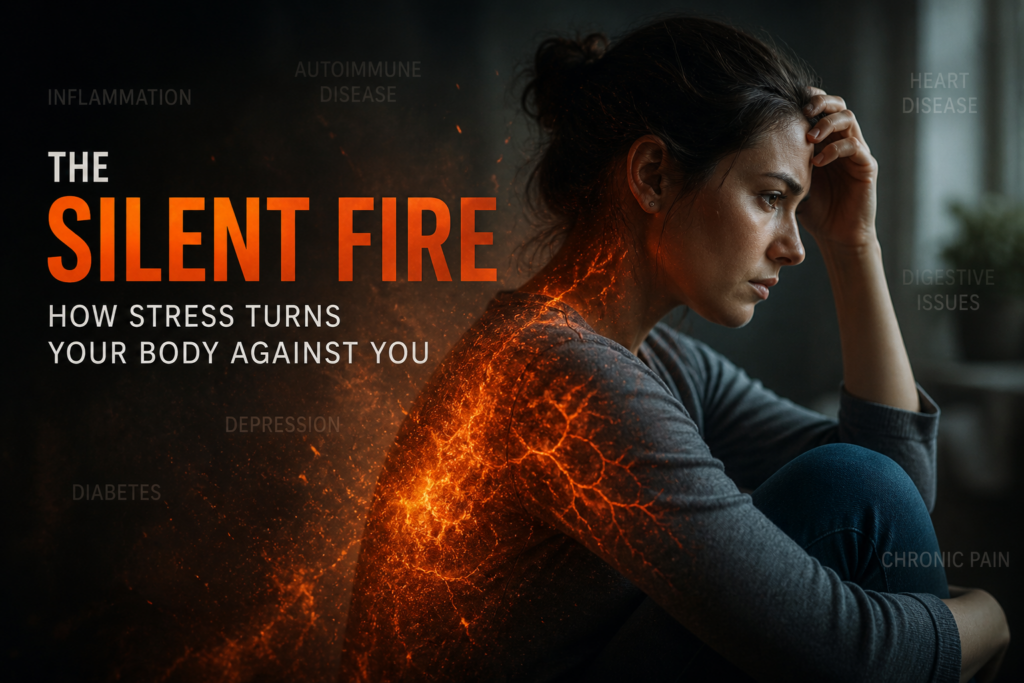
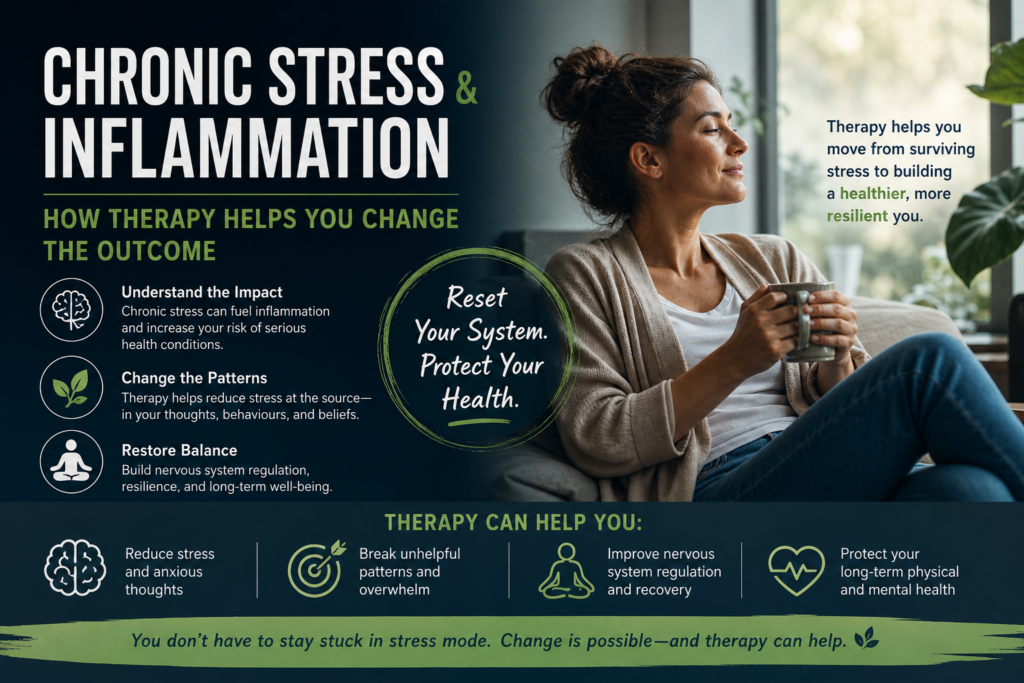
The Silent Fire: How Stress Turns Your Body Against You and How to Find Help in Ontario
You don’t feel inflammation.
That’s what makes it dangerous.
No alarm bells. No sharp pain. Just a slow, smouldering shift beneath the surface—quiet enough to ignore, powerful enough to change the trajectory of your health.
And if you’re living in chronic stress, it may already be happening.
The Stress Response Was Never Meant to Last
Your body is brilliantly designed for survival.
When a stressor hits—a deadline, an argument, a moment of fear—your system activates instantly:
* Heart rate rises
* Stress hormones surge
* Immune signals mobilize
This is not the problem.
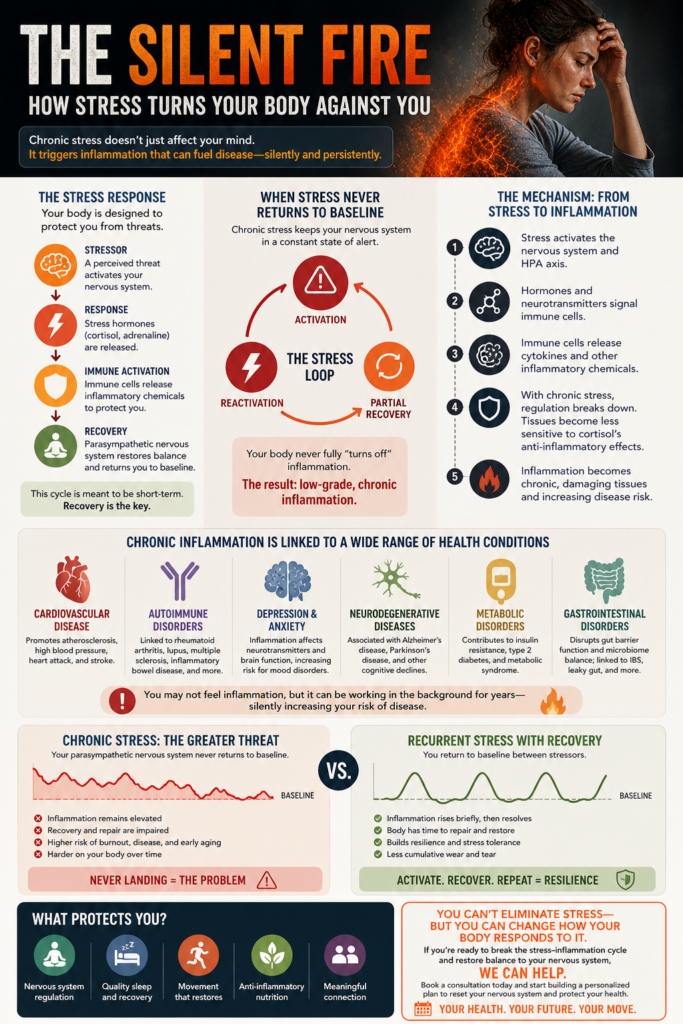
In fact, short bursts of stress can enhance immune function and sharpen your focus. The body expects activation followed by recovery—a return to baseline, regulated by the parasympathetic nervous system (“rest and digest”).
That return is everything.
Because when it doesn’t happen, the system doesn’t just stay “on.”
It starts to change.
When Stress Becomes a Biological Loop
Chronic stress doesn’t just mean “a lot of stress.”
It means your nervous system never fully comes back down.
Instead of:
activation → recovery → baseline
You get:
activation → partial recovery → reactivation → never quite landing
Over time, this leads to a profound shift in how your body regulates inflammation.
Chronic psychosocial stress has been consistently associated with elevated low-grade inflammation, even when traditional stress markers (like cortisol) appear within normal ranges (Rohleder, 2012).
That’s the trap.
Your body looks “fine” on the surface—but underneath, the immune system is becoming dysregulated.
The Mechanism: From Stress to Inflammation
Here’s what’s happening behind the scenes:
1. Stress activates the nervous system and HPA axis
This releases cortisol, adrenaline, and other mediators.
2. Immune cells respond to these signals
They release inflammatory cytokines—chemical messengers designed to protect you.
3. With chronic stress, regulation breaks down
Tissues become less sensitive to cortisol’s anti-inflammatory effects (Rohleder, 2011).
4. Inflammation becomes persistent
Not acute. Not helpful. Just… ongoing.
This is often called low-grade systemic inflammation—and it’s one of the most important pathways linking stress to disease.
The Critical Role of the Parasympathetic Nervous System
Here’s the part most people miss:
It’s not just how high your stress goes.
It’s whether your system can come back down.
The parasympathetic nervous system—especially via vagal pathways—actively suppresses inflammation and restores physiological balance. When it functions well, it acts like a brake on the immune system.
But chronic stress weakens that brake.
When parasympathetic activity is impaired:
* The body struggles to “turn off” inflammation
* Recovery becomes incomplete
* The system shifts toward ongoing activation
This is why chronic, unrelenting stress is more harmful than repeated high stress with recovery in between.
Your body can handle spikes.
It cannot handle never landing.
The Diseases Linked to Chronic Inflammation
This isn’t theoretical.
Chronic stress–driven inflammation has been linked to:
Cardiovascular Disease
Inflammation contributes directly to atherosclerosis and heart disease (Black, 2002).
Autoimmune Disorders
Conditions such as rheumatoid arthritis, lupus, and inflammatory bowel disease are associated with stress-related immune dysregulation (Haykin & Rolls, 2021).
Depression and Anxiety
Inflammation alters neurotransmitter systems and brain function, contributing to mood disorders such as depression (Chan et al., 2023).
Neurodegenerative Diseases
Chronic inflammatory processes are implicated in conditions like Alzheimer’s and Parkinson’s disease (Chan et al., 2023).
Metabolic Disorders
Including insulin resistance and type 2 diabetes, where inflammation disrupts metabolic signalling (Rohleder, 2012).
Gastrointestinal Conditions
Stress-driven inflammation can impair gut barrier function and microbiome balance (Haykin & Rolls, 2021).
The Subtle Danger: You Can Function Like This for Years
This is where people get misled.
You can:
* Keep working
* Keep showing up
* Keep pushing through
All while your baseline is quietly shifting.
The body adapts—until it doesn’t.
By the time symptoms appear, the process is often well underway.
A Hard Truth Most People Avoid
You don’t need extreme stress to create damage.
You need unresolved stress.
The kind that:
* Lingers in your body after the situation ends
* Keeps your mind cycling long after the event
* Never fully settles
That’s the stress that drives inflammation.
Not the peak—but the persistence.
What Actually Protects You
If you take one thing from this, let it be this:
Your health is not determined by how much stress you experience.
It’s determined by how effectively you recover from it.
The goal is not a stress-free life.
It’s a nervous system that can:
* Activate when needed
* Return to baseline reliably
* Spend enough time in restoration to repair what stress disrupts
This Is Where Change Becomes Personal
Reading this, you might already recognize something:
* You’re always a little “on”
* You don’t fully relax, even when things are calm
* Your body doesn’t feel like it resets
That’s not just psychological.
That’s physiological.
And it’s modifiable.
The Opportunity Most People Miss
By the time inflammation shows up as illness, the window for prevention has narrowed—but it hasn’t closed.
The earlier you intervene:
* The more reversible these processes are
* The more control you have over long-term outcomes
But this isn’t about generic advice like “reduce stress.”
It’s about understanding:
* Your stress patterns
* Your nervous system responses
* Your recovery gaps
And building a targeted plan that actually shifts your baseline.
If You’re Paying Attention, This Is the Moment
Most people will read something like this and move on.
A smaller group will pause and think:
“This might be me.”
If that resonates at all, don’t ignore it.
Because the trajectory you’re on is not fixed—but it does require intentional change.
A structured review of your stress patterns, nervous system regulation, and addressing daily load isn’t indulgent.
It’s preventative care for living a longer, better, life.
A Better Way Forward
You can keep pushing through and hope your body keeps up—or you can intervene while you still have leverage. If you recognize yourself in this pattern of never quite settling, this is the point where insight needs to turn into action.
Working with a trained clinician to map your stress patterns, assess your nervous system regulation, and build a structured plan for recovery isn’t a luxury—it’s how you prevent long-term damage. Real change comes from targeted, consistent work: restoring parasympathetic tone, reducing baseline activation, and creating conditions where your body can actually repair.
If you’re ready to stop running on a system that never fully resets, CONTACT US today to book a consultation and start building a plan that brings your nervous system—and your health—back into balance.
References
Black, P. H. (2002). Stress and the inflammatory response: A review of neurogenic inflammation. Brain, Behavior, and Immunity, 16(6), 622–653.
Chan, K. L., Poller, W. C., Swirski, F. K., & Russo, S. J. (2023). Central regulation of stress-evoked peripheral immune responses. Nature Reviews Neuroscience, 24, 591–604.
Haykin, H., & Rolls, A. (2021). The neuroimmune response during stress: A physiological perspective. Immunity, 54(9), 1933–1947.
Rohleder, N. (2011). Variability in stress system regulatory control of inflammation: A critical factor mediating health effects of stress. Expert Review of Endocrinology & Metabolism, 6(2), 269–278.
Rohleder, N. (2012). Stress system regulation of chronic low-grade inflammation. Advances in Neuroimmune Biology, 3(3–4), 265–276.
Prepared by Dr. Jennifer Barbera, PhD, Registered Psychologist
Dr. Jennifer Barbera PhD, C. Psych is a licensed psychologist with over 25 years of counselling experience. She has extensive clinical expertise supporting individuals and couples with anxiety, trauma, depression, addiction, and relationship challenges. Her work combines evidence-based approaches with practical strategies to help clients build resilience and improve well-being.