Why Adverse Childhood Experiences (ACEs) Matter in Psychological Assessment
Adverse Childhood Experiences (ACEs) are one of the most important frameworks for understanding how early life stress can shape both mental and physical health across the lifespan. In clinical practice, exploring early adverse experiences is not about assigning blame or focusing unnecessarily on the past—it is about building a clearer, more compassionate understanding of how early environments may continue to influence present-day functioning.
In our psychology practice, we include an ACEs measure as part of our intake process because it helps us identify meaningful patterns and connections. This allows us to provide more targeted, trauma-informed, and effective care.
What Are Adverse Childhood Experiences?
ACEs refer to potentially traumatic experiences that occur before the age of 18. These experiences are typically grouped into three categories: abuse, neglect, and household dysfunction (Felitti et al., 1998).
A key finding across decades of research is that ACEs are common and cumulative. The more categories of adversity a person is exposed to, the greater the likelihood of later challenges in both mental and physical health (Felitti et al., 1998; Hughes et al., 2017).
The 10 ACE Questions
The standard ACE questionnaire (included in our initial intake assessment) includes 10 categories of early adversity. Each is scored as present or absent, creating a total ACE score ranging from 0 to 10.
Abuse
1. Emotional abuse: Did a parent or adult in the household often insult, humiliate, or put you down?
2. Physical abuse: Did a parent or adult often push, grab, slap, or physically harm you?
3. Sexual abuse: Did an adult or older person ever engage in sexual contact with you?
Neglect
4. Emotional neglect: Did you often feel that no one in your family loved you or thought you were important?
5. Physical neglect: Did you often feel you didn’t have enough to eat, had to wear dirty clothes, or had no one to protect you?
Household Dysfunction
6. Parent treated violently: Was your parent or stepparent treated violently by a partner?
7. Household substance use: Did you live with anyone who had a problem with alcohol or drugs?
8. Household mental illness: Did a household member struggle with depression or suicidal behaviour?
9. Parental separation or divorce: Did your parents separate or divorce?
10. Incarcerated household member: Did a household member go to prison?
These questions are not diagnostic. Rather, they provide a structured way to understand early environments that may have shaped emotional, relational, and physiological development.
The Link Between ACEs and Mental Health
Research consistently shows a strong association between ACEs and a wide range of mental health challenges. Individuals with higher ACE scores are at increased risk for depression, anxiety, substance use, and suicidality (Anda et al., 2006; Chapman et al., 2004).
Importantly, these associations are not simply correlational—they are rooted in developmental processes. Chronic exposure to stress during childhood can disrupt the development of key brain systems involved in emotional regulation, threat detection, and executive functioning.
Over time, this may contribute to:
• Heightened sensitivity to stress
• Difficulty regulating emotions
• Negative self-beliefs and internal narratives
• Increased reliance on coping strategies such as avoidance or substance use
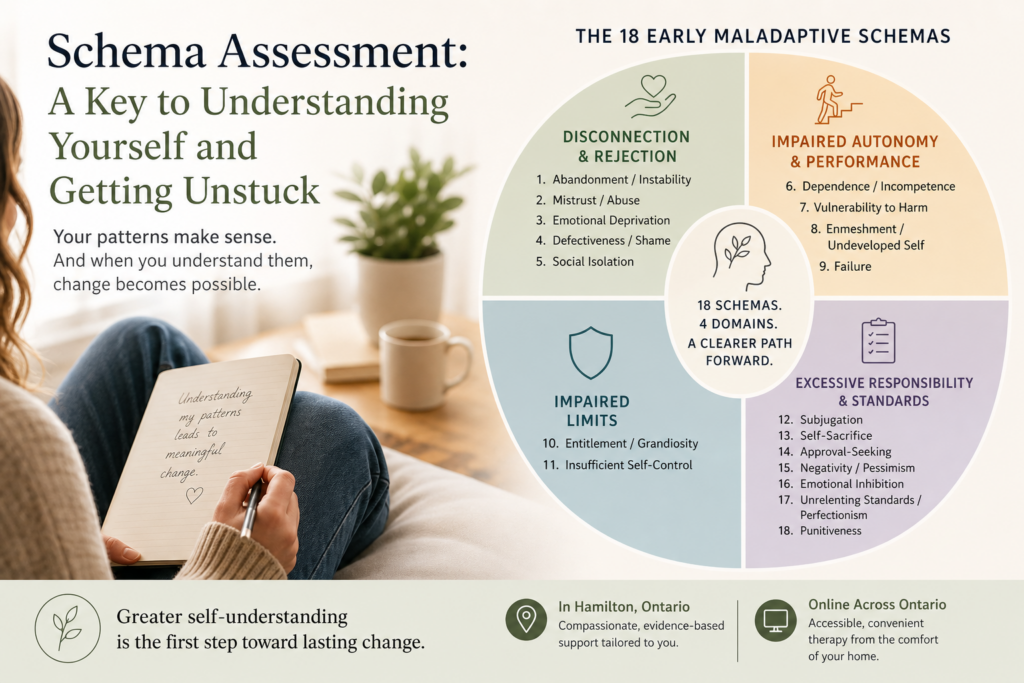
There is also a meaningful connection between early adverse experiences and the development of early maladaptive schemas—deeply ingrained patterns of thinking and feeling about oneself, others, and the world. For example, experiences of neglect or inconsistent caregiving may contribute to schemas related to abandonment, mistrust, or defectiveness. Understanding this link can be an important bridge to schema-focused work, which we explore further in our related blog post on schemas.
The Link Between ACEs and Physical Health
ACEs are also strongly associated with long-term physical health outcomes. Individuals with higher ACE scores have increased risk for a range of chronic conditions, including cardiovascular disease, chronic lung disease, liver disease, and chronic pain (Felitti et al., 1998; Hughes et al., 2017).
This connection is largely explained by the concept of prolonged stress activation. When a child grows up in an environment that is unpredictable, unsafe, or emotionally unsupported, their stress response system is activated more frequently and for longer periods.
Over time, this can lead to “wear and tear” on the body—often referred to as allostatic load—which affects:
• The immune system
• The cardiovascular system
• Hormonal regulation
• Inflammatory processes
These physiological changes help explain why early adversity can have such far-reaching effects on long-term health.
ACEs and Health Behaviours
Another important pathway linking ACEs to later outcomes is through health behaviours. Individuals with higher ACE scores are more likely to engage in behaviours such as smoking, alcohol use, and physical inactivity (Anda et al., 2006).
These behaviours are often misunderstood. Rather than being viewed simply as “poor choices,” they are often coping strategies—ways of managing distress, regulating emotions, or numbing difficult internal experiences.
Recognising this shifts the clinical focus from judgment to understanding, which is essential for effective intervention.
Why We Include ACEs in Our Intake Assessment
Including ACEs in an intake assessment allows us to move beyond surface-level symptoms and understand the broader context of a person’s experiences.
Without this context, it is easy to:
• Focus only on current symptoms without understanding their origins
• Misinterpret coping strategies as pathology
• Miss important relational or developmental patterns
By incorporating ACEs into our assessment process, we can:
• Identify root contributors to current concerns
• Understand long-standing emotional and relational patterns
• Tailor treatment approaches to be trauma-informed
• Integrate approaches such as schema therapy, when relevant
This is one of the reasons why comprehensive psychological assessment is so important. A thorough assessment does not just identify what is happening—it helps clarify why it is happening, which is essential for meaningful and lasting change. This is also why we emphasize assessment as a core part of our services, ensuring that treatment is guided by a deep and accurate understanding of each client’s history and needs.
From Awareness to Intervention
While ACEs are associated with increased risk, they do not determine outcomes. Many individuals with high ACE scores go on to lead healthy, fulfilling lives.
Protective factors play a critical role in shaping resilience, including:
• Supportive relationships
• Access to mental health care
• Opportunities for meaning and connection
• Development of adaptive coping skills
In therapy, understanding ACEs allows us to work more effectively by:
• Processing unresolved experiences
• Building emotional regulation skills
• Challenging unhelpful beliefs and schemas
• Strengthening self-compassion and resilience
This approach moves beyond symptom management toward deeper, more sustainable change.
ACEs as Part of a Comprehensive Assessment Approach
In our practice, ACEs are one component of a broader, evidence-based assessment process. Alongside clinical interviews, standardized measures, and current symptom evaluation, understanding early adverse experiences helps us develop a more complete and nuanced clinical picture.
This ensures that treatment is not only evidence-based, but also personalized, trauma-informed, and aligned with each individual’s unique history and goals.
If you are considering therapy, an initial closer look at your ACES score can be a valuable first step in understanding your experiences and identifying the most effective path forward. CONTACT US today for more information or to set up an appointment.
References
Anda, R. F., Felitti, V. J., Bremner, J. D., Walker, J. D., Whitfield, C., Perry, B. D., Dube, S. R., & Giles, W. H. (2006). The enduring effects of abuse and related adverse experiences in childhood. European Archives of Psychiatry and Clinical Neuroscience, 256(3), 174–186.
Chapman, D. P., Whitfield, C. L., Felitti, V. J., Dube, S. R., Edwards, V. J., & Anda, R. F. (2004). Adverse childhood experiences and the risk of depressive disorders in adulthood. Journal of Affective Disorders, 82(2), 217–225.
Felitti, V. J., Anda, R. F., Nordenberg, D., Williamson, D. F., Spitz, A. M., Edwards, V., Koss, M. P., & Marks, J. S. (1998). Relationship of childhood abuse and household dysfunction to many of the leading causes of death in adults. American Journal of Preventive Medicine, 14(4), 245–258.
Hughes, K., Bellis, M. A., Hardcastle, K. A., Sethi, D., Butchart, A., Mikton, C., Jones, L., & Dunne, M. P. (2017). The effect of multiple adverse childhood experiences on health: A systematic review and meta-analysis. The Lancet Public Health, 2(8), e356–e366.
Prepared by Dr. Jennifer Barbera, PhD, Registered Psychologist
Dr. Jennifer Barbera PhD, C. Psych is a licensed psychologist with over 25 years of counselling experience. She has extensive clinical expertise supporting individuals and couples with anxiety, trauma, depression, addiction, and relationship challenges. Her work combines evidence-based approaches with practical strategies to help clients build resilience and improve well-being.