How to Find WSIB Psychological Assessments in Hamilton & Across Ontario
Comprehensive WSIB Psychological Assessments in Hamilton & Across Ontario: Fast, Accurate, and Compassionate Care
If you’re dealing with a psychological injury related to work such as PTSD, navigating the Workplace Safety and Insurance Board (WSIB) process can feel stressful and overwhelming. One of the most important steps in your claim—and your recovery—is obtaining a comprehensive psychological assessment.
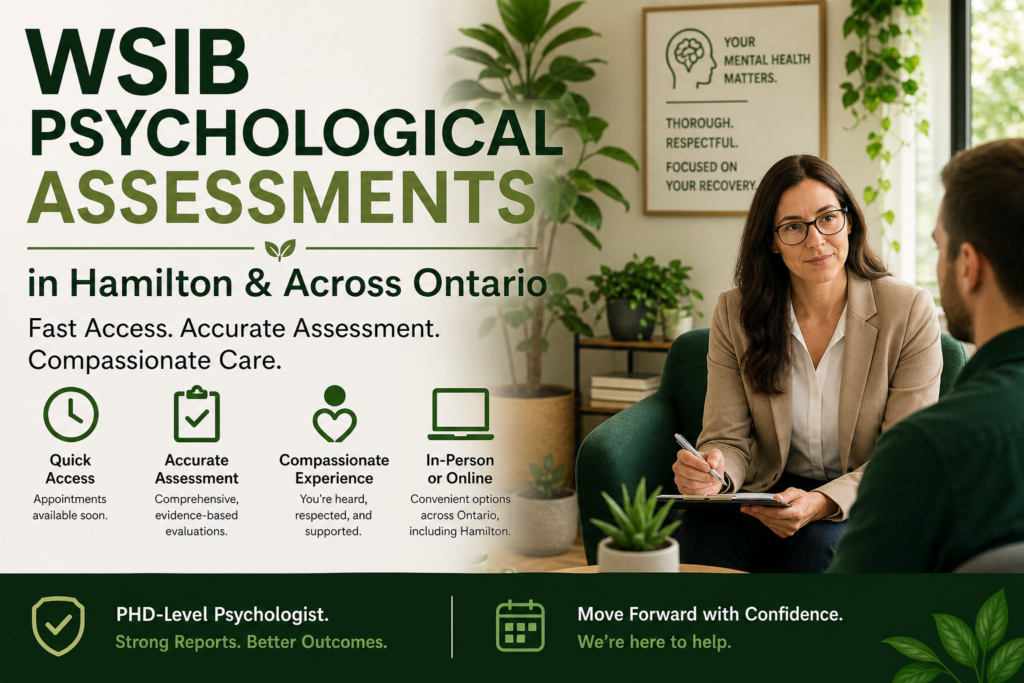
Whether you are searching for a WSIB psychological assessment in Hamilton or looking for a secure online assessment anywhere in Ontario, timely access to a high-quality, PhD-level psychologist can make a meaningful difference in both your clinical outcomes and the strength of your case.
If you are looking to inquire about a WSIB assessment CONTACT US today.
What Is a WSIB Psychological Assessment?
A WSIB psychological assessment is a structured, evidence-based evaluation conducted by a registered psychologist or psychological associate. Its purpose is to:
* Identify the presence and severity of a psychological condition
* Determine whether the condition is related to workplace factors
* Assess functional limitations affecting work capacity
* Provide clear treatment and return-to-work recommendations
These assessments are a key part of the WSIB decision-making process and are often used to guide both entitlement and recovery or treatment planning.
Why Timely, High-Quality Assessments Matter
Delays or incomplete assessments don’t just slow things down—they can actively work against you.
Research shows that workplace psychological injuries are often complex, involving overlapping symptoms such as anxiety, depression, trauma, and chronic pain. Without a thorough assessment, important aspects of a person’s condition can be overlooked, leading to ineffective treatment planning and delayed recovery (Dobson et al., 2025).
At the same time, studies examining injured workers in Ontario highlight that individuals frequently experience gaps in access to appropriate mental health services, which can prolong distress and complicate return-to-work outcomes (Noël et al., 2022).
The impact of delays or low-quality assessments:
* Misdiagnosis or incomplete diagnostic clarity
* Weak or unclear reports that do not support WSIB decision-making
* Delayed access to treatment
* Prolonged disability and reduced likelihood of successful return to work
The benefits of fast, comprehensive assessment:
* Clear, accurate diagnosis
* Strong, defensible reporting
* Faster treatment approval
* More effective and realistic recovery planning
What Makes a Comprehensive WSIB Psychological Assessment?
Not all assessments are equal. A truly comprehensive evaluation—particularly one conducted or overseen by a PhD-level psychologist—goes well beyond basic screening.
1. In-Depth Clinical Interview
A high-quality assessment includes a detailed exploration of:
* Workplace events and their psychological impact
* Symptom development over time
* Personal and medical history (without over-pathologizing)
* Current functioning across work, home, and social settings
2. Standardized Psychological Testing
Evidence-based assessment tools are often used to improve diagnostic accuracy and objectivity. These may evaluate:
* Depression and anxiety symptoms
* Trauma-related symptoms (e.g., PTSD)
* Cognitive functioning and concentration
* Personality patterns and coping styles
3. Functional Capacity Analysis
WSIB decisions rely heavily on function. A strong report clearly outlines:
* What you are currently able to do
* What limitations interfere with work
* What accommodations or supports may be needed
4. Clear, Structured Reporting
The final report must be:
* Clinically sound and evidence-based
* Clearly written for non-clinical readers
* Directly relevant to WSIB criteria and decision-making
Why Choose Services Led by an Experienced PhD-Level Psychologist?
There are clear advantages to working with a PhD-level psychologist, particularly in complex or disputed cases.
These advantages include:
* Advanced training in diagnosis and case formulation
* Expertise in complex presentations (e.g., trauma, chronic pain, comorbidity)
* Stronger medico-legal report writing
* Greater experience supporting WSIB or legal processes
In situations where clarity and credibility matter, that additional depth of training can be critical.
Dr. Barbera PhD C. Psych has been conducting WSIB assessments since 2009 (first under supervision, then autonomously since 2013).
A Compassionate Approach Matters
Let’s be honest: the WSIB process can feel stressful, impersonal, and, at times, invalidating.
Research examining injured workers’ experiences in Ontario found that many individuals reported feeling misunderstood or unsupported during the claims process, highlighting the importance of respectful, client-centered care (Noël et al., 2022).
A high-quality psychological assessment should not add to that burden.
What a compassionate assessment includes:
* A respectful, non-judgmental environment
* Space to fully share your experience
* Clear explanations of the process
* Sensitivity to emotional distress
* A balanced approach that is both objective and humane
Compassion does not compromise objectivity—it enhances the accuracy and depth of the assessment.
WSIB Psychological Assessments in Hamilton and Online Across Ontario
If you’re located in Hamilton, you may be considering local, in-person services. However, many individuals are now choosing secure virtual assessments offered across Ontario.
Benefits of online WSIB psychological assessments:
* Faster access to appointments
* No travel time or commuting stress
* Greater flexibility in scheduling
* Access to an experienced psychologist beyond your immediate area
Virtual assessments, when conducted properly, provide the same clinical rigour and are fully accepted within WSIB processes.
What to Expect: Timeline and Process
A streamlined WSIB psychological assessment process typically includes:
1. Initial intake within a few days
2. Assessment sessions (often 1–2 appointments)
3. Completion of standardized measures
4. Report delivery within approximately 3-10 days
Faster timelines allow you to move forward with both your claim and your recovery without unnecessary delay.
Frequently Asked Questions (FAQ)
How do I get a WSIB psychological assessment in Ontario?
You will typically need a referral from a WSIB case manager.
How long does the assessment take?
The assessment itself may take several hours across one or two sessions. The written report is usually completed within one to two weeks.
Are online assessments accepted by WSIB?
Yes. Virtual assessments conducted by registered psychologists in Ontario using secure platforms are commonly accepted.
What conditions can be assessed?
Common workplace-related psychological conditions include:
* Post-traumatic stress disorder (PTSD)
* Depression
* Anxiety disorders
* Adjustment disorders
* Chronic pain-related psychological conditions
Will the assessment determine if my WSIB claim is approved?
No, the final decision rests with WSIB. However, a clear, well-supported psychological report can significantly influence the outcome.
What should I look for in a provider?
* Experience with WSIB assessments
* PhD-level training (especially for complex cases)
* Timely access to appointments
* Clear, professional reporting
* A compassionate, client-centered approach
Next Steps
If you’re searching for a WSIB psychological assessment in Hamilton or anywhere in Ontario, the goal isn’t just to “get assessed.” It’s to get assessed well—and without delay.
Prioritize:
* Quick access, so your recovery isn’t stalled
* Accurate, comprehensive evaluation, so your condition is fully understood
* A compassionate experience, so you feel supported throughout the process
Those elements don’t just improve your experience—they directly impact your recovery and your path forward. CONTACT US today to ask about availability.
References
Dobson, K. G., Chien, Y.-C., Carnide, N., Furlan, A. D., & Smith, P. M. (2025). Uncovering mental health profiles of workers with a physically disabling injury or illness using the complete state mental health framework. Journal of Occupational Rehabilitation, 35, 929–944.
Edgelow, M., Brar, S., & Fecica, A. (2023). Workers’ compensation usage and return-to-work outcomes for Ontario public safety personnel with mental stress injury claims: 2017–2021. Frontiers in Organizational Psychology, 1, Article 1133501.
Herring, M. G., Martin, L., & Kristman, V. L. (2021). Characteristics and needs of persons admitted to an inpatient psychiatric hospital with workers’ compensation coverage. Frontiers in Psychiatry, 12, Article 657699.
Noël C, Scharf D, Hawkins J, Lund J, Kozik J, Péfoyo Koné A. Experiences, impacts and service needs of injured and ill workers in the WSIB process: evidence from Thunder Bay and District (Ontario, Canada). Health Promot Chronic Dis Prev Can. 2022 Jul;42(7):272-287.
Prepared by Dr. Jennifer Barbera, PhD, Registered Psychologist
Dr. Jennifer Barbera PhD, C. Psych is a licensed psychologist with over 25 years of counselling experience. She has extensive clinical expertise supporting individuals and couples with anxiety, trauma, depression, addiction, and relationship challenges. She has been working with WSIB-referred individuals since 2009. Her work combines evidence-based approaches with practical strategies to help clients build resilience and improve well-being.