Stress vs Anxiety: How to Tell the Difference
Learn the difference between stress and anxiety, how to tell what you’re experiencing, and how therapy can help manage stress and reduce anxiety symptoms.
Stress vs Anxiety: How to Tell the Difference and When Therapy Can Help
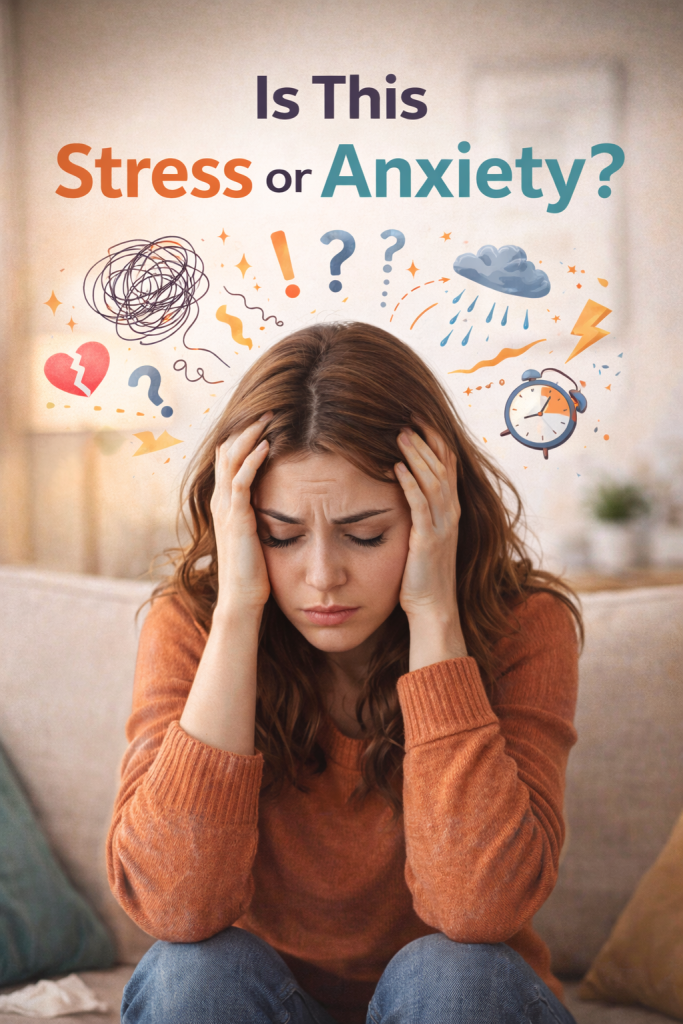
Many people ask, “Is this just stress, or is it anxiety?” The two are closely related and often overlap, but they are not the same. Understanding the difference between normal stress and anxiety can help you respond more effectively, reduce unnecessary self-criticism, and know when professional support may be helpful.
Searches for stress vs anxiety, how to tell if I have anxiety, and when to seek therapy for stress continue to rise as more people struggle with chronic pressure, uncertainty, and emotional overload.
What Is Stress?
Stress is a natural and expected response to demands, challenges, or change. It is usually linked to an identifiable external situation, such as work deadlines, relationship conflict, financial pressure, health concerns, or major life transitions.
Stress activates the nervous system to help you focus, problem-solve, and take action. In manageable doses, stress can even be motivating.
Common signs of stress include:
• Feeling overwhelmed or pressured
• Tension in the body, headaches, or fatigue
• Irritability or short temper
• Trouble concentrating
• Temporary sleep disruption
Importantly, stress typically decreases once the situation resolves or when demands lessen. The question your system is asking during stress is: “How do I handle this?”
What Is Anxiety?
Anxiety involves a persistent sense of threat or worry that continues even when there is no immediate danger. While anxiety can be triggered by stress, it often becomes internally driven rather than situation-specific.
Anxiety is more about anticipation than response. The nervous system remains on high alert, scanning for what could go wrong (Grupe, & Nitschke, 2013).
Common signs of anxiety include:
• Excessive or constant worry
• Feeling on edge, restless, or keyed up
• Racing thoughts or catastrophic thinking
• Tight chest, shortness of breath, or nausea
• Difficulty sleeping due to mental overactivity
• Avoidance of situations that trigger fear
Unlike stress, anxiety does not reliably turn off when the external situation improves. The underlying question becomes: “What if something bad happens?”
Key Differences Between Stress and Anxiety
Stress is usually tied to a specific external pressure, while anxiety persists even without a clear cause. Stress tends to feel time-limited and situational; anxiety feels ongoing and harder to control.
Stress often motivates action, whereas anxiety can lead to paralysis, avoidance, or constant mental looping. Stress responses usually settle with rest or resolution, while anxiety often requires intentional intervention.
That said, chronic stress can evolve into anxiety if the nervous system never gets a chance to reset (McEwen, 2007).
How to Tell If This Is Normal Stress or Anxiety
Ask yourself the following questions:
• Does my distress ease when the situation improves?
• Can I relax once tasks are done, or does my mind stay activated?
• Is my worry proportional to the situation, or does it spiral?
• Am I avoiding things because of fear rather than lack of time or energy?
• Has this been going on for weeks or months?
If your symptoms are short-term, situational, and improve with rest or support, you are likely dealing with normal stress. If they are persistent, intrusive, and interfering with daily life, anxiety may be playing a larger role.
Neither response means something is “wrong” with you. Both are signals from your nervous system that support is needed.
Why Stress and Anxiety Are Often Misunderstood
Many people minimize anxiety by calling it stress, or blame themselves for not “handling stress better.” Others assume anxiety means weakness or overreaction. In reality, both stress and anxiety are adaptive responses shaped by life experience, environment, and nervous system learning.
Ignoring the difference can lead to coping strategies that don’t work, such as trying to think your way out of anxiety or pushing harder through burnout-level stress.
How Therapy Can Help With Stress and Anxiety
Therapy is not only for crisis or severe symptoms. It is one of the most effective ways to learn how your nervous system responds to pressure and how to work with it rather than against it.
For stress, therapy can help you:
• Identify sources of overload and unrealistic expectations
• Develop boundaries and pacing skills
• Improve emotional regulation and recovery
• Prevent chronic stress from turning into anxiety or burnout
For anxiety, therapy can help you:
• Understand fear patterns and triggers
• Reduce avoidance and mental looping
• Build tolerance for uncertainty
• Retrain the nervous system’s threat response
Approaches such as cognitive behavioural therapy (CBT), Acceptance and Commitment Therapy (ACT), and trauma-informed therapies can address both stress management and anxiety symptoms in an integrated way.
Stress and Anxiety Are Signals, Not Failures
Both stress and anxiety are forms of communication from your system. They are asking for adjustment, support, or change—not self-judgment.
Learning the difference allows you to respond appropriately, whether that means practical problem-solving, nervous system regulation, or deeper therapeutic work.
If stress feels unrelenting or anxiety is shaping your choices, seeking therapy can help you regain clarity, balance, and a sense of agency. You do not need to wait until things are unbearable to benefit from support. Contact us today.
References
Grupe, D. W., & Nitschke, J. B. (2013). Uncertainty and anticipation in anxiety: An integrated neurobiological and psychological perspective. Nature Reviews Neuroscience, 14(7), 488–501.
McEwen, B. S. (2007). Physiology and neurobiology of stress and adaptation: Central role of the brain. Physiological Reviews, 87(3), 873–904.
Prepared by Dr. Jennifer Barbera, PhD, Registered Psychologist
Dr. Jennifer Barbera PhD, C. Psych is a licensed psychologist with over 25 years of counselling experience. She has extensive clinical expertise supporting individuals and couples with anxiety, trauma, depression, addiction, and relationship challenges. Her work combines evidence-based approaches with practical strategies to help clients build resilience and improve well-being.