How to Reduce Burnout By Addressing Perfectionism
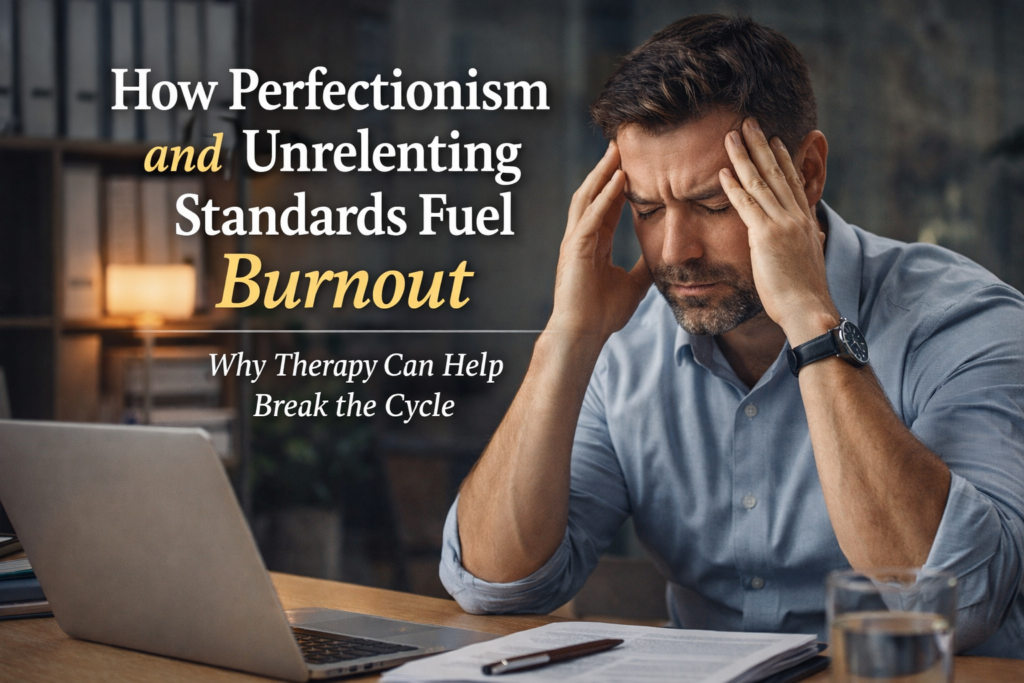
Learn how perfectionism and unrelenting standards contribute to burnout and discover evidence‑based strategies to restore balance, energy, and well‑being.
Understanding Burnout Beyond “Being Busy”
Burnout is more than fatigue after a long week—it’s a state of emotional, mental, and physical exhaustion brought on by chronic stress (Maslach & Leiter, 2016). In clinical terms, burnout often involves emotional depletion, growing cynicism or detachment, and a reduced sense of personal effectiveness. While workplace demands are often emphasized, internal pressures like ingrained beliefs about performance are equally influential.
Many people experiencing burnout appear successful on the outside. They’re often highly capable, committed, and diligent. Yet, beneath that competence can lie an internal pattern—a schema—that relentlessly pushes them to perform beyond sustainable limits.
The Hidden Driver: Perfectionism and Unrelenting Standards
Perfectionism isn’t simply wanting to do well—it’s a psychological pattern where anything short of flawless feels unacceptable. A key internal driver for many is the unrelenting standards schema, a concept rooted in schema therapy that describes deeply held beliefs about needing to meet extremely high expectations (Young, Klosko, & Weishaar, 2003).
Research consistently shows that perfectionism is associated with elevated stress and burnout. For instance, Hill et al. (2010) found that self‑oriented perfectionism predicts burnout symptoms across several domains of life. These patterns include:
• Setting excessively high personal standards
• Feeling chronic pressure to be productive
• Struggling to relax without guilt
• Tying worth to performance
• Focusing more on what’s left to do than what’s already done
On the surface, this pattern may look like success. Over time, however, these internal drivers accelerate burnout because they reinforce constant striving without restorative rest.
How Perfectionism Fuels Burnout
The connection between perfectionism and burnout is structural.
First, perfectionism expands workload. When “good enough” is never enough, even simple tasks inflate into prolonged efforts, increasing stress and prolonging completion times (Suh et al., 2022).
Second, perfectionism keeps the nervous system in chronic activation—rest becomes uncomfortable rather than calming.
Third, perfectionism fosters self‑criticism over self‑recognition, magnifying perceived shortcomings and devaluing achievements.
Finally, it compromises true recovery; even during breaks, the perfectionistic mind often reviews, plans, or worries, preventing genuine mental rest.
Why “Just Relaxing” Doesn’t Work
Common advice for burnout—like “take a break” or “practice self‑care”—misses the deeper issue when perfectionism drives distress. If your internal schema links self‑worth to constant productivity, rest may trigger anxiety or guilt. You might think:
• “I should be doing something more useful right now.”
• “I can’t relax until everything is done.”
• “If I slow down, I’ll fall behind.”
Without addressing these internal schemas, temporary relief tends to fade quickly.
Recognizing the Pattern in Yourself
Burnout linked to perfectionism and unrelenting standards often shows up as:
• Difficulty stopping work even when exhausted
• Feeling “behind” despite adequate performance
• Avoiding tasks due to fear they won’t meet high standards
• Irritability or emotional numbness
• Loss of satisfaction in achievements
These patterns can look like high‑functioning burnout, where external functioning seems intact but internal strain is substantial (Maslach & Leiter, 2016). Examining whether an unrelenting standards schema drives these tendencies is an important step toward meaningful change.
Shifting from Perfectionism to Sustainability
Reducing burnout requires shifting your relationship with standards, effort, and identity. Start by redefining “good enough”: this doesn’t mean lowering values, but aligning effort with task importance. Practice intentionally incomplete action—finishing tasks at 80–90% can help retrain tolerance for “enough” rather than “perfect.”
Develop self‑observation instead of self‑criticism. When you notice perfectionistic urges, pause and ask: What’s driving this right now? Fear? Habit? Pressure? Awareness creates space for choice. Plan structured recovery into your routine—rest should not be something you have to “earn,” but a planned and protected part of your day. Finally, begin separating identity from output: your worth is not determined by how much you accomplish.
These shifts align with evidence that cognitive and schema‑focused strategies help reduce the stress associated with internalized perfectionistic standards (Flett & Hewitt, 2002).
When to Seek Support
If these patterns feel deeply rooted, you’re not alone. Schema‑focused and evidence‑based therapies can help identify the origins of unrelenting standards and support the development of more adaptive ways of relating to yourself and your work. Breaking the cycle of perfectionism and burnout isn’t about becoming less driven—it’s about cultivating sustainability. Read more about preventing burnout.
If you’re ready to move from constant pressure to a balanced, grounded approach to living and working, we invite you to CONTACT US today to begin that shift with support tailored to your life.
Start Your Path to Better Balance and Improved Well-Being
Perfectionism may be rewarded in the short term, making its long‑term cost easy to overlook. Burnout is not a sign of weakness—it’s a signal that internal patterns like unrelenting standards need attention. By challenging these schemas and creating space for flexibility, rest, and self‑compassion, you’re not lowering the bar—you’re building a life you can sustain.
References
Flett, G. L., & Hewitt, P. L. (2002). Perfectionism and maladjustment: An overview of theoretical, definitional, and treatment issues. In G. L. Flett & P. L. Hewitt (Eds.), Perfectionism: Theory, research, and treatment (pp. 5–31). American Psychological Association.
Hill, A. P., Hall, H. K., & Appleton, P. R. (2010). Perfectionism and burnout in competitive athletes: Mediating role of coping strategies. The Sport Psychologist, 24(1), 12–34.
Maslach, C., & Leiter, M. P. (2016). Understanding the burnout experience: Recent research and its implications for psychiatry. World Psychiatry, 15(2), 103–111.
Suh H, Liou PY, Jeong J, Kim SY. Perfectionism, Prolonged Stress Reactivity, and Depression: A Two-Wave Cross-Lagged Analysis. J Ration Emot Cogn Behav Ther. 2022 Nov 7:1-15.
Young, J. E., Klosko, J. S., & Weishaar, M. E. (2003). Schema therapy: A practitioner’s guide. Guilford Press.
Prepared by Dr. Jennifer Barbera, PhD, Registered Psychologist
Dr. Jennifer Barbera PhD, C. Psych is a licensed psychologist with over 25 years of counselling experience. She has extensive clinical expertise supporting individuals and couples with anxiety, trauma, depression, addiction, and relationship challenges. Her work combines evidence-based approaches with practical strategies to help clients build resilience and improve well-being.