How to Get an ADHD Assessment in Hamilton & Ontario
How to Get an ADHD Assessment in Hamilton & Ontario (2026 Guide: Costs, Wait Times, and What to Expect) If you’ve been wondering whether your struggles with focus, procrastination, or…

Learn how Acceptance and Commitment Therapy (ACT) helps ADHD by improving focus, emotional regulation, and values-driven behaviour with practical strategies and research-backed insights.
If you’re still figuring out whether ADHD is part of the picture, you might start with foundational resources like ADHD in adults: symptoms, causes and practical strategies that actually help or ADHD assessment in Ontario: what happens step-by-step can clarify what to expect.
Attention-Deficit/Hyperactivity Disorder (ADHD) is often described in terms of inattention, impulsivity, and disorganization—but that framing can be misleading. Many individuals with ADHD don’t lack knowledge or ability; they struggle with consistent, flexible action when faced with distraction, overwhelm, or internal discomfort.
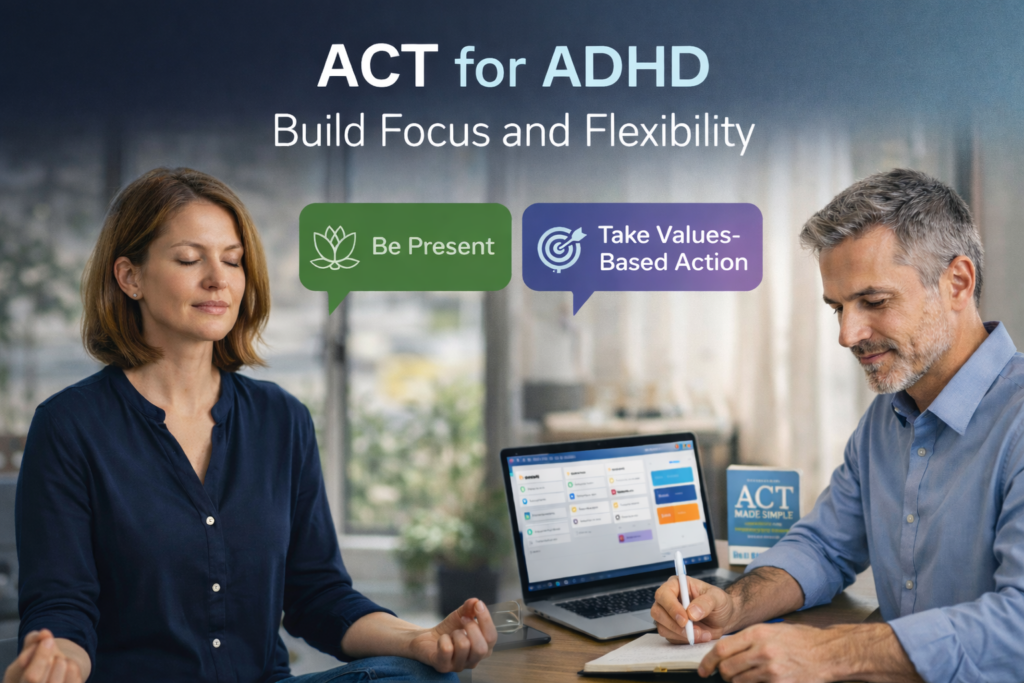
This is where Acceptance and Commitment Therapy (ACT) offers something different. Rather than trying to “fix” thoughts or eliminate distractions, ACT helps people build psychological flexibility—the ability to stay present and take meaningful action even when the mind is busy.
ACT focuses on six core processes:
• Acceptance
• Cognitive defusion
• Present-moment awareness
• Self-as-context
• Values clarification
• Committed action
Instead of challenging or replacing thoughts, ACT teaches individuals to change their relationship with them.
As Dr. Russ Harris explains in his work, the goal is not to feel better all the time—it’s to live better, even when difficult thoughts and feelings show up.
ADHD-related challenges often overlap with other experiences, which can make things confusing. For example, difficulty concentrating might be ADHD, anxiety, burnout—or a mix of all three. If that’s something you’re sorting through, ADHD versus anxiety: why they feel the same (how to tell the difference) and Do I have ADHD or am I just burnt out? How modern life affects focus and executive function can help you tease apart those differences.
From an ACT perspective, ADHD can involve:
• Getting pulled away by internal distractions (thoughts, urges, emotions)
• Avoiding tasks that feel boring or overwhelming
• Acting quickly to reduce discomfort (impulsivity)
• Losing sight of long-term values in the moment
This isn’t about a lack of effort—it’s about how the mind interacts with behaviour under pressure.
Cognitive Defusion: Getting Unhooked from Thoughts
ADHD often comes with fast, convincing thoughts:
• “This is too boring”
• “I’ll do it later”
• “I just can’t focus today”
ACT teaches defusion—stepping back from thoughts instead of automatically obeying them.
For example:
• “I’m noticing the thought that this is too boring.”
This creates just enough distance to choose your next move more intentionally. To learn more, read Using ACT and Cognitive Defusion to Improve Negative Thinking.
Avoidance fuels many ADHD challenges. When something feels tedious or frustrating, it’s natural to delay.
ACT shifts the goal:
• Not “How do I get rid of this feeling?”
• But “Can I make room for this feeling and still take action?”
This reduces the constant internal battle that drains energy. To learn more read Radical Acceptance for Anxiety and Well-being.
Mindfulness is one of ACT’s most practical tools for ADHD.
Simple practices include:
• Brief check-ins with your breath
• Noticing when your attention drifts
• Gently bringing it back without self-criticism
Over time, this strengthens attentional control in a realistic, repeatable way. To learn more read Mindfulness: A Path to Inner Peace and Well-being.
External pressure (deadlines, expectations) often isn’t enough to sustain focus for people with ADHD.
ACT builds motivation from the inside out by clarifying values:
• What kind of person do you want to be?
• What matters in your relationships, work, and daily life?
When tasks are connected to values, they become more meaningful—and easier to engage with.
Many people with ADHD know exactly what they should do—but struggle to follow through.
ACT helps by:
• Breaking tasks into small, doable steps
• Encouraging action even when motivation is low
• Prioritizing consistency over perfection
If you’re looking for additional practical strategies, 20 effective tips for managing ADHD offers complementary tools that pair well with ACT.
ACT works best alongside other supports, such as:
• Medication
• Executive functioning tools
• Behavioural strategies
• Psychoeducation
For a broader overview of these approaches, ADHD in adults: symptoms, causes and practical strategies that actually help is a helpful companion resource.
ACT doesn’t replace other strategies and resources—it helps you stick with them, especially when things get difficult.
Research on ACT and related mindfulness-based approaches for ADHD is growing:
• ACT-based interventions have been linked to improvements in attention and behavioural regulation (Mitchell et al., 2013).
• Psychological flexibility is associated with better emotional regulation and functioning (Knouse & Zvorsky, 2016).
• Mindfulness-based approaches show moderate effectiveness in reducing ADHD symptoms (Cairncross & Miller, 2016).
While more research is still needed, the existing evidence supports ACT as a valuable addition to ADHD treatment.
To start applying ACT principles:
These skills take practice—but they create lasting change.
If ADHD symptoms are affecting your daily life, relationships, or sense of direction, therapy can help you move forward more effectively. ACT offers a structured, compassionate way to build focus, resilience, and meaningful action.
If you’re ready to shift from feeling stuck to taking purposeful steps, we invite you to CONTACT US today and explore how ACT-informed therapy can support your goals.
Cairncross, M., & Miller, C. J. (2016). The effectiveness of mindfulness-based therapies for ADHD: A meta-analytic review. Journal of Attention Disorders, 20(7), 558–571.
Hayes, S. C., Strosahl, K. D., & Wilson, K. G. (2012). Acceptance and commitment therapy: The process and practice of mindful change (2nd ed.). Guilford Press.
Harris, R. (2009). ACT made simple: An easy-to-read primer on acceptance and commitment therapy. New Harbinger Publications.
Knouse, L. E., & Zvorsky, I. (2016). Mindfulness-based interventions for ADHD. Current Attention Disorders Reports, 8(1), 2–11.
Mitchell, J. T., Zylowska, L., & Kollins, S. H. (2013). Mindfulness meditation training for attention-deficit/hyperactivity disorder in adulthood: Current empirical support, treatment overview, and future directions. Cognitive and Behavioral Practice, 22(2), 172–191.
Prepared by Dr. Jennifer Barbera, PhD, Registered Psychologist
Dr. Jennifer Barbera PhD, C. Psych is a licensed psychologist with over 25 years of counselling experience. She has extensive clinical expertise supporting individuals and couples with anxiety, trauma, depression, addiction, and relationship challenges. Her work combines evidence-based approaches with practical strategies to help clients build resilience and improve well-being.