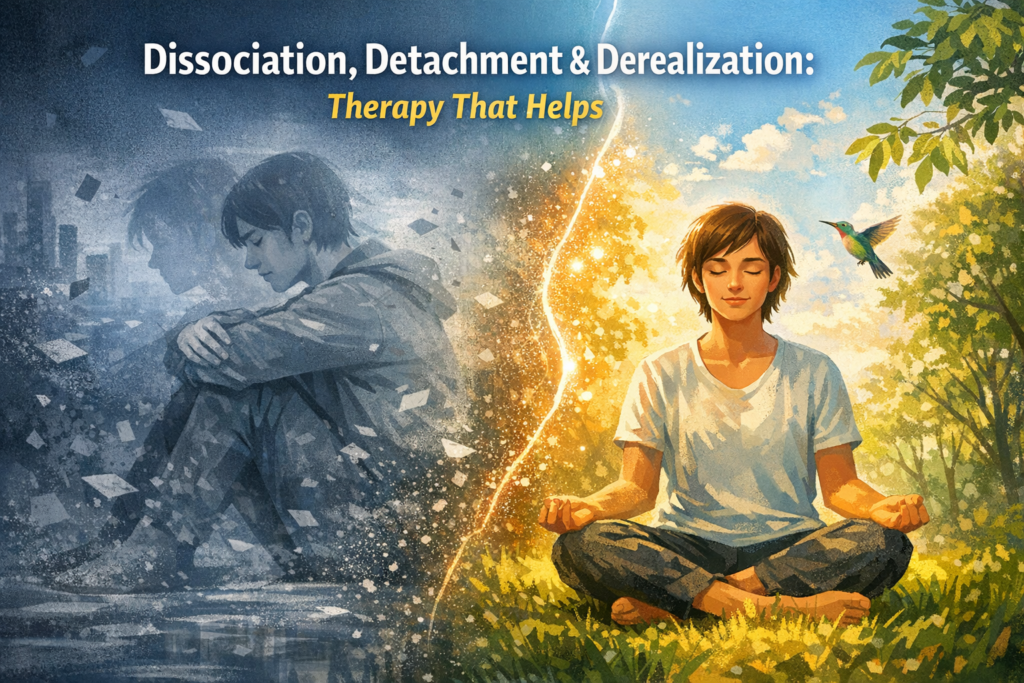
What causes emotional numbness or detachment and how to heal
Learn the differences between dissociation, detachment, and derealization, and how ACT therapy, mindfulness, and psychological flexibility can help you reconnect with the present moment.
Dissociation, Detachment & Derealization Explained
Many people who struggle with anxiety, trauma, or chronic stress describe a confusing experience: “I feel disconnected from myself or the world.” They may say things feel unreal, distant, foggy, or dreamlike.
In psychology, these experiences are often described using terms like dissociation, detachment, depersonalization, and derealization. While these words are related, they describe slightly different ways the mind attempts to cope when stress or overwhelm becomes too intense.
Understanding the differences can help people feel less frightened by these experiences—and can also guide effective therapy. Increasingly, therapists are using Acceptance and Commitment Therapy (ACT) to help people reconnect with the present moment through mindfulness, acceptance, and psychological flexibility skills.
What Is Dissociation?
Dissociation is an umbrella term for experiences in which normally integrated psychological processes—such as awareness, memory, identity, or perception—become temporarily disconnected.
In simple terms, dissociation is the mind’s way of pulling away from experience when something feels overwhelming, threatening, or emotionally intense.
Dissociation can occur on a spectrum. At the mild end, people may briefly “zone out” while driving or reading. At the more intense end, dissociation can involve feeling detached from one’s body, emotions, or surroundings, or even losing time.
Psychologists often describe dissociation as involving several different processes, including:
• Detachment – feeling separated from oneself or the world
• Depersonalization – feeling detached from one’s body or sense of self
• Derealization – feeling detached from the external world
These experiences can occur during periods of high anxiety, trauma reminders, panic, or emotional overwhelm.
Importantly, dissociation is not a sign that someone is “going crazy.” In many cases, it is the nervous system attempting to protect the person from emotional overload.
What Is Detachment?
In clinical psychology, detachment refers to a feeling of disconnection from one’s internal experiences or surroundings.
This can include:
• Feeling emotionally numb
• Feeling distant from one’s body
• Experiencing thoughts or emotions as if they are far away
• Feeling like you are observing life rather than participating in it
Detachment is often considered a type of dissociative experience, and it frequently includes depersonalization or derealization symptoms.
While uncomfortable, detachment is often the nervous system’s attempt to reduce emotional intensity when stress becomes overwhelming.
What Is Depersonalization?
Depersonalization refers specifically to feeling detached from oneself.
People experiencing depersonalization may describe:
• Feeling like they are observing themselves from outside their body
• Feeling robotic or on autopilot
• Feeling disconnected from their emotions
• Experiencing their body as unfamiliar or unreal
Researchers describe depersonalization as a sense of unreality or detachment from one’s thoughts, feelings, sensations, or body.
Even though the experience can feel frightening, people usually remain aware that the feeling is unusual, which helps distinguish it from psychotic experiences.
What Is Derealization?
Derealization refers to feeling detached from the external world rather than from oneself.
People often describe:
• The world feeling foggy, flat, or dreamlike
• Colours or sounds feeling distorted
• Other people seeming distant or unreal
• A sense of being behind a glass wall or watching life through a screen
Clinically, derealization is defined as a sense of unreality or detachment from one’s surroundings, where the environment may appear dreamlike, artificial, or visually distorted.
Like depersonalization, individuals usually recognize that the experience is a perceptual distortion rather than reality.
Why Do Dissociative Experiences Happen?
Dissociation is often linked to stress, trauma, or anxiety.
When the nervous system becomes overwhelmed, the brain may temporarily shift into protective modes such as:
• emotional numbing
• attentional narrowing
• perceptual detachment
This can reduce emotional pain in the moment, but when dissociation becomes frequent or persistent, it can interfere with daily functioning.
Research suggests dissociation may also involve disruptions in how the brain integrates sensory signals from the body and environment, which can contribute to feelings of detachment from the self or world.
The good news is that therapy can help people learn skills to reconnect with their experiences safely and gradually.
How ACT Therapy Helps with Dissociation and Detachment
Acceptance and Commitment Therapy (ACT) offers a powerful framework for working with dissociation, detachment, and derealization.
Rather than trying to eliminate uncomfortable experiences, ACT focuses on building psychological flexibility—the ability to stay present, open, and engaged with life even when difficult thoughts or sensations arise.
Several ACT processes are particularly helpful.
1. Mindfulness and Present-Moment Awareness
Mindfulness skills help individuals reconnect with the here and now.
Dissociation often involves a disconnection from present sensory experience. Mindfulness practices gently train attention to return to:
• breathing
• bodily sensations
• sounds and sights in the environment
• physical grounding
Research suggests that mindfulness skills are associated with lower levels of dissociation, partly because they improve attention regulation and emotional acceptance. 
Over time, these practices can strengthen a person’s ability to remain present during stressful moments rather than automatically disconnecting.
2. Acceptance of Internal Experiences
One of the paradoxes of dissociation is that the harder people try to suppress uncomfortable sensations, the more disconnected they may feel.
ACT helps individuals practice acceptance—allowing thoughts, emotions, and sensations to exist without fighting them.
Instead of pushing away anxiety or numbness, therapy helps people learn to:
• notice sensations
• make space for them
• allow them to rise and fall naturally
This reduces the need for the mind to “escape” through dissociation.
3. Cognitive Defusion
ACT also teaches defusion skills, which help people step back from thoughts rather than becoming overwhelmed by them.
For example, instead of thinking:
“Something is wrong with me.”
ACT encourages noticing:
“I’m having the thought that something is wrong with me.”
This subtle shift reduces the emotional intensity of distressing thoughts and allows individuals to remain more grounded in the present.
4. Values and Reconnection with Life
Finally, ACT helps people reconnect with what matters most to them—their values.
Dissociation often creates a sense of distance from life. Values-based action helps restore a sense of direction and engagement.
Even small steps—such as connecting with loved ones, engaging in meaningful activities, or pursuing personal goals—can gradually rebuild a sense of presence and vitality.
Therapy for Dissociation Can Help You Reconnect
Experiences like detachment, depersonalization, or derealization can feel unsettling, but they are also understandable responses of the nervous system when stress or trauma becomes overwhelming.
With the right support, many people learn to understand these experiences and develop skills to reconnect with the present moment.
Therapy approaches such as ACT focus on strengthening mindfulness, acceptance, and psychological flexibility so that individuals can gently re-engage with their thoughts, emotions, and surroundings.
If you or someone you care about is struggling with dissociation or feelings of unreality, we invite you to contact us today to learn how therapy can help you reconnect with yourself and your life.
Frequently Asked Questions
Is dissociation the same as derealization?
Not exactly. Dissociation is an umbrella term for experiences where awareness or perception becomes disconnected. Derealization is a specific type of dissociation in which the external world feels unreal or dreamlike.
What causes feelings of detachment from reality?
Detachment can occur during periods of intense stress, anxiety, trauma, panic, or emotional overwhelm. It is often the nervous system’s way of temporarily protecting the mind from distress.
Can therapy help with derealization or dissociation?
Yes. Many therapy approaches can help, particularly treatments that build grounding and emotional regulation skills. Acceptance and Commitment Therapy (ACT), mindfulness practices, DBT and trauma-informed therapy can help individuals reconnect with their thoughts, emotions, and environment.
How does mindfulness help dissociation?
Mindfulness strengthens attention and awareness of present-moment experiences, such as breathing, body sensations, and surroundings. This can gently reduce the sense of disconnection that occurs during dissociation.
References
D’Antoni, F., Feruglio, S., & Matiz, A. (2022). Mindfulness meditation leads to increased dispositional mindfulness and interoceptive awareness linked to a reduced dissociative tendency. Journal of Trauma & Dissociation, 23(1).
Hunter, E. C. M., Sierra, M., & David, A. S. (2004). The epidemiology of depersonalisation and derealisation. Social Psychiatry and Psychiatric Epidemiology, 39(1), 9–18.
Millman, L. S. M., Hunter, E. C. M., Terhune, D. B., & Orgs, G. (2023). Online structured dance/movement therapy reduces bodily detachment in depersonalization-derealization disorder. Complementary Therapies in Clinical Practice, 51, 101749.
Vancappel, A., Hingray, C., Reveillere, C., & El-Hage, W. (2024). Disentangling the link between mindfulness and dissociation in PTSD: The mediating role of attention and emotional acceptance. Journal of Trauma & Dissociation, 25(1), 30–44.
Van der Kolk, B. A. (2014). The body keeps the score: Brain, mind, and body in the healing of trauma. Viking.
Prepared by Dr. Jennifer Barbera, PhD, Registered Psychologist
Dr. Jennifer Barbera PhD, C. Psych is a licensed psychologist with over 25 years of counselling experience. She has extensive clinical expertise supporting individuals and couples with anxiety, trauma, depression, addiction, and relationship challenges. Her work combines evidence-based approaches with practical strategies to help clients build resilience and improve well-being.