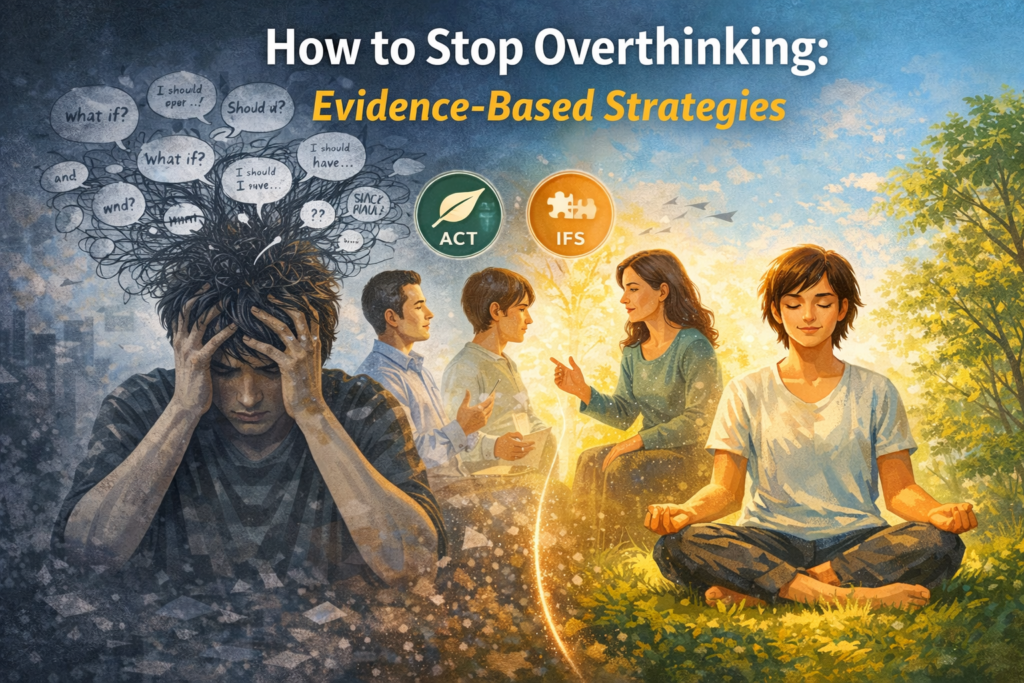
How to Stop Overthinking: Evidence-Based Strategies
Discover why you overthink everything and how ACT and IFS therapy, combined with understanding temperament and schemas, can reduce rumination and self-doubt.
Do you ever find yourself asking, “Why do I overthink everything?” Overthinking—also called rumination—is when the mind repeatedly cycles through worries, doubts, or “what if” scenarios without reaching a solution.
While occasional reflection can be helpful, persistent rumination is associated with heightened anxiety, depression and even emotion regulation challenges. Learning to manage overthinking is crucial for mental health, emotional resilience, and overall wellbeing.
What Is Rumination and Why Address It?
Rumination involves repetitive thinking focused on negative emotions, self-doubt, or perceived mistakes. It can trap you in cycles of worry and indecision, and often amplifies stress rather than solving problems. Persistent overthinking affects sleep, concentration, decision-making, and relationships. Understanding its roots is the first step in addressing it effectively.
Factors That Contribute to Overthinking
Inherited Temperament and Personality Traits
Some people are naturally more sensitive to stress, prone to worry, or highly conscientious. Conscientiousness, for instance, is a trait associated with diligence, self-discipline, and attention to detail. While these qualities can be strengths, in combination with high anxiety or fear of making mistakes, conscientious individuals can be more prone to rumination.
Experiences Growing Up and Unmet Needs
Early life experiences shape how we interpret and respond to stress. Children who grow up with inconsistent caregiving, overcritical environments, or high expectations may internalize schemas such as:
• Vulnerability to harm – believing the world is unsafe
• Fear of losing control – needing to manage outcomes rigidly
• Unrelenting standards / perfectionism – feeling they must always perform flawlessly
These schemas can intensify self-doubt, worry, and repetitive thinking, creating a perfect storm for overthinking in adulthood.
The Role of Self-Doubt and Rumination
Schemas rooted in unmet needs or early stress can fuel persistent rumination. People who overthink often replay past interactions, anticipate negative outcomes, or second-guess their decisions. Over time, this becomes automatic, reinforcing patterns of worry and reducing confidence in one’s ability to act.
How ACT Can Help Reduce Overthinking
Acceptance and Commitment Therapy (ACT) offers strategies to break the cycle of rumination by building psychological flexibility. ACT teaches:
• Mindfulness and present-moment awareness – noticing thoughts without getting trapped in them
• Acceptance – allowing uncomfortable thoughts or emotions to exist without fighting them
• Cognitive defusion – observing thoughts as mental events rather than facts
• Values-based action – engaging in meaningful activities despite worrying thoughts
By practising these skills, individuals learn to notice overthinking without being pulled in, reducing the emotional intensity of rumination.
How IFS Supports Addressing Overthinking
Internal Family Systems (IFS) therapy complements ACT by helping individuals unblend from parts of themselves that fuel rumination. In IFS:
• Overthinking is often driven by “protective parts” trying to prevent harm, failure, or criticism
• These parts may be linked to early unmet needs or internalized perfectionist standards
• By gently acknowledging and understanding these parts, clients can reduce conflict and self-criticism, creating space for more adaptive coping
Combining ACT and IFS provides a powerful toolkit: ACT teaches practical skills to observe and defuse rumination, while IFS addresses the internal dynamics that drive repetitive thoughts.
Practical Steps to Reduce Overthinking:
1. Notice the pattern – Track when and what you overthink
2. Label your thoughts – Use defusion techniques (“I am having the thought that…”)
3. Practice mindfulness – Focus on the present moment using breath, body, or sensory cues
4. Engage your values – Take small actions aligned with what matters most to you
5. Dialogue with parts – In IFS, identify which part is overthinking and acknowledge its protective intent
6. Self-compassion – Avoid self-criticism for overthinking; it often strengthens rumination
Over time, these strategies can retrain your mind to reduce the grip of rumination, increase self-confidence, and allow for more intentional action.
When to Seek Therapy
If overthinking interferes with work, relationships, or daily functioning, therapy can provide structured support and evidence-based strategies. Integrating ACT and IFS approaches allows clients to address both the thoughts themselves and the internal patterns driving them.
Overthinking is not a personal failing—it is a learned pattern reinforced by temperament, upbringing, and internalized standards. With guidance, it can be unlearned.
If you find yourself stuck in endless loops of self-doubt or worry, we invite you to contact us today to explore how therapy can help you break free from rumination and regain clarity and confidence in your life.
Frequently Asked Questions (FAQ)
What does it mean to overthink or ruminate?
Overthinking, or rumination, is when your mind repeatedly cycles through worries, doubts, or “what if” scenarios without reaching a solution. Unlike occasional reflection, persistent rumination can increase stress, anxiety, and self-doubt.
Why do I overthink everything?
Overthinking is influenced by a combination of inherited temperament, personality traits like conscientiousness, early life experiences, and internalized schemas such as fear of losing control, vulnerability to harm, or unrelenting standards. These factors can make your mind more prone to repetitive worry and self-doubt.
How can temperament affect rumination?
People with naturally high sensitivity or high conscientiousness may be more diligent and detail-oriented, but this can also make them prone to overthinking. They may worry excessively about mistakes, outcomes, or meeting expectations.
How do early experiences contribute to overthinking?
Growing up in environments with high criticism, unpredictable caregiving, or excessive pressure can lead to internalised schemas. These schemas create patterns of rumination, perfectionism, and self-doubt in adulthood.
Can therapy help with overthinking?
Yes. Evidence-based therapies like Acceptance and Commitment Therapy (ACT) and Internal Family Systems (IFS) can reduce rumination. ACT helps you observe and defuse repetitive thoughts, while IFS addresses internal parts that drive overthinking, reducing self-criticism and worry.
What are practical strategies to stop overthinking?
Some strategies include:
- Practising mindfulness and present-moment awareness
- Using cognitive defusion techniques (“I’m having the thought that…”)
- Engaging in values-based actions to redirect focus
- Dialogue with internal parts through IFS
- Practising self-compassion and avoiding self-criticism
When should I seek professional help for overthinking?
If overthinking interferes with work, relationships, sleep, or decision-making, seeking therapy can provide structured support. A therapist can help you apply ACT and IFS strategies to break patterns of rumination and self-doubt.
How long does it take to reduce overthinking with therapy?
Results vary depending on individual factors such as personality, life experiences, and commitment to practice. Many people notice improvements in rumination and clarity within several weeks to months of consistent therapy and skill practice.
Can overthinking lead to mental health issues?
Persistent overthinking is associated with increased risk for anxiety, depression, and sleep disturbances. Addressing rumination early with therapy and self-regulation strategies can prevent escalation of symptoms.
References
Ciesla, J. A., & Roberts, J. E. (2002). Rumination, negative cognition, and their relationship to depression. Cognitive Therapy and Research, 26(3), 293–309.
Hayes, S. C., Strosahl, K. D., & Wilson, K. G. (2016). Acceptance and Commitment Therapy: The Process and Practice of Mindful Change (2nd ed.). New York, NY: Guilford Press.
Schwartz, R. C. (1995). Internal Family Systems Therapy. New York, NY: Guilford Press.
Prepared by Dr. Jennifer Barbera, PhD, Registered Psychologist
Dr. Jennifer Barbera PhD, C. Psych is a licensed psychologist with over 25 years of counselling experience. She has extensive clinical expertise supporting individuals and couples with anxiety, trauma, depression, addiction, and relationship challenges. Her work combines evidence-based approaches with practical strategies to help clients build resilience and improve well-being.