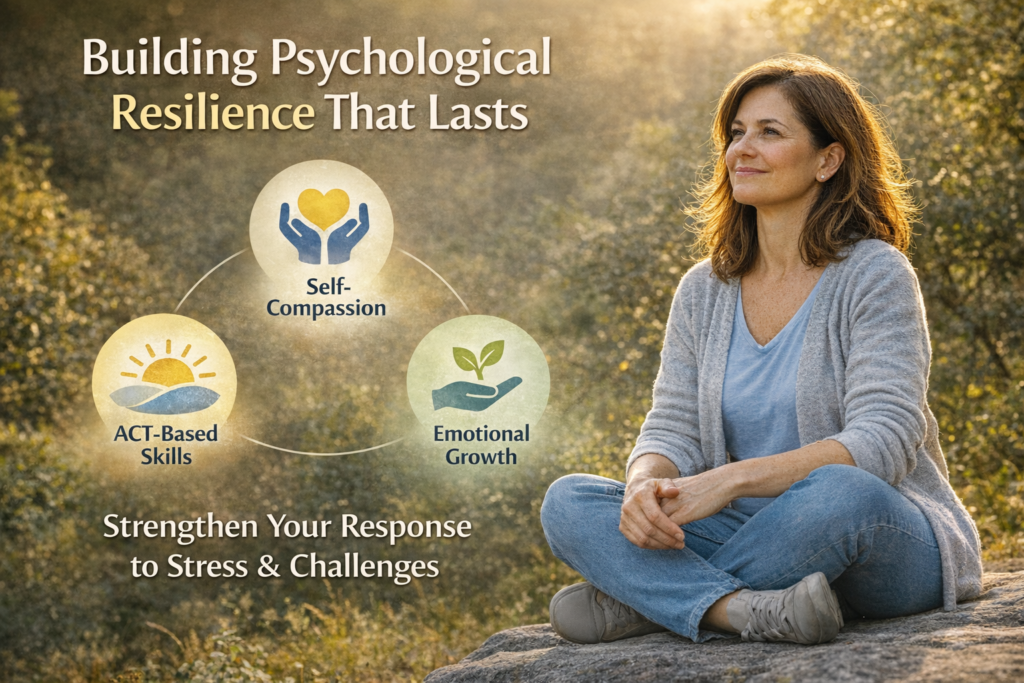
How to Build Psychological Resilience That Lasts
Learn what psychological resilience is, why it matters for mental health, and how to strengthen it using evidence-based approaches like Acceptance and Commitment Therapy (ACT) and self-compassion.
What Is Psychological Resilience?
Psychological resilience refers to the ability to adapt, recover, and continue moving forward in the face of stress, adversity, or life challenges. It does not mean avoiding pain or remaining unaffected by difficult experiences. Rather, resilience involves the capacity to experience hardship while still maintaining psychological flexibility, meaningful engagement in life, and a sense of personal direction.
Resilient individuals are not immune to stress, grief, disappointment, or uncertainty. They simply develop skills that allow them to navigate these experiences without becoming as overwhelmed or stuck. In psychology, resilience is increasingly understood as a set of learnable processes rather than a fixed personality trait. This means people can intentionally build resilience over time by strengthening certain mental habits, emotional skills, and behavioural patterns.
At its core, psychological resilience reflects a person’s ability to remain connected to their values and sense of purpose even when life becomes difficult. This also refers to psychological flexibility.
Why Psychological Resilience Is Important
Life inevitably involves uncertainty, loss, and change. From workplace stress and relationship challenges to illness or major life transitions, adversity is a normal part of the human experience. Psychological resilience helps individuals respond to these stressors in ways that protect mental health, prevent burnout and support long-term well-being.
Research consistently shows that higher resilience is associated with lower levels of anxiety, depression, burnout and PTSD. Resilient people are more likely to maintain emotional balance during stressful periods, recover more quickly after setbacks, and continue pursuing meaningful goals despite obstacles.
Resilience also supports important areas of daily functioning. It improves problem-solving, strengthens relationships, and enhances the ability to tolerate difficult emotions without resorting to avoidance behaviours that can worsen distress over time.
Importantly, resilience does not eliminate pain. Instead, it helps people carry life’s challenges more effectively, allowing them to respond thoughtfully rather than react impulsively when stress arises.
Psychological Flexibility: The Foundation of Resilience
One of the most powerful psychological processes underlying resilience is psychological flexibility. This concept, central to Acceptance and Commitment Therapy (ACT), refers to the ability to stay present with thoughts and emotions while choosing actions that align with personal values.
When psychological flexibility is low, people often become entangled in unhelpful thought patterns such as rumination, self-criticism, or catastrophic thinking. These patterns can narrow behavioural choices and increase emotional suffering.
Psychological flexibility allows individuals to step back from these mental habits and respond more intentionally. Rather than trying to eliminate difficult thoughts or feelings, flexible individuals learn to acknowledge them while still engaging in meaningful behaviour.
In many ways, resilience grows from this ability to say: “This is difficult, and I can still choose how I move forward.”
Developing Resilience Through ACT-Based Skills
Acceptance and Commitment Therapy offers practical tools for strengthening resilience. One of the central ACT principles is acceptance, which involves making space for uncomfortable emotions rather than struggling to suppress them. Ironically, the effort to control or avoid difficult feelings often intensifies distress. Acceptance helps individuals respond with openness instead of resistance.
Another key ACT skill is cognitive defusion, which teaches people to notice thoughts as mental events rather than absolute truths. For example, instead of becoming overwhelmed by the thought “I cannot handle this,” a person might learn to observe it as “I’m noticing the thought that I cannot handle this.” This subtle shift reduces the power of negative thinking and allows for more flexible responses.
ACT also emphasizes values clarification. Resilient individuals tend to have a clear understanding of what matters most to them—whether that involves family, learning, compassion, creativity, or community contribution. When people act in alignment with their values, they are better able to persist through challenges because their actions are connected to something meaningful.
Finally, committed action encourages taking small, purposeful steps toward valued goals, even when motivation is low or emotions are difficult. Over time, these actions reinforce a sense of agency and forward movement.
The Role of Self-Compassion in Resilience
Another powerful contributor to psychological resilience is self-compassion. Self-compassion involves responding to personal struggles with the same kindness, understanding, and patience that one would offer to a close friend.
Many people assume that self-criticism motivates improvement, but research suggests the opposite. Harsh self-judgement often increases shame, discouragement, and avoidance. Self-compassion, by contrast, creates emotional safety that allows people to learn from setbacks without becoming overwhelmed by them.
Self-compassion includes three core elements: self-kindness, common humanity, and mindful awareness. Self-kindness involves treating oneself with warmth during difficult moments. Common humanity reminds us that suffering and imperfection are universal aspects of being human. Mindfulness helps people notice painful experiences without exaggerating or suppressing them.
When individuals cultivate self-compassion, they develop a more supportive internal dialogue. This inner support system strengthens resilience because it allows people to face challenges without feeling alone or inadequate.
Small Practices That Build Resilience Over Time
Resilience is built through consistent practice rather than dramatic changes. Small daily habits can gradually strengthen psychological flexibility and self-compassion.
Mindfulness practices help train attention to remain grounded in the present moment, reducing rumination about the past or worry about the future. Reflecting on personal values can guide meaningful goal setting and decision-making. Practising compassionate self-talk during stressful moments can soften the impact of setbacks.
Equally important is maintaining behaviours that support overall well-being, such as healthy sleep patterns, social connection, and balanced activity levels. These habits create a stable foundation from which psychological resilience can grow.
An important point of consideration about resilience
Although psychological resilience is widely discussed and supported in mental health research, some scholars caution against viewing it as solely an individual trait or personal strength. In particular resilience can sometimes be framed in ways that unintentionally place too much responsibility on individuals to “bounce back” from adversity while overlooking the important role of social support, community resources, and broader life circumstances.
As researcher Michael Ungar (2011) notes, resilience depends not only on a person’s internal abilities but also on the availability of supportive environments that make coping resources accessible. These critiques do not diminish the value of resilience; rather, they encourage a more nuanced understanding of how resilience develops.
Evidence-based approaches such as Acceptance and Commitment Therapy (ACT) and self-compassion training recognize this complexity by focusing on skills that help individuals respond flexibly to difficult thoughts and emotions while also encouraging connection, meaning, and supportive relationships. In this way, resilience is best understood not as a demand to “be strong,” but as a set of learnable processes that help people navigate life’s inevitable challenges with greater psychological flexibility and care toward themselves.
Strengthening Resilience with Professional Support
While many resilience skills can be developed independently, professional support can help individuals learn and apply these strategies more effectively. Therapies grounded in ACT and self-compassion training provide structured approaches for developing psychological flexibility, emotional awareness, and value-driven behaviour.
Developing resilience does not mean facing challenges alone. With the right tools and guidance, people can learn to respond to adversity with greater clarity, courage, and self-understanding. If you are interested in strengthening your resilience and improving your mental well-being, we invite you to contact us today to learn how evidence-based psychological approaches can support meaningful and lasting change.
Learn more about preventing burnout and developing resiliency for handling stress:
Signs of High Functioning Burnout (when you’re coping but not ok)
Battling Burnout: Strategies to Overcome Burnout and Thrive
Burnout Help in Ontario: A Step by Step Guide
Preventing Burnout: Long Term Strategies for Sustainable Energy and Well-being
How to Reduce Burnout by Addressing Perfectionism
From Burnout to Balance: Practical Daily Habits for High Achievers
References:
Marshall EJ, Brockman RN. The Relationships Between Psychological Flexibility, Self-Compassion, and Emotional Well-Being. J Cogn Psychother. 2016;30(1):60-72.
Ungar, M. (2011). The social ecology of resilience: Addressing contextual and cultural ambiguity of a nascent construct. American Journal of Orthopsychiatry, 81(1), 1–17.
Prepared by Dr. Jennifer Barbera, PhD, Registered Psychologist
Dr. Jennifer Barbera PhD, C. Psych is a licensed psychologist with over 25 years of counselling experience. She has extensive clinical expertise supporting individuals and couples with anxiety, trauma, depression, addiction, and relationship challenges. Her work combines evidence-based approaches with practical strategies to help clients build resilience and improve well-being.