
Stress vs Anxiety: How to Tell the Difference
Learn the difference between stress and anxiety, how to tell what you’re experiencing, and how therapy can help manage stress and reduce anxiety symptoms. Stress vs Anxiety: How to Tell…

Explore what hypervigilance is, how it connects to worry and trauma, and how evidence‑based approaches like ACT and IFS can support recovery and emotional regulation.
What Is Hypervigilance and Why It Matters
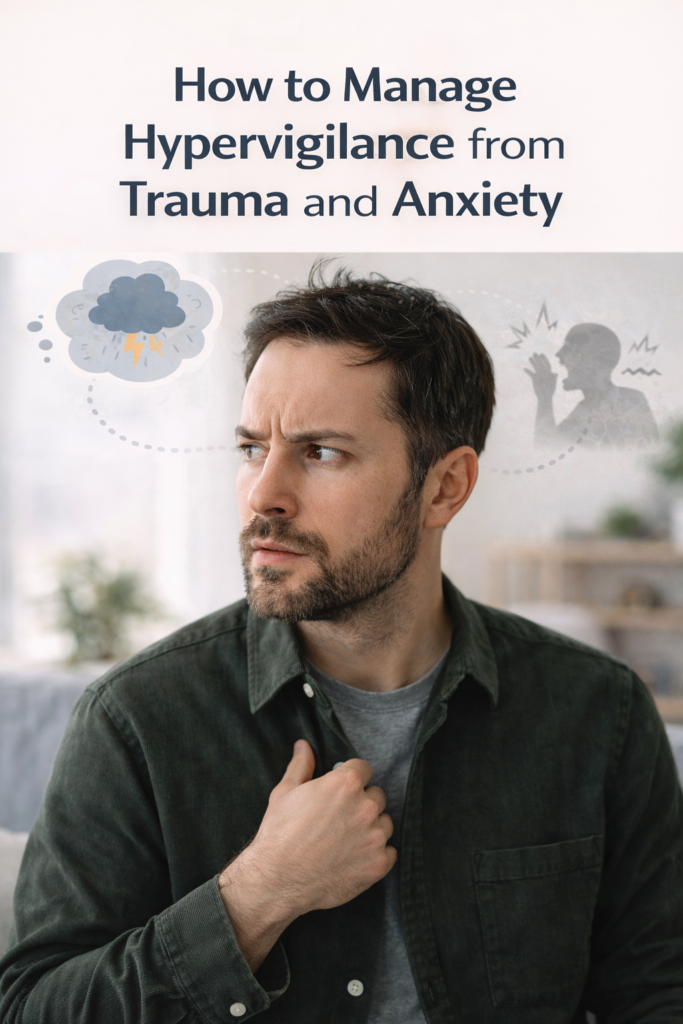
Hypervigilance refers to a state of heightened alertness, where the nervous system stays tuned to potential threats even in safe environments. Although a certain level of awareness can be helpful in genuinely risky situations, persistent hypervigilance takes an emotional and physical toll. People often describe it as “being on edge,” constantly scanning for danger, or feeling anxious and unable to relax.
While hypervigilance is often discussed in the context of trauma and post‑traumatic stress, it also shares features with worry—a repetitive, future‑focused attention on threat. Understanding what drives hypervigilance and how it differs depending on the source is essential for effective intervention.
How Hypervigilance Shows Up in Worry and Trauma
Hypervigilance related to worry usually involves scanning for potential future problems or negative outcomes. This cognitive pattern often overlaps with anxiety disorders such as generalized anxiety disorder (GAD), where persistent worry becomes a habitual way of monitoring for danger (McLaughlin & Nolen‑Hoeksema, 2011). Anxious individuals engage in extended attention to perceived threats as a mental strategy to prevent harm—though it paradoxically increases distress over time.
In contrast, trauma‑related hypervigilance is grounded in past threat. According to research on post‑traumatic stress disorder (PTSD), individuals who have experienced significant trauma may develop hypervigilance as a survival strategy that becomes stuck in a continuous “threat mode” even when safety is present (Brewin, 2015). In this form, hypervigilance manifests as intense startle responses, exaggerated threat perception, heightened physical arousal, and difficulty disengaging attention from perceived danger cues.
Hypervigilance tends to involve these core elements:
• Heightened attention to threat
• Difficulty relaxing or shifting focus
• Physical tension and increased arousal
• Reduced ability to feel safe in the present moment
The Biological and Psychological Bases of Hypervigilance
Hypervigilance engages both the nervous system and learned cognitive patterns. On a biological level, activation of the amygdala and stress response systems facilitates a state of constant alertness (Pitman et al., 2012). When the brain repeatedly perceives threat, neural pathways reinforce this pattern. As a result, even neutral or safe cues may trigger disproportionate physiological responses.
Psychologically, hypervigilance links closely with attentional bias toward threat, a process in which the mind preferentially focuses on signs of danger. Worry and trauma each support this bias through different learning histories: worry as a strategy to avoid uncertainty, and trauma as a learned survival mechanism where heightened monitoring protected life in the past. Over time, these habitual patterns can feel automatic and difficult to shift without intentional practice.
Why Hypervigilance Persists
Hypervigilance persists because it feels functional in the short term. If scanning for danger once kept someone safe, the brain holds onto that pattern even when the context has changed. The problem is that the survival strategy becomes mismatched with the current environment, leading to chronic stress, fatigue, and emotional strain.
For people with trauma histories, cues that resemble past danger can trigger full nervous‑system activation—even when objectively safe. For worriers, repetitive scanning increases anxiety because it reinforces beliefs that threats are everywhere or that constant monitoring will prevent bad outcomes.
How ACT Helps Reduce Hypervigilance
Acceptance and Commitment Therapy (ACT) focuses on changing how one relates to thoughts and sensations rather than trying to eliminate them. ACT helps with hypervigilance in several key ways:
Cognitive Defusion
This involves learning to notice thoughts and body sensations (like tension or alertness) without automatically giving them authority or treating them as literal danger signals. A core ACT practice might be noticing a thought such as, “What if something bad happens?” and reframing it as, “I’m noticing my mind is scanning for possible danger.” This reduces fusion with the anxious message and weakens its grip on attention.
Acceptance of Sensations
Rather than trying to push away uncomfortable physical sensations, ACT teaches mindful acceptance. Because avoidance tends to increase hypervigilant responses, allowing sensations to exist without resistance can gradually reduce reactivity (Twohig, Hayes, & Masuda, 2006).
Values‑Based Living
ACT encourages people to engage in meaningful activity even when the mind and body signal threat. For hypervigilance, this means building a life that’s grounded in what matters—relationships, creativity, service—despite heightened alertness.
Research demonstrates that ACT not only reduces anxiety symptoms but also shifts cognitive fusion and experiential avoidance, the processes that sustain hypervigilance in anxiety disorders (Hayes, Luoma, Bond, Masuda, & Lillis, 2006).
How Internal Family Systems (IFS) Addresses Hypervigilance
Internal Family Systems (IFS) offers a complementary way of understanding hypervigilance by viewing it as the voice of protective “parts” within the psyche. In IFS, the mind is not a single entity but a system of parts trying to help the person cope.
A hypervigilant part often plays a protector role: “If I stay alert, nothing bad will happen.” While the intention is safety, the strategy keeps the nervous system activated and the person stuck in prolonged stress.
Unblending and Witnessing
IFS teaches people to notice when a part is driving behaviour and to create distance between the part and the Self. For example, rather than identifying with the sensation of being on high alert (“I am on edge”), the person learns to observe (“A protective part of me is scanning for danger”). This distinction reduces reactivity and creates space for choice.
Curiosity and Compassion
Instead of criticising a hypervigilant part (“Why can’t you just calm down?”), IFS invites curiosity about the part’s intention: “What are you trying to protect me from? When did you start doing this?” Meeting the part with compassion often reduces its need to stay on high alert.
Integration with Other Parts
IFS can help hypervigilant parts feel understood and supported, which reduces the need for constant scanning. Over time, this leads to a calmer internal system and greater capacity to respond flexibly to real threats without generating chronic stress.
Combining Approaches for Best Results
ACT and IFS both focus on transforming how you relate to internal experiences—whether that’s a thought, a bodily sensation, or a protective part of yourself. By learning to observe without reacting and approach these experiences with curiosity and compassion, you can gradually reduce the intensity of hypervigilance and reclaim a sense of safety and calm.
For guidance on applying these approaches to worry- or trauma-related hypervigilance, we invite you to contact us today to explore personalised support and evidence-based strategies tailored to your needs.
What is hypervigilance?
Hypervigilance is a state of heightened alertness where the brain stays tuned to potential danger, even in safe contexts.
How is hypervigilance different from everyday worry?
Everyday worry tends to involve concern about potential future events. Hypervigilance, especially related to trauma, often involves heightened physiological arousal and persistent threat scanning even when no real threat exists.
Can therapy help reduce hypervigilance?
Yes. Evidence‑based approaches like ACT and compassion‑oriented therapies like IFS can reduce the intensity of hypervigilance by changing how a person relates to internal experiences and reducing fusion with threat signals.
Is hypervigilance only related to trauma?
No. While trauma is a common source of hypervigilance, persistent worry and anxiety disorders can also create patterns of heightened threat monitoring.
How long does it take to see changes in hypervigilance?
It depends on the individual and the consistency of practice. Some people notice shifts in weeks with regular therapeutic support, while deeper patterns may take longer to rewire.
References
Brewin, C. R. (2015). The nature and significance of memory disturbance in post‑traumatic stress disorder. Annual Review of Clinical Psychology, 11, 301–327.
Hayes, S. C., Luoma, J. B., Bond, F. W., Masuda, A., & Lillis, J. (2006). Acceptance and commitment therapy: Model, processes and outcomes. Behaviour Research and Therapy, 44(1), 1–25.
McLaughlin, K. A., & Nolen‑Hoeksema, S. (2011). Rumination as a transdiagnostic factor in depression and anxiety. Behaviour Research and Therapy, 49(3), 186–193.
Pitman, R. K., Rasmusson, A. M., Koenen, K. C., et al. (2012). Biological studies of post‑traumatic stress disorder. Nature Reviews Neuroscience, 13(11), 769–787.
Prepared by Dr. Jennifer Barbera, PhD, Registered Psychologist
Dr. Jennifer Barbera PhD, C. Psych is a licensed psychologist with over 25 years of counselling experience. She has extensive clinical expertise supporting individuals and couples with anxiety, trauma, depression, addiction, and relationship challenges. Her work combines evidence-based approaches with practical strategies to help clients build resilience and improve well-being.