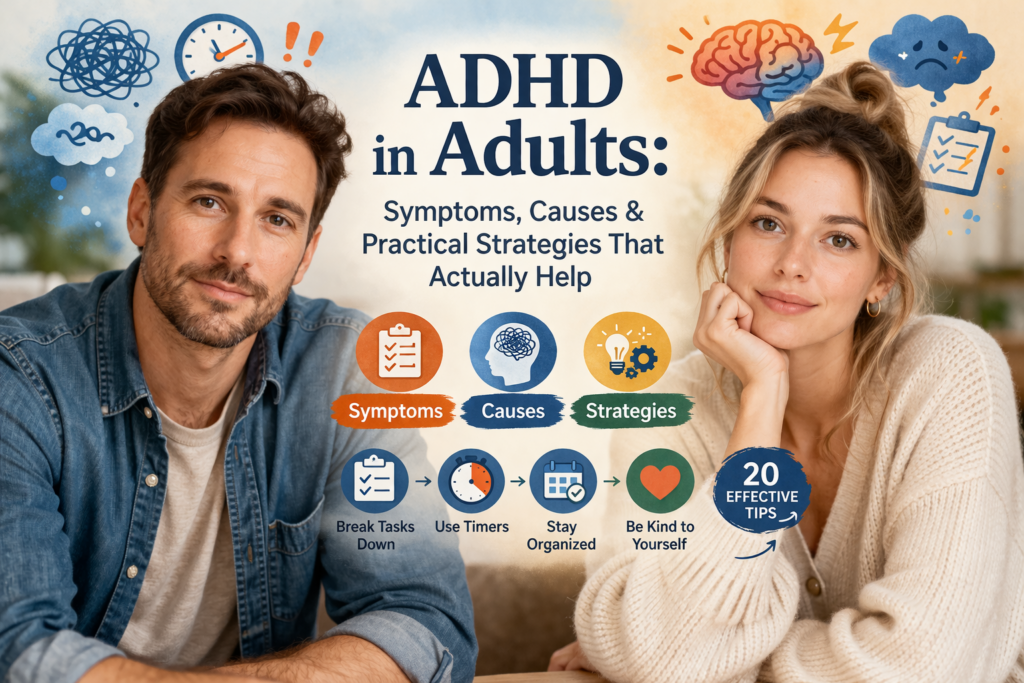
Do I Have ADHD or Am I Just Burnt Out? How Modern Life Affects Focus and Executive Function
In Canada and other Western societies, conversations about attention‑deficit/hyperactivity disorder (ADHD) are increasingly common across schools, workplaces, and healthcare settings. ADHD is a neurodevelopmental condition with clear diagnostic criteria that include persistent patterns of inattention, hyperactivity, and impulsivity. Yet many of the behaviours we associate with ADHD — distractibility, impulsive decision‑making, difficulty planning or organizing — are also influenced by lifestyle factors that affect executive functioning. This can make distinguishing between true ADHD and lifestyle‑related executive disruptions more challenging in clinical practice.
Executive functions are the cognitive skills that help us plan, organize, maintain attention, regulate impulses, and adapt to changing demands. These skills are linked closely to the prefrontal cortex, the brain region most associated with self‑regulation and goal‑directed behaviour (Martínez et al., 2016). Disruptions in executive functioning can create behaviours that look like ADHD, even in individuals without neurodevelopmental ADHD.
Below, we explore key lifestyle factors — sleep disruption, excessive screen exposure, physical inactivity, and chronic stress — that research indicates can impair executive functioning and produce behaviours overlapping with ADHD symptoms.
Sleep Disruption and Executive Function Challenges
Sleep problems are widespread in Western cultures, especially among adolescents and adults juggling school, work, technology, and social commitments. Poor sleep doesn’t just make us tired — it disrupts cognitive control.
Research has shown that sleep deprivation significantly impairs executive functions such as attention, working memory, and inhibitory control — the very skills that are deficient in ADHD (Floros et al., 2021). Likewise, sleep disturbances are highly prevalent in individuals diagnosed with ADHD, and evidence suggests that sleep problems can mimic or worsen inattentive and impulsive behaviours (Hvolby, 2015).
Sleep disruptions and irregular circadian rhythms have been implicated in executive dysfunction and daytime attentional challenges (Cassoff et al., 2012), making it possible for sleep issues to confound ADHD diagnosis if they are not identified and addressed.
Screen Time, Digital Multitasking, and Attention
In modern Western life, screens are everywhere — from smartphones and laptops to video games and streaming platforms. High amounts of screen time are associated with attentional difficulties and impulsivity behaviours that resemble ADHD symptoms.
For example, longitudinal research linking screen time with ADHD symptom development found that higher daily screen use was associated with increases in ADHD symptoms over time, and even measurable differences in brain structure in adolescents (Shou, Yamashita, & Mizuno, 2025).
Similarly, increases in screen exposure among adolescents have been shown to correlate with more severe impulsivity and attentional problems over a five‑year period (Wallace et al., 2023). These findings suggest that screen‑based environments may contribute to behaviours that superficially resemble ADHD, in part by affecting neural processes and reinforcing rapid attention shifts rather than sustained focus.
Physical Inactivity, Movement, and Cognitive Control
Western lifestyles often include long periods of sedentary behaviour, especially in school and office settings. Physical activity, on the other hand, plays a role in supporting executive functioning.
Studies of children with ADHD have found that higher levels of physical activity are associated with better executive functioning and that sleep may help explain part of this link (Liang et al., 2022). Although this research focuses on children with diagnosed ADHD, the mechanisms it highlights — where movement supports brain processes underlying attention and planning — apply broadly.
Physical inactivity, therefore, may contribute to executive struggles that resemble ADHD symptoms, especially in contexts where sleep quality is poor or routines lack structured physical engagement.
Chronic Stress and Executive Control
Chronic stress — from socioeconomic pressures, academic demands, workplace overload, or life transitions — has a profound impact on cognitive functioning. Stress interferes with executive processes like working memory, response inhibition, and cognitive flexibility, even in people without ADHD (Arnsten, 2018 as reviewed by Wright, 2020). Prolonged stress alters neural networks in the prefrontal cortex, reducing the brain’s capacity to sustain attention and regulate impulses.
While stress doesn’t cause ADHD, experimental and clinical evidence shows that chronic stress can produce executive dysfunction and attention problems consistent with ADHD symptom profiles. This makes stress an important lifestyle factor to consider when clinicians assess attention and self‑regulation complaints in adolescents and adults.
Why Distinguishing Lifestyle Effects from ADHD Matters
ADHD is a legitimate neurodevelopmental disorder rooted in genetic and neurobiological factors. However, when lifestyle factors like disrupted sleep, excessive screen activity, sedentary routines, and chronic stress impact executive functioning, they can produce behaviours that mimic ADHD symptoms even in people without the disorder. This complicates diagnosis — and underscores the importance of comprehensive assessments that explore lifestyle patterns alongside symptom reports.
For clinicians and families, understanding the interaction between lifestyle and cognition helps ensure that assessments are accurate and that interventions target both underlying neurodevelopmental issues and modifiable lifestyle factors that influence functioning.
Take Action: Supporting Focus and Executive Functioning
If you or someone you care about struggles with attention, planning, or impulse control, it’s important to remember that these challenges may have multiple contributing factors — including lifestyle. Before jumping to conclusions about ADHD, consider exploring sleep habits, screen time, physical activity, and stress management as part of your daily routine.
For parents, educators, or adults experiencing persistent attentional difficulties, taking steps like establishing consistent sleep schedules, limiting excessive screen use, engaging in regular physical activity, and practising stress‑reduction techniques can improve executive functioning and overall well‑being.
At the same time, if difficulties persist or significantly interfere with daily life, it’s essential to consult a qualified healthcare professional for a comprehensive assessment. Proper evaluation ensures that any underlying ADHD, sleep disorder, or other contributing factors are accurately identified and addressed.
Your attention, focus, and cognitive health are worth proactive care. Start by reflecting on your lifestyle, making small adjustments, and seeking professional guidance when needed — because executive functioning is not just about attention, it’s about living life fully and effectively. CONTACT US today for assistance with either an assessment or therapy.
References
Cassoff, J., Wiebe, S. T., & Gruber, R. (2012). Sleep patterns and the risk for ADHD: A review. Nature and Science of Sleep, 4, 73–80.
Floros, O., Axelsson, J., Almeida, R., Tigerström, L., Lekander, M., Sundelin, T., & Petrovic, P. (2021). Vulnerability in executive functions to sleep deprivation is predicted by subclinical attention‑deficit/hyperactivity disorder symptoms. Biological Psychiatry: Cognitive Neuroscience and Neuroimaging, 6(3), 290–298.
Hvolby, A. (2015). Associations of sleep disturbance with ADHD: Implications for treatment. ADHD Attention Deficit and Hyperactivity Disorders, 7, 1–18.
Liang, X., Li, R., Wong, S. H. S., Sum, R. K. W., Wang, P., Yang, B., & Sit, C. H. P. (2022). Physical activity and executive function in children with ADHD: The mediating role of sleep. Frontiers in Pediatrics, 9, Article 775589.
Shou, Q., Yamashita, M., & Mizuno, Y. (2025). Association of screen time with attention‑deficit/hyperactivity disorder symptoms and their development: The mediating role of brain structure. Translational Psychiatry, 15, Article 447.
Wallace, J., Boers, E., Ouellet, J., & Afzali, M. H. (2023). Screen time, impulsivity, neuropsychological functions and their relationship to growth in adolescent attention‑deficit/hyperactivity disorder symptoms. Scientific Reports, 13, 18108.
Wright, E. C. (2020). Neurobiological insights into stress‑induced attention deficit. Biological Psychiatry, 88(7), e29–e31.
Dr. Jennifer Barbera PhD, C. Psych is a licensed psychologist with over 25 years of counselling experience. She has extensive clinical expertise supporting individuals and couples with anxiety, trauma, depression, addiction, and relationship challenges. Her work combines evidence-based approaches with practical strategies to help clients build resilience and improve well-being.