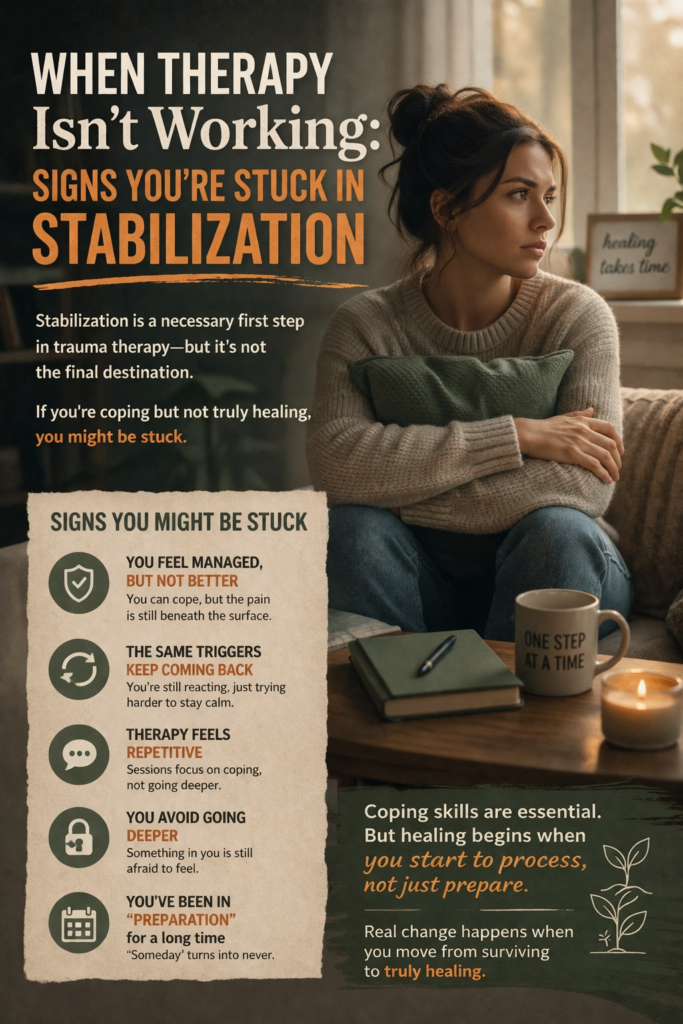
When Therapy Isn’t Working: Signs You’re Stuck in Stabilization
Many people begin trauma therapy with a sense of hope. They learn grounding techniques, develop coping skills, and begin to feel more in control of their emotions. In the early stages, this progress can feel significant—and it is.
But for some, that progress eventually plateaus.
Despite having tools to manage distress, the same triggers continue to show up. The same emotional patterns repeat. And over time, therapy can begin to feel like it’s helping you cope—but not truly helping you heal.
If this sounds familiar, you may be stuck in what is known as the stabilization phase of trauma therapy.
If you haven’t yet explored the foundation of this, it may help to read Why Coping Skills Don’t Heal Trauma and Common Signs of Trauma, as this post builds directly on those concepts.
What Is the Stabilization Phase?
In trauma treatment, stabilization is the initial phase focused on safety, emotional regulation, and symptom management. Many evidence-based models emphasize the importance of this stage before engaging in deeper trauma processing (Shapiro, 2018).
During stabilization, individuals learn how to:
• Regulate emotional distress
• Reduce overwhelming symptoms
• Build a sense of internal safety
• Function more effectively in daily life
This phase is essential. Without it, trauma processing can become overwhelming or even destabilizing. However, stabilization is not intended to be the end point of therapy.
Trauma recovery models consistently describe treatment as a phase-based process, with stabilization followed by trauma processing and integration (Cloitre et al., 2012).
When Stabilization Becomes a Plateau
For some individuals, therapy remains focused on stabilization for extended periods of time. While this may initially feel helpful, it can eventually lead to a sense of being stuck.
You may notice that:
• You have many coping tools, but still feel triggered
• Emotional reactions feel more controlled, but not resolved
• The same issues continue to resurface
• Therapy sessions feel repetitive or predictable
This plateau can be confusing. After all, you are doing the work. You are applying the strategies. So why does it feel like nothing is really changing?
The answer often lies in the difference between managing symptoms and processing trauma.
Sign 1: You Feel Managed, But Not Better
One of the clearest indicators that you may be stuck in stabilization is the feeling of being “held together” rather than genuinely improved.
Coping skills can reduce the intensity of distress, but they do not change the underlying memory networks that drive trauma responses (van der Kolk, 2014). As a result, symptoms may become more tolerable without actually resolving.
You may find yourself thinking:
• “I can get through it, but it still affects me”
• “I’m functioning, but I don’t feel different inside”
This is often a sign that deeper processing has not yet occurred.
Sign 2: The Same Triggers Keep Coming Back
In conditions such as Post-traumatic stress disorder, triggers activate unprocessed memories that remain stored in a fragmented form (American Psychiatric Association, 2013).
If therapy is primarily focused on coping strategies, those triggers may become easier to manage—but they do not disappear.
Repeated activation of the same triggers suggests that the underlying material has not been integrated. Research on emotional processing highlights that avoidance of trauma-related material maintains symptoms over time (Foa, Hembree, & Rothbaum, 2007).
If this resonates, you may also want to revisit How to Know When You’re Ready for Trauma Processing to better understand the transition point.
Sign 3: Therapy Feels Repetitive
Another common sign is a sense that therapy sessions are beginning to feel the same.
You may spend sessions:
• Reviewing coping strategies
• Discussing current stressors
• Managing symptoms without exploring deeper experiences
While these conversations can be helpful, they may not lead to meaningful change if they do not move toward processing the underlying trauma.
Over time, this can lead to frustration or even doubt about whether therapy is working.
Sign 4: You Avoid Going Deeper
Avoidance is a core feature of trauma. It is not simply about avoiding external reminders, but also about avoiding internal experiences such as emotions, sensations, and memories (Foa et al., 2007).
Even in therapy, this can show up as:
• Changing the subject when things feel too intense
• Focusing on problem-solving rather than emotional exploration
• Feeling hesitant or fearful about revisiting past experiences
This is not a failure—it is a protective response. However, when avoidance remains unaddressed, it can prevent the processing needed for healing.
For additional support in building tolerance for internal experience, see How to Reset Your Nervous System After Trauma.
Sign 5: You’ve Been in “Preparation” for a Long Time
Preparation is important. But for some individuals, preparation becomes indefinite.
You may hear:
• “We’re still building coping skills”
• “You’re not quite ready yet”
In some cases, this is clinically appropriate. However, research suggests that many individuals benefit from earlier access to trauma processing when adequate support is in place (De Jongh et al., 2016).
If months—or even years—have passed without transitioning into deeper work, it may be worth exploring whether therapy has become overly focused on stabilization.
Why This Happens
There are several reasons why people become stuck in stabilization:
• Fear of overwhelming emotions
• Therapist caution about pacing
• Lack of training in trauma processing approaches
• Misunderstanding that coping equals healing
Additionally, trauma itself creates a phobia of internal experience, making it difficult to approach the very material that needs to be processed (Foa et al., 2007).
Understanding this can help shift the perspective from “something is wrong with me” to “my system is protecting me in a way that now needs to evolve.”
What Actually Moves Therapy Forward
Moving beyond stabilization involves shifting from symptom management to trauma processing.
Evidence-based approaches such as Eye Movement Desensitization and Reprocessing (EMDR) and Internal Family Systems (IFS) are designed to access and resolve the underlying memory networks that drive symptoms (Shapiro, 2018; Schwartz, 2021).
These approaches support:
• Safe engagement with traumatic material
• Integration of fragmented memories
• Reduction in emotional and physiological reactivity
• Lasting changes in beliefs and self-perception
If you’d like to explore this further, see EMDR Therapy: How It Works.
When You’re Ready to Move Forward
Transitioning out of stabilization does not mean abandoning coping skills. It means using them as a foundation while beginning to process deeper experiences.
Signs you may be ready include:
• Increased ability to tolerate emotional discomfort
• Curiosity about your internal experience
• Frustration with staying at the surface level
• A sense that you are “ready for more”
This transition is best done with a therapist trained in trauma-focused approaches who can support pacing, safety, and integration.
Move Forward in your Healing
Stabilization is a critical and necessary phase of trauma therapy. It builds the safety and regulation needed for deeper work.
But it is not the destination.
If therapy feels like it is helping you cope but not truly helping you heal, it may be time to explore whether you are ready to move beyond stabilization. With the right support and approach, it is possible to move from managing symptoms to resolving them. CONTACT US today to set up an appointment or learn more.
References
American Psychiatric Association. (2013). Diagnostic and statistical manual of mental disorders (5th ed.). Author.
Cloitre, M., Courtois, C. A., Charuvastra, A., Carapezza, R., Stolbach, B. C., & Green, B. L. (2012). Treatment of complex PTSD: Results of the ISTSS expert clinician survey on best practices. Journal of Traumatic Stress, 25(6), 615–627.
De Jongh, A., Amann, B. L., Hofmann, A., Farrell, D., & Lee, C. W. (2016). The status of EMDR therapy in the treatment of posttraumatic stress disorder 30 years after its introduction. Journal of EMDR Practice and Research, 10(3), 129–138.
Foa, E. B., Hembree, E. A., & Rothbaum, B. O. (2007). Prolonged exposure therapy for PTSD: Emotional processing of traumatic experiences. Oxford University Press.
Schwartz, R. C. (2021). No bad parts: Healing trauma and restoring wholeness with the Internal Family Systems model. Sounds True.
Shapiro, F. (2018). Eye movement desensitization and reprocessing (EMDR) therapy: Basic principles, protocols, and procedures (3rd ed.). Guilford Press.
van der Kolk, B. A. (2014). The body keeps the score: Brain, mind, and body in the healing of trauma. Viking.