Why Coping Skills Don’t Heal Trauma & How to Heal
Most people come to therapy expecting to learn coping skills—and many do. Breathing exercises, grounding techniques, and distraction strategies can help reduce distress in the moment. These tools are widely taught, easy to apply, and often provide immediate relief.
But what happens when the symptoms keep coming back?
If you’ve ever felt like you’re managing your trauma rather than truly healing from it, you’re not alone. Coping skills can make distress more tolerable, but on their own, they often don’t resolve the underlying issue. To understand why, we need to look more closely at what trauma actually is—and what it requires to heal.
If you’re newer to this topic, you might first want to read Common Signs of Trauma and How Complex Trauma and Attachment Injury Affect Recovery to better understand how trauma shows up and why it can be so persistent.
Why Coping Skills Feel Helpful—But Fall Short
Coping skills are designed to regulate the nervous system during periods of distress. Techniques such as slow breathing, grounding through the senses, and attentional shifting can reduce emotional intensity and restore a sense of control.
These strategies are valuable, particularly in early stages of therapy when stabilization is essential. Research consistently supports the importance of building emotional regulation capacity before engaging in deeper trauma work (Shapiro, 2018).
However, there is a critical distinction that is often missed:
Feeling better is not the same as being healed.
Coping skills primarily address symptoms. They can reduce anxiety, calm physiological arousal, and interrupt distressing thoughts, but they do not resolve the underlying trauma memory networks. As a result, many individuals experience a recurring cycle—temporary relief followed by the return of symptoms.
Trauma Is More Than Stress
Trauma is not simply an intensified stress response. It reflects a disruption in how the brain and nervous system process and store experience. In conditions such as Post-traumatic stress disorder, distressing events are not fully integrated into adaptive memory systems (American Psychiatric Association, 2013).
Instead, aspects of the experience—images, emotions, physical sensations, and core beliefs—remain stored in a fragmented and state-dependent form. These unprocessed memory networks can be easily activated, leading to intrusive symptoms, hyperarousal, and avoidance (van der Kolk, 2014).
If you’d like a deeper breakdown of how these trauma symptoms develop, see Common Signs of Trauma.
From this perspective, trauma symptoms are not random; they reflect the nervous system’s ongoing attempt to process unresolved material.
The Hidden Fear That Keeps Trauma Stuck
One of the most important factors in trauma is the development of a fear of internal experience. Following a distressing event, it is not only the memory that becomes threatening, but also the emotions, body sensations, and thoughts associated with it.
Over time, individuals may begin to avoid these internal experiences altogether. This pattern is well understood within trauma frameworks as a form of conditioned avoidance that maintains symptoms (Foa, Hembree, & Rothbaum, 2007).
This avoidance can present in subtle ways:
• Distracting from emotional discomfort
• Suppressing or shutting down feelings
• Avoiding triggers that activate internal responses
• Relying heavily on strategies that quickly reduce distress
If you’re noticing this pattern, it can be helpful to explore How to Reset Your Nervous System After Traumato build capacity for staying present without becoming overwhelmed.
When Coping Skills Become Avoidance
Coping strategies are not inherently problematic. The challenge arises when they are used in a way that prevents deeper processing.
For example, grounding techniques are highly effective for reducing acute distress. However, when used to immediately shut down emotional activation every time it arises, they can interrupt the natural processing of that experience.
Over time, this can lead to a subtle shift where coping becomes a form of avoidance.
When emotional experiences are consistently avoided, the nervous system does not have the opportunity to update or integrate them. This reinforces the perception that these internal states are dangerous, maintaining the cycle of distress (Foa et al., 2007).
This is one reason individuals may feel stuck in therapy despite having strong coping skills.
What Actually Heals Trauma
If coping skills manage symptoms, trauma healing requires something different: processing and integration.
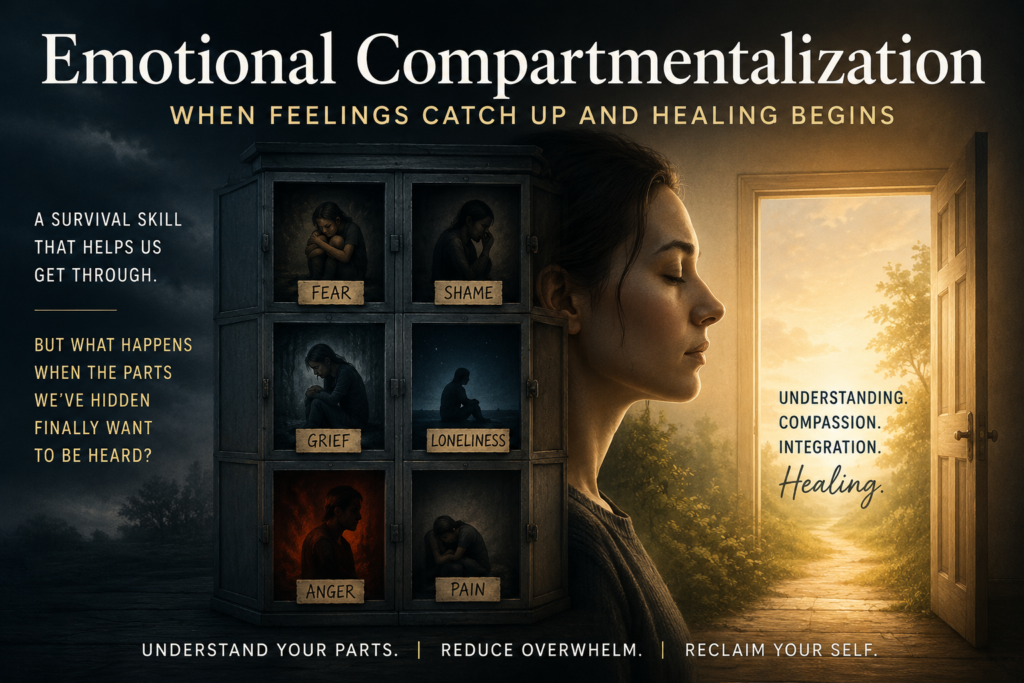
Trauma-focused therapies such as Eye Movement Desensitization and Reprocessing (EMDR) and Internal Family Systems (IFS) are designed to access and resolve unprocessed memory networks.
EMDR, for example, facilitates adaptive information processing, allowing distressing memories to be reprocessed and integrated (Shapiro, 2018; Chen et al., 2014). IFS works by helping individuals relate to and heal internal parts that carry unresolved emotional burdens (Schwartz, 2021).
Rather than avoiding distress, these approaches support individuals in safely engaging with it, leading to:
• Reduced emotional intensity
• Shifts in core beliefs
• Decreased physiological reactivity
• Integration of previously fragmented experiences
For a more detailed explanation, you can link to EMDR Therapy: How It Works.
Signs You Might Be Stuck in Stabilization
Stabilization is an important phase of trauma therapy, but it is not intended to be the endpoint. Indicators that you may be stuck in this phase include:
• You feel more controlled, but not fundamentally better
• The same triggers continue to produce strong reactions
• Therapy focuses primarily on coping strategies
• There is limited exploration of underlying experiences
• You avoid engaging with deeper emotional material
If you’re unsure whether you’re ready to move beyond stabilization, see How to Know When You’re Ready for Trauma Processing.
When Coping Skills Are Still Important
Coping skills remain an essential component of trauma treatment. They help establish safety, regulate overwhelming emotional states, and support functioning in daily life.
Research and clinical models emphasize the importance of stabilization as a foundation for trauma processing (Shapiro, 2018). Without sufficient capacity for regulation, deeper work can become overwhelming or counterproductive.
The key is to recognize that coping skills are a starting point—not the endpoint.
Moving Toward Real Healing
Healing from trauma involves gradually increasing the capacity to experience internal states without avoidance or overwhelm. This process is most effective when supported by a trained therapist using evidence-based, trauma-focused approaches.
It also involves a shift in orientation—from avoiding distress to developing the ability to move through it safely.
If you’re beginning to consider this shift, the next steps in this series may be helpful:
• When Therapy Isn’t Working: Signs You’re Stuck in Stabilizatio
These topics build directly on the patterns discussed here and help guide the transition from symptom management to deeper healing.
Moving Beyond Coping Toward Deeper Healing
Coping skills are a valuable and necessary part of mental health care. They provide relief, increase stability, and help individuals manage distress in the short term.
However, they do not, on their own, resolve trauma.
True healing requires addressing the underlying experiences that continue to drive symptoms. When those experiences are safely processed and integrated, the need for constant coping decreases, and a more lasting sense of resolution can emerge (van der Kolk, 2014).
Healing doesn’t come from avoiding what hurts. It comes from safely processing it.
If you’re finding that coping skills are helping you get through the day but not truly resolving the deeper impact of trauma, it may be time to consider a different approach. Trauma healing is possible with the right support and evidence-based treatment. CONTACT US today to learn more about how trauma-focused therapy can help you move beyond managing symptoms toward lasting healing.
References
American Psychiatric Association. (2013). Diagnostic and statistical manual of mental disorders (5th ed.). Author.
Chen, Y.-R., Hung, K.-W., Tsai, J.-C., Chu, H., Chung, M.-H., Chen, S.-R., Liao, Y.-M., Chang, Y.-C., & Chou, K.-R. (2014). Efficacy of eye-movement desensitization and reprocessing for patients with posttraumatic stress disorder: A meta-analysis of randomized controlled trials. PLoS ONE, 9(8), e103676.
Foa, E. B., Hembree, E. A., & Rothbaum, B. O. (2007). Prolonged exposure therapy for PTSD: Emotional processing of traumatic experiences. Oxford University Press.
Schwartz, R. C. (2021). No bad parts: Healing trauma and restoring wholeness with the Internal Family Systems model. Sounds True.
Shapiro, F. (2018). Eye movement desensitization and reprocessing (EMDR) therapy: Basic principles, protocols, and procedures (3rd ed.). Guilford Press.
van der Kolk, B. A. (2014). The body keeps the score: Brain, mind, and body in the healing of trauma. Viking.
Prepared by Dr. Jennifer Barbera, PhD, Registered Psychologist
Dr. Jennifer Barbera PhD, C. Psych is a licensed psychologist with over 25 years of counselling experience. She has extensive clinical expertise supporting individuals and couples with anxiety, trauma, depression, addiction, and relationship challenges. Her work combines evidence-based approaches with practical strategies to help clients build resilience and improve well-being.