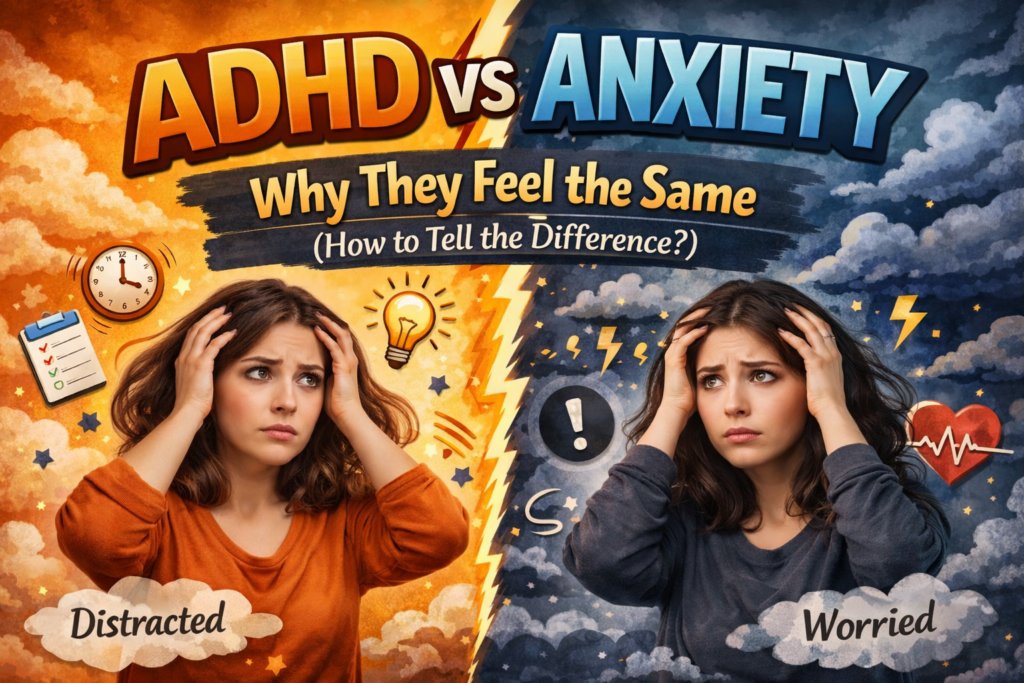
ADHD vs Anxiety: Why They Feel the Same (How to Tell the Difference)
If you’ve ever wondered whether you might have ADHD or anxiety, you’re not alone. Many adults in Ontario notice difficulty focusing, feeling overwhelmed, procrastinating, or mentally “shutting down” under pressure—and assume it must be one or the other.
In reality, ADHD and anxiety often look very similar on the surface. Both can affect concentration, memory, sleep, and motivation. Both can leave you feeling stuck, frustrated, and unsure why things that seem simple for others feel so difficult.
But underneath, they are driven by different processes in the brain and nervous system, which means understanding the difference is key to getting effective support.
If you’re still unsure whether ADHD is part of the picture, you may want to start with How Do I Know If I Have ADHD? before continuing.
Why ADHD and Anxiety Feel So Similar
At a glance, ADHD and anxiety can produce nearly identical day-to-day struggles. You might find yourself unable to start tasks, easily distracted, overwhelmed by responsibilities, or constantly overthinking what needs to get done.
This overlap happens because both conditions affect executive functioning, the set of cognitive processes responsible for planning, attention, emotional regulation, and follow-through (Barkley, 2015). When executive functioning is disrupted, everyday tasks can feel disproportionately difficult.
In ADHD, these challenges stem primarily from differences in attention regulation, impulse control, and working memory. In anxiety, similar difficulties often arise because the brain is preoccupied with perceived threats, pulling attention toward worry and away from the task at hand (Eysenck et al., 2007).
In other words, the outcome may look the same—but the reason is different.
The Key Difference: Distraction vs Threat
One of the most useful ways to distinguish ADHD from anxiety is to look at what is driving the difficulty.
ADHD is primarily a disorder of attention regulation. The mind tends to wander, jump between tasks, or struggle to stay engaged unless something is particularly stimulating or urgent. This can happen even in calm situations.
Anxiety, by contrast, is driven by threat detection. The brain becomes hyper-focused on potential risks, worries, or “what if” scenarios. Difficulty concentrating is not due to lack of attention, but because attention is being pulled toward worry.
Research supports this distinction. Cognitive models of anxiety suggest that attention is biased toward perceived threats, which interferes with task performance (Eysenck et al., 2007). ADHD, on the other hand, is associated with broader impairments in executive control and sustained attention (Barkley, 2015).
A simple way to think about it:
• ADHD → “My mind won’t stay on this”
• Anxiety → “My mind won’t stop thinking about something else”
How Symptoms Show Up Differently
While there is overlap between ADHD and anxiety, certain patterns can help differentiate the two.
With ADHD, you might notice:
• Chronic difficulty starting or finishing tasks
• Frequent distraction, even without obvious stress
• Losing track of time or forgetting details
• Periods of hyperfocus on highly engaging activities
With anxiety, you might notice:
• Persistent worry or mental rumination
• Avoidance of tasks due to fear of failure or mistakes
• Physical symptoms like tension, restlessness, or a racing heart
• Difficulty concentrating specifically when feeling stressed
Importantly, anxiety can also look like procrastination. But the reason is different. In ADHD, procrastination is often related to difficulty initiating tasks. In anxiety, it is more often driven by avoidance of discomfort or fear.
If you’re unsure how anxiety itself works, it can help to read What Is the Difference Between Anxiety and Stress? for a clearer foundation.
When ADHD and Anxiety Co-Occur
One of the reasons this question is so confusing is that ADHD and anxiety frequently occur together. Research suggests that a significant proportion of adults with ADHD also meet criteria for an anxiety disorder (Kessler et al., 2006).
When both are present, they can reinforce each other. For example:
• ADHD-related disorganization can lead to chronic stress
• Repeated overwhelm can increase anxiety
• Anxiety can further impair attention and working memory
This can create a cycle where it becomes difficult to tell which came first.
Modern Life, Burnout, and the ADHD Question
In recent years, more adults have started questioning whether they have ADHD. While increased awareness is part of this, lifestyle factors also play a role.
Chronic stress, poor sleep, constant digital stimulation, and high cognitive demands can all impair attention and executive functioning. These effects can mimic or amplify ADHD-like symptoms, even in individuals without a neurodevelopmental condition.
If this resonates, it’s worth exploring The Impact of Modern Life on Attention and Executive Functioning, as these factors can significantly influence how symptoms show up.
Why the Distinction Matters
Understanding whether your difficulties are driven primarily by ADHD, anxiety, or a combination of both matters because the most effective interventions differ.
ADHD-focused treatment often emphasizes:
• Skills for organization and time management
• Behavioural strategies and environmental supports
• In some cases, medication
Anxiety-focused treatment often emphasizes:
• Reducing avoidance behaviours
• Cognitive restructuring
• Gradual exposure to feared situations
Both may involve evidence-based therapies such as cognitive behavioural therapy, which has strong support across conditions (Hofmann et al., 2012), but the focus of treatment will differ depending on the underlying issue.
Without this distinction, it’s possible to feel like therapy “isn’t working,” when in reality the approach may not be targeting the core problem.
What If You’re Still Not Sure?
If you’re reading this and thinking, “This still sounds like both,” you’re not alone. Many people fall somewhere in the overlap.
A useful next step is to look at patterns over time:
• Have these difficulties been present since childhood? (more consistent with ADHD)
• Do they worsen significantly during periods of stress? (more consistent with anxiety)
• Do you feel driven by distraction or by worry?
You may also find it helpful to read ADHD in Adults: Symptoms, Causes, and Practical Strategies] or 20 Practical Strategies for Managing ADHD to learn more and review what can help.
Ultimately, a thoughtful psychological assessment with a trained clinician can help clarify what is happening and guide you toward the most effective support.
A Better Way Forward
ADHD and anxiety can feel almost identical from the inside. Both can leave you struggling to focus, overwhelmed by daily demands, and questioning why things feel harder than they should.
But the difference lies in what is driving those experiences. ADHD reflects differences in how attention and executive functioning are regulated, while anxiety reflects a nervous system that is oriented toward detecting and responding to threat.
Understanding that distinction is not about labelling yourself—it’s about finding the right path forward. When you understand what is actually happening, it becomes much easier to choose strategies and supports that lead to real change. CONTACT US today to discuss options or to schedule and appointment.
References
Barkley, R. A. (2015). Attention-deficit hyperactivity disorder: A handbook for diagnosis and treatment (4th ed.). Guilford Press.
Eysenck, M. W., Derakshan, N., Santos, R., & Calvo, M. G. (2007). Anxiety and cognitive performance: Attentional control theory. Emotion, 7(2), 336–353.
Hofmann, S. G., Asnaani, A., Vonk, I. J., Sawyer, A. T., & Fang, A. (2012). The efficacy of cognitive behavioural therapy: A review of meta-analyses. Cognitive Therapy and Research, 36(5), 427–440.
Kessler, R. C., Adler, L., Barkley, R., et al. (2006). The prevalence and correlates of adult ADHD in the United States. American Journal of Psychiatry, 163(4), 716–723.
Prepared by:
Dr. Jennifer Barbera PhD, C. Psych who is a licensed psychologist with over 25 years of counselling experience. She has extensive clinical expertise supporting individuals and couples with anxiety, trauma, depression, addiction, and relationship challenges. Her work combines evidence-based approaches with practical strategies to help clients build resilience and improve well-being.