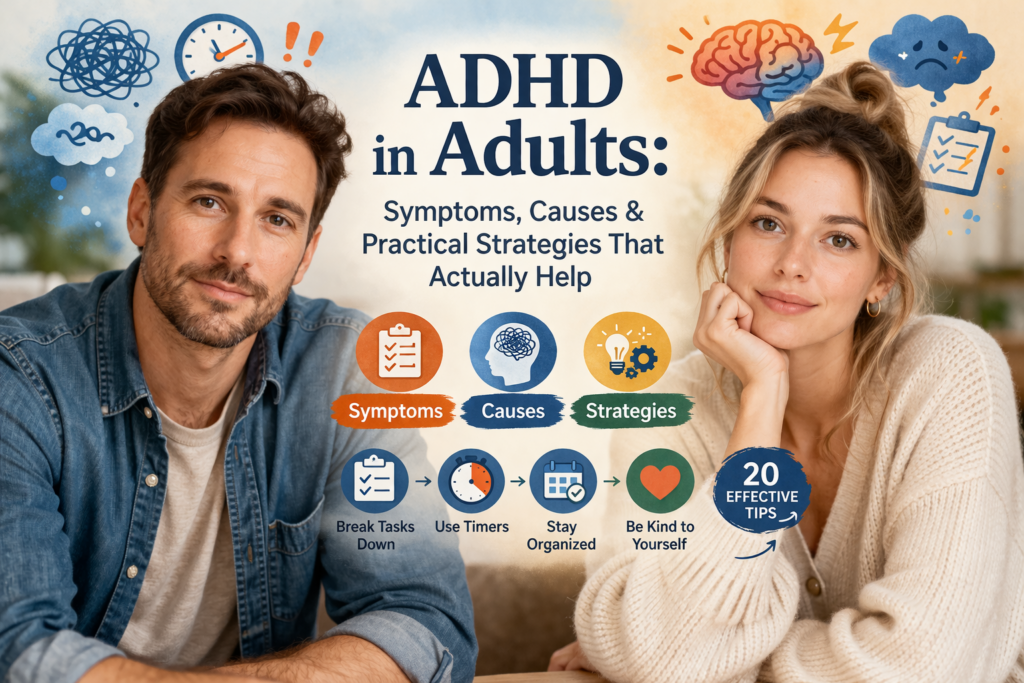
ADHD in Adults: Symptoms, Causes, and Practical Strategies That Actually Help
Attention-Deficit/Hyperactivity Disorder (ADHD) is often misunderstood, especially in adults. Many people picture hyperactive children, but ADHD frequently shows up very differently later in life—quieter, internal, and often hidden behind coping strategies that eventually stop working. Research over the past two decades has highlighted that ADHD commonly persists into adulthood and can significantly impact daily functioning, relationships, and well-being (Barkley et al., 2008; Kessler et al., 2006).
If you’ve ever felt like you know what to do but can’t seem to follow through, struggle with focus despite trying hard, or find yourself stuck in cycles of overwhelm and burnout, ADHD may be worth exploring.
If you’re unsure where to start, you might want to read How Do I Know If I Have ADHD? to get a clearer picture of whether this fits your experience.
What ADHD Actually Is (and Isn’t)
ADHD is a neurodevelopmental condition that affects how the brain regulates attention, motivation, and executive functioning. It is not about laziness, lack of intelligence, or poor discipline. Neuropsychological research points to differences in executive functioning—particularly in areas like inhibition, working memory, and cognitive flexibility (Barkley, 1997).
In adults, ADHD often shows up as:
• Difficulty starting or finishing tasks
• Trouble organizing or prioritizing
• Forgetfulness or losing track of time
• Emotional reactivity or feeling overwhelmed easily
There are different presentations of ADHD, including primarily inattentive, hyperactive-impulsive, and combined types. Many adults—especially women—are diagnosed later in life because their symptoms were missed or misunderstood growing up (Quinn & Madhoo, 2014).
Common Signs of ADHD in Adults
ADHD tends to affect daily functioning in ways that build up over time:
• Procrastination, even on important tasks
• Starting many things but finishing few
• Chronic disorganization
• Difficulty managing time (underestimating or overestimating)
• Avoiding tasks that feel mentally demanding
• Trouble maintaining routines
Emotionally, ADHD can look like:
• Feeling easily overwhelmed
• Irritability or low frustration tolerance
• Shame or self-criticism about not “keeping up”
• Burnout from constantly trying to compensate
You may also notice overlap with issues like Burnout, Perfectionism, or low Self-Esteem, which can both mask and intensify ADHD symptoms.
Why ADHD Happens
ADHD is largely linked to how the brain regulates dopamine, a neurotransmitter involved in motivation, reward, and focus. This contributes to difficulties with sustaining attention on tasks that are not immediately engaging or rewarding (Volkow et al., 2009).
Genetics play a significant role, and environmental factors—like chronic stress or lack of structure—can make symptoms more noticeable or harder to manage.
It’s also important to understand that ADHD is not a lack of ability—it’s a difference in how effort, attention, and motivation are regulated by the brain.
What ADHD Actually Feels Like
This is where many people recognize themselves.
ADHD often feels like:
• “I know what I need to do, but I can’t get myself to do it.”
• Getting stuck in a loop of thinking, planning, and avoiding
• Being productive under pressure, but struggling with consistency
• Swinging between overworking and shutting down
There’s often a gap between intention and action, which can lead to frustration and self-doubt. Over time, this can create a cycle of avoidance, guilt, and burnout—patterns that are well-documented in adults with ADHD (Barkley et al., 2008).
ADHD vs Anxiety, Trauma, and Depression
ADHD can overlap with other concerns, which sometimes makes it harder to identify.
For example:
• Anxiety may look like restlessness and difficulty concentrating
• Trauma can affect attention, memory, and emotional regulation
• Depression can reduce motivation and energy
At the same time, untreated ADHD can lead to anxiety or depression due to chronic stress and functional impairment (Kessler et al., 2006).
Lifestyle Factors That Can Mimic or Worsen ADHD
It’s also important to consider that certain lifestyle factors can look like ADHD—or make existing symptoms more intense. In particular, sleep difficulties, inconsistent routines, high stress, and low physical activity can all affect attention, memory, and emotional regulation.
In some cases, these patterns can mimic ADHD symptoms, which is why a careful and comprehensive assessment is important before drawing conclusions. At the same time, for individuals who do have ADHD, these factors can significantly amplify day-to-day challenges if they are not addressed.
20 Effective Tips for Managing ADHD
There is no one-size-fits-all solution, but practical strategies can make a meaningful difference. The key is to work with your brain, not against it. Evidence-based approaches, including cognitive behavioural strategies and environmental modifications, have been shown to improve functioning in adults with ADHD (Safren et al., 2005).
1. Break tasks into very small, clear steps
2. Use external reminders instead of relying on memory
3. Set timers to create urgency and structure
4. Start before you feel ready
5. Focus on “good enough” instead of perfect
6. Use visual cues (lists, sticky notes, calendars)
7. Pair tasks with something enjoyable (music, coffee, environment)
8. Reduce distractions in your environment
9. Create consistent routines where possible
10. Work in short bursts with breaks
11. Use accountability (tell someone your plan)
12. Prioritize tasks the night before
13. Limit multitasking
14. Identify your peak focus times
15. Build in recovery time to prevent burnout
16. Practice self-compassion when things don’t go as planned
17. Notice patterns instead of judging them
18. Use body-based strategies (movement, grounding) to reset focus
19. Set realistic expectations for productivity
20. Get support when needed
If you want a deeper breakdown, you can explore 20 Effective Tips for Managing ADHD.
Treatment Options for ADHD
Support for ADHD often includes a combination of approaches:
• Therapy (such as cognitive behavioural therapy or ADHD-focused coaching)
• Medication, which has strong evidence for improving core symptoms
• Lifestyle supports like sleep, structure, and stress management
Multimodal treatment approaches are generally considered most effective, particularly when tailored to individual needs (Safren et al., 2005).
How Do I Know If I Would Benefit from a Psychological Assessment for ADHD?
A psychological assessment can help clarify whether ADHD is present and distinguish it from other concerns like anxiety or mood-related challenges.
You might benefit from an assessment if:
• You’ve struggled with focus, organization, or follow-through for a long time
• Your challenges are affecting work, school, or relationships
• You feel stuck despite trying different strategies
• You’re unsure whether ADHD, anxiety, or something else is driving your symptoms
If you’re considering this step, you can learn more in Signs I Would Benefit from a Psychological Assessment.
When to Seek Support
If ADHD is interfering with your daily functioning or causing ongoing stress, it’s worth seeking support. You don’t need to wait until things feel unmanageable.
Understanding how your brain works can reduce frustration and open up more effective ways of coping.
ADHD is not a personal failure—it’s a pattern that can be understood, supported, and worked with. Help is available for finding the strategies and approaches that make life feel more manageable and sustainable. CONTACT US today.
References
Barkley, R. A. (1997). Behavioural inhibition, sustained attention, and executive functions: Constructing a unifying theory of ADHD. Psychological Bulletin, 121(1), 65–94.
Barkley, R. A., Murphy, K. R., & Fischer, M. (2008). ADHD in adults: What the science says. Guilford Press.
Holton, K. F., & Nigg, J. T. (2016). The association of lifestyle factors and ADHD in children. Journal of Attention Disorders, 20(9), 785–796.
Kessler, R. C., Adler, L., Barkley, R., Biederman, J., Conners, C. K., Demler, O., … & Zaslavsky, A. M. (200 The prevalence and correlates of adult ADHD in the United States. American Journal of Psychiatry, 163(4), 716–723.
Quinn, P. O., & Madhoo, M. (2014). A review of attention-deficit/hyperactivity disorder in women and girls. Primary Care Companion for CNS Disorders, 16(3).
Safren, S. A., Otto, M. W., Sprich, S., Winett, C. L., Wilens, T. E., & Biederman, J. (2005). Cognitive behavioural therapy for ADHD in medication-treated adults with continued symptoms. Behaviour Research and Therapy, 43(7), 831–842.
Volkow, N. D., Wang, G. J., Kollins, S. H., Wigal, T. L., Newcorn, J. H., Telang, F., … & Swanson, J. M. (2009). Evaluating dopamine reward pathway in ADHD: Clinical implications. JAMA, 302(10), 1084–1091.
Prepared by Dr. Jennifer Barbera, PhD, Registered Psychologist
Dr. Jennifer Barbera PhD, C. Psych is a licensed psychologist with over 25 years of counselling experience. She has extensive clinical expertise supporting individuals and couples with anxiety, trauma, depression, addiction, and relationship challenges. Her work combines evidence-based approaches with practical strategies to help clients build resilience and improve well-being.