How to Let Go of Resentment and Find Peace
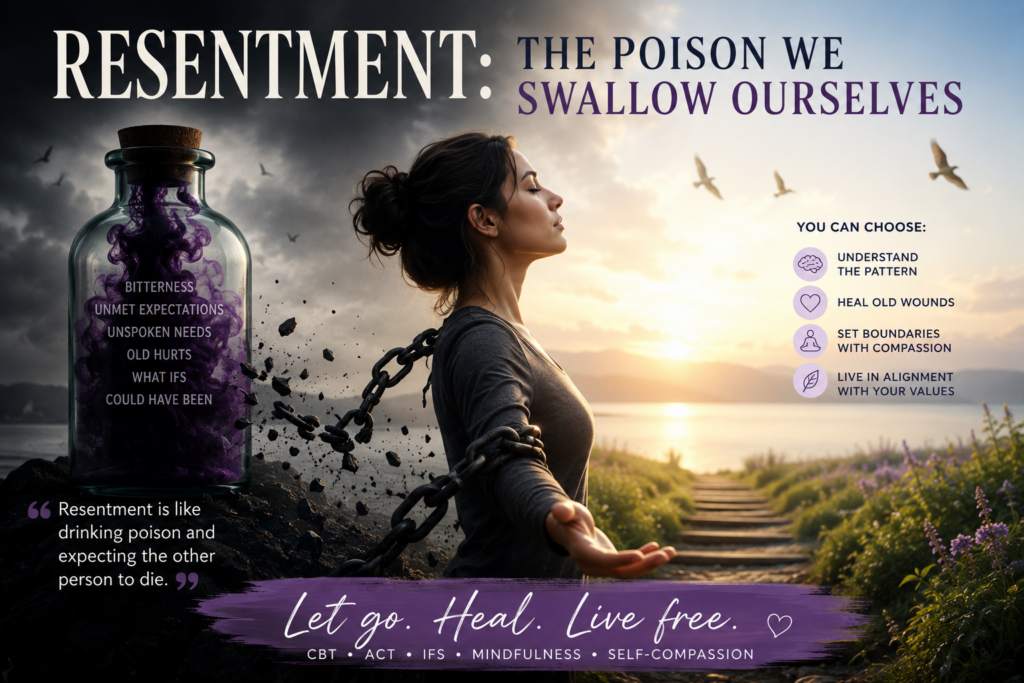
Resentment: The Poison We Swallow Ourselves
“Resentment is like drinking poison and expecting the other person to die.” While this quote is often attributed to various sources, its message captures an important psychological truth: resentment rarely hurts the other person nearly as much as it harms the individual carrying it.
Many people assume resentment develops solely because someone has wronged them. While hurtful experiences can certainly trigger resentment, the emotion is often maintained by deeper patterns involving boundaries, expectations, beliefs about fairness, and unresolved emotional pain. Left unchecked, resentment can quietly shape relationships, increase stress, fuel anxiety and depression, and erode overall wellbeing.
The encouraging news is that resentment is not simply something to “get over.” Modern evidence-based therapies can help people understand why it develops, resolve the underlying issues that sustain it, and move towards healthier, more satisfying relationships.
Why Resentment Is So Toxic
Resentment is a complex emotional state involving anger, disappointment, injustice, and unresolved hurt. Unlike brief anger, resentment tends to linger. It often becomes repetitive, with individuals mentally replaying conversations, imagined confrontations, or perceived betrayals long after the original event.
Research consistently demonstrates that chronic rumination and prolonged negative emotional states are associated with elevated stress, poorer psychological health, increased physiological arousal, and reduced overall wellbeing (Nolen-Hoeksema et al., 2008).
When resentment becomes chronic, it can:
* Increase anxiety and depressive symptoms
* Contribute to chronic stress and emotional exhaustion
* Damage intimacy and trust
* Lead to emotional withdrawal or passive-aggressive behaviour
* Narrow one’s perspective so that new interactions are filtered through past injuries
Ironically, the person we resent may have little awareness of the emotional burden we continue to carry.
How Resentment Quietly Builds
Resentment rarely appears overnight. More commonly, it accumulates through repeated experiences in which our needs are not acknowledged or expressed.
The People-Pleasing Trap
One of the most common pathways to resentment begins with excessive accommodation.
Many people pride themselves on being helpful, agreeable, and dependable. They say yes when they want to say no. They avoid conflict. They suppress disappointment to keep the peace.
Initially this may appear generous. However, over time an internal ledger begins to form:
“I’ve always been there for them.”
“Why doesn’t anyone appreciate everything I do?”
“I keep sacrificing for everyone else.”
The paradox is that resentment often develops not because others demanded too much, but because we repeatedly volunteered more than we genuinely wanted to give.
Difficulty asserting needs, fear of disappointing others, perfectionism, and beliefs such as “good people always put others first” frequently contribute to this pattern.
Healthy relationships require generosity—but they also require clear boundaries.
The Other Extreme: Unrealistic Expectations and Entitlement
At the opposite end of the continuum, resentment can develop when expectations become rigid or unrealistic.
Some individuals carry deeply held assumptions such as:
* People should always treat me fairly.
* Others should know what I need without my having to ask.
* Life should unfold according to my expectations.
* If I work hard, I should never experience disappointment.
Schema Therapy refers to one version of this pattern as an Entitlement/Grandiosity Schema, while unrealistic standards may also stem from other schemas involving unrelenting standards, mistrust, or emotional deprivation (Young et al., 2003).
When reality inevitably falls short, resentment emerges because the world continually violates these internal rules.
This does not mean a person’s feelings are invalid. Rather, it highlights that suffering often arises from the gap between rigid expectations and the imperfect reality of human relationships.
Sometimes the Hurt Is Real
Not all resentment reflects distorted thinking.
Sometimes resentment develops because someone truly was betrayed, manipulated, neglected, abused, or repeatedly treated unfairly.
In these situations, attempts to simply “think differently” may feel invalidating.
Instead, healing often involves:
* acknowledging the legitimacy of the hurt
* processing grief and anger
* establishing healthier boundaries
* deciding what role, if any, the relationship should have moving forward
Forgiveness, where appropriate, is a personal choice—not an obligation. It should never require tolerating ongoing mistreatment.
How CBT Helps
Cognitive Behavioural Therapy (CBT) examines the relationship between thoughts, emotions, and behaviours.
When working with resentment, CBT helps individuals identify thinking patterns that may unintentionally maintain suffering, including:
* mind reading
* catastrophizing
* “should” statements
* all-or-nothing thinking
* overgeneralization
For example:
“They never appreciate me.”
“People shouldn’t behave this way.”
“If they cared, they’d know what I need.”
These thoughts often feel unquestionably true, yet they are frequently incomplete or exaggerated.
CBT also encourages behavioural change.
Rather than repeatedly replaying unfair experiences, individuals learn skills such as:
* assertive communication
* problem solving
* boundary setting
* reducing rumination
* responding intentionally rather than reacting automatically
How ACT Helps
Acceptance and Commitment Therapy (ACT) offers a different perspective.
Rather than attempting to eliminate difficult emotions, ACT encourages individuals to change their relationship with them.
Resentment often pulls us into endless mental battles about what should have happened.
ACT helps individuals notice thoughts such as:
“This shouldn’t have happened.”
without becoming completely fused with them.
Through mindfulness, acceptance, and cognitive defusion, resentment becomes an experience to observe—not a story that defines one’s identity.
ACT also shifts attention toward values.
Instead of asking:
“Who was right?”
ACT asks:
“What kind of person do I want to be now?”
This shift allows people to make choices based on their values rather than allowing resentment to dictate future behaviour.
How Internal Family Systems (IFS) Helps
Internal Family Systems (IFS) views the mind as consisting of different “parts” that developed to protect us.
The resentful part often has an important purpose.
It may be attempting to:
* prevent future betrayal
* ensure our needs are finally recognized
* protect vulnerable feelings of rejection
* guard against being taken advantage of again
Rather than suppressing resentment, IFS invites curiosity.
What is this part afraid would happen if it let go?
Frequently, underneath resentment lies a much younger wounded part carrying sadness, shame, loneliness, or fear.
As these underlying wounds are compassionately processed, the protective resentful part often no longer needs to work so hard.
The Common Thread
Although resentment may arise from very different life experiences, a common theme often emerges:
Something important feels unresolved.
Whether that involves unspoken needs, ineffective boundaries, unrealistic expectations, old attachment wounds, or genuine betrayal, resentment signals that attention is needed.
Rather than viewing resentment as a flaw to eliminate, it can be understood as valuable information pointing towards areas requiring healing, clarity, and change.
Moving Towards Freedom
Freedom from resentment does not necessarily mean forgetting the past or excusing harmful behaviour.
Instead, it involves reclaiming emotional energy that has become trapped in repeated mental battles over events that cannot be changed.
Sometimes this means learning to say “no.”
Sometimes it means adjusting unrealistic expectations.
Sometimes it means grieving what should have been.
Sometimes it means processing old wounds with compassion.
And sometimes it means recognizing that continuing to carry resentment hurts us far more than it hurts the person who originally caused the pain.
The goal is not to deny what happened.
The goal is to ensure that yesterday’s injuries no longer control today’s life.
If you or a loved one are burdened by resentment, CONTACT US today to set up an appointment.
References
Hayes, S. C., Strosahl, K. D., & Wilson, K. G. (2012). Acceptance and commitment therapy: The process and practice of mindful change (2nd ed.). Guilford Press.
Nolen-Hoeksema, S., Wisco, B. E., & Lyubomirsky, S. (2008). Rethinking rumination. Perspectives on Psychological Science, 3(5), 400–424.
Young, J. E., Klosko, J. S., & Weishaar, M. E. (2003). Schema therapy: A practitioner’s guide. Guilford Press.
Beck, J. S. (2021). Cognitive behaviour therapy: Basics and beyond (3rd ed.). Guilford Press.
Prepared by Dr. Jennifer Barbera, PhD, Registered Psychologist
Dr. Jennifer Barbera PhD, C. Psych is a licensed psychologist with over 25 years of counselling experience. She has extensive clinical expertise supporting individuals and couples with anxiety, trauma, depression, addiction, and relationship challenges. Her work combines evidence-based approaches with practical strategies to help clients build resilience and improve well-being.