How to Change Your Personality by Understanding Temperament and Schemas
Changing Personality: Temperament, Schemas, and Growth
Learn how inherited temperament and core schemas shape personality and how therapy can help update patterns for lasting change.
How Personality Forms: Temperament Meets Core Schemas
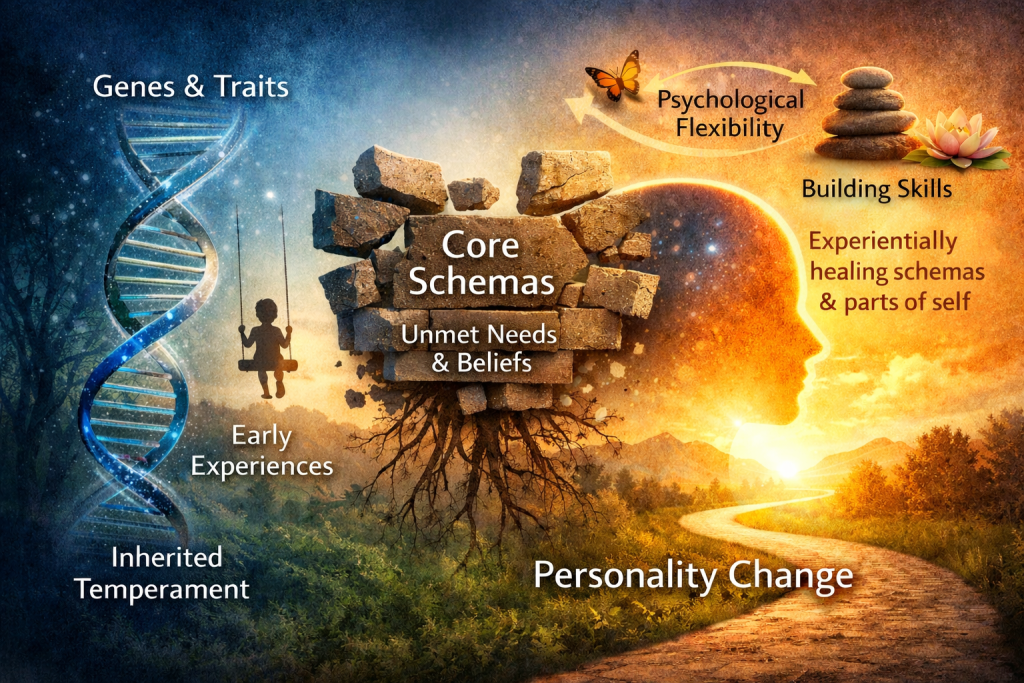
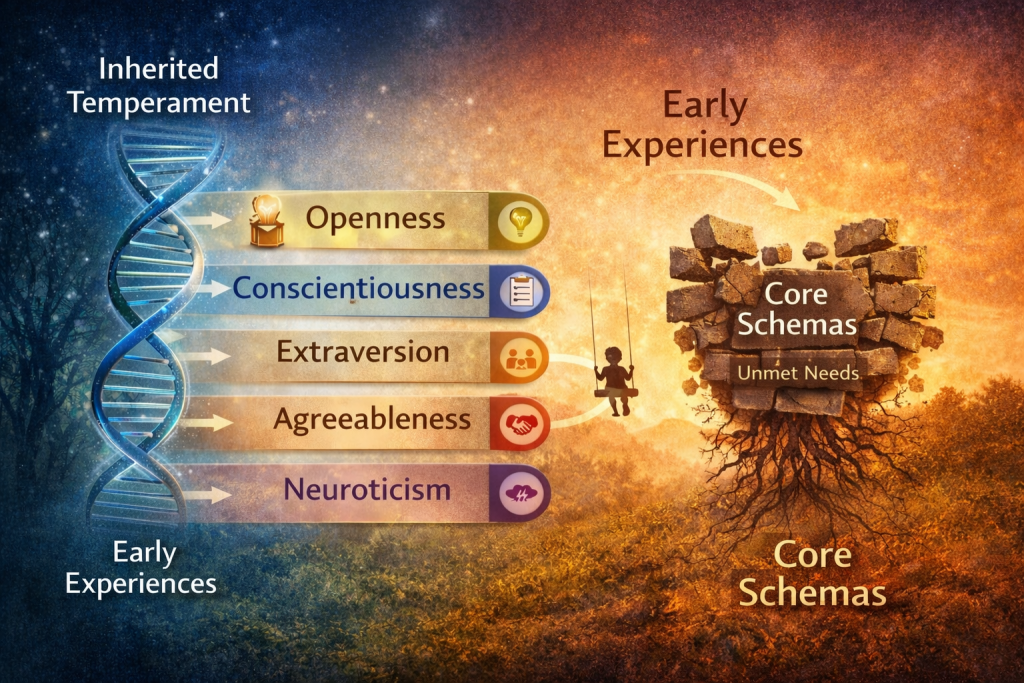
Personality is the intricate combination of how we perceive, think, feel, and behave. It is not simply fixed; rather, it develops through the interaction of inherited temperament and the core schemas that emerge based on whether our fundamental needs were met during early life.
Temperament provides the biological foundation: it shapes our natural reactivity, energy, curiosity, and emotional sensitivity.
Core schemas, in contrast, are the beliefs and mental patterns formed to make sense of our experiences, particularly those tied to unmet needs.
For example, a child with a naturally sensitive temperament who experiences inconsistent care will more readily develop schemas of mistrust, abandonment, or defectiveness.
These schemas then guide automatic interpretations, emotional responses, and behavioural strategies, often outside of conscious awareness. Personality, in this sense, is a product of nature and experience—a dynamic system of inherited traits and learned patterns.
The Key to Personal Change: Combining Flexibility, Skills, and Values
Because personality arises from temperament and schemas, changing patterns we want to adjust is not about trying to overwrite temperament. Instead, effective change requires a therapeutic approach that combines:
1. Psychological Flexibility & skills development – Learning to observe thoughts, feelings, and urges without being dominated by them, allowing more adaptive choices. Practising emotional regulation, distress tolerance, mindfulness, and defusion skills.
2. Values and Goals Awareness – Clarifying what truly matters, what we want to feel, and how we want to act in our lives.
3. Assessing & shifting schemas- identifying and understanding exactly what core needs were not fully met, and the schemes that you took on to adapt to those unmet needs, then working in therapy experientially to meet those needs and update the schemas or parts of self.
This approach works because it targets the core schemas or internalized parts that block us. For instance, a schema of defectiveness may trigger self-criticism and avoidance.
Therapy provides tools to identify, challenge, and update that schema while practicing new ways of responding that align with personal values. Over time, this changes both emotional experience and behaviour in a more lasting, meaningful way.
A meta‑analysis of over 200 intervention studies found that therapy and related interventions can produce measurable changes in personality traits such as neuroticism and conscientiousness, demonstrating that traits are not fixed but can shift with meaningful experience and effort (Roberts et al., 2017).
How Therapy Updates Schemas and Parts
Schemas are like mental programs: once formed, they automatically interpret experiences and guide behaviour. Through guided therapy, these schemas can be softened, updated, or healed. Techniques often involve:
• Experiential exercises that allow one to feel unmet needs being met in a safe context.
• Imaginal work to rehearse new responses or reframe old experiences.
• Skills application in real-life situations to reinforce new patterns.
Because temperament sets a range of natural tendencies, therapy works with—not against—these inherent traits. For example, a naturally cautious individual may learn to take calculated risks aligned with their values, while a highly reactive person may learn strategies to regulate intense emotions without suppressing them.
Personality Change is Possible
While personality traits have a biological foundation and schemas are deeply ingrained, they are not immutable. By combining flexibility, skill-building, and clear direction about values, it is possible to shift how one thinks, feels, and behaves.
The focus is not on erasing who you are, but on helping the parts and schemas that are stuck or blocking you to adapt in ways that better serve your goals and well-being.
Understanding your temperament and schemas allows for targeted growth. It empowers you to act with intention rather than habit, to feel emotions fully without being overwhelmed, and to align behaviour with what truly matters.
We invite you to contact us today to explore how therapy can help you update old schemas, heal unmet needs, and create meaningful change in the ways you think, feel, and behave.
References:
Roberts BW, Luo J, Briley DA, Chow PI, Su R, Hill PL. A systematic review of personality trait change through intervention. Psychol Bull. 2017 Feb;143(2):117-141.
Roberts, B. W., & Mroczek, D. (2008). Personality trait change in adulthood. Current Directions in Psychological Science, 17(1), 31–35
Prepared by Dr. Jennifer Barbera, PhD, Registered Psychologist
Dr. Jennifer Barbera PhD, C. Psych is a licensed psychologist with over 25 years of counselling experience. She has extensive clinical expertise supporting individuals and couples with anxiety, trauma, depression, addiction, and relationship challenges. Her work combines evidence-based approaches with practical strategies to help clients build resilience and improve well-being.