The ACT Matrix: How to Turn Therapy Insights Into Meaningful Action
From Insight to Action: How the ACT Matrix Helps Us Live What Matters
One of the most frustrating experiences in therapy is knowing what you want to do differently—and still finding yourself doing the same thing.
You may understand why you become defensive with your partner. You may know that exercise helps your mood. You may have decided that you want to stop drinking, scrolling, overeating, procrastinating, or using other forms of emotional numbing. You may even have developed considerable insight into the thoughts, emotions, memories, and experiences that keep you stuck.
And yet, when the moment arrives, insight can disappear remarkably quickly.
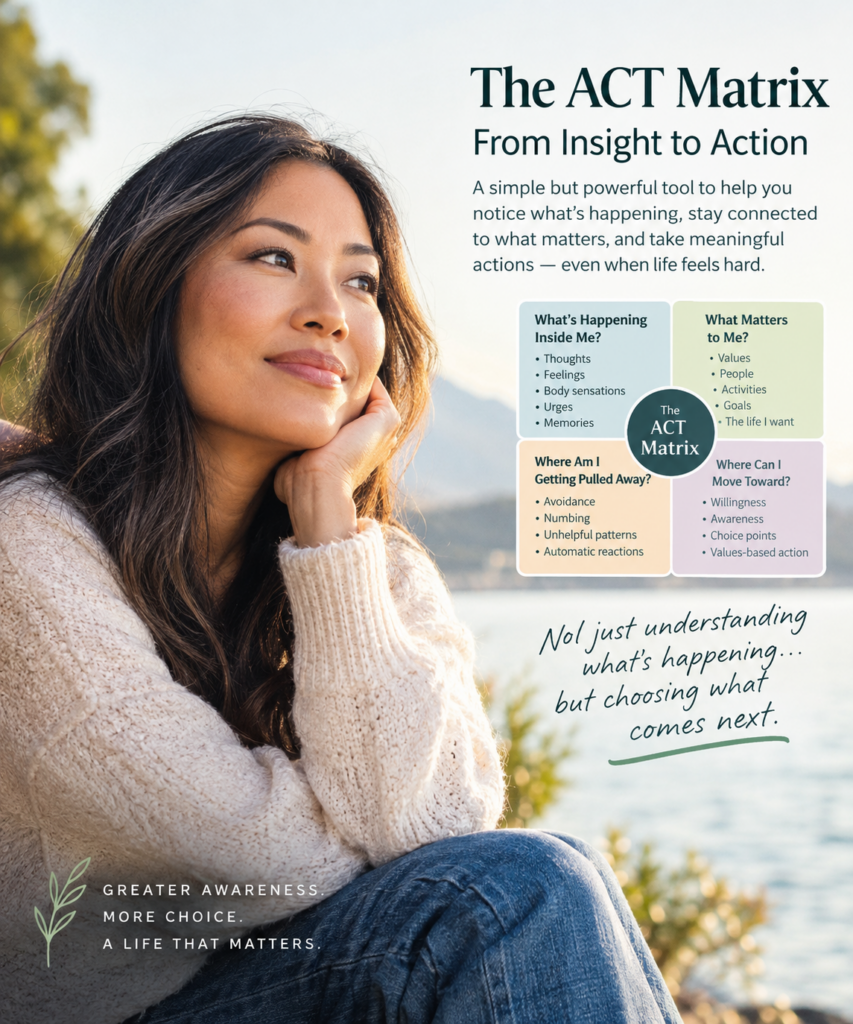
This is where the ACT Matrix, a practical tool from Acceptance and Commitment Therapy (ACT), can become particularly powerful. Rather than asking us simply to understand ourselves better, the Matrix helps us notice what is happening in the moment and reconnect with the direction in which we actually want our lives to move.
The gap between knowing and doing
Psychotherapy often generates important insights. We learn about our patterns, identify triggers, challenge unhelpful thinking, develop coping strategies, and clarify our values.
But insight does not automatically become behaviour.
The ACT Matrix helps bridge this gap by repeatedly bringing our attention back to a deceptively simple question:
“In this moment, am I moving toward the person and life that matter to me, or am I getting pulled away by what is showing up inside me?”
At its core, the Matrix maps two things: what we experience internally and externally, and how we respond to those experiences.
On one side are the thoughts, feelings, bodily sensations, memories, urges and mental stories that show up inside us. On the other are the people, activities and aspects of life that matter to us. The Matrix then helps us distinguish between actions that move us toward what matters and behaviours that are primarily attempts to get away from uncomfortable internal experiences.
That distinction is crucial.
Psychological flexibility does not mean feeling calm, confident or motivated before taking action. It means becoming increasingly able to make meaningful choices even when difficult thoughts and feelings are present.
Research on ACT increasingly supports psychological flexibility as an important mechanism of change. A 2024 systematic review and meta-analysis of 67 studies found that ACT was associated with reductions in psychological inflexibility—including cognitive fusion, experiential avoidance and inaction—and increases in flexibility, acceptance, defusion and committed action. These changes were also associated with reductions in psychological distress.
The power of the “hook”
One of the most useful concepts associated with the Matrix is the idea of being hooked.
A hook is anything that captures our attention and pulls us into an automatic pattern of responding.
It might be a thought:
“They don’t appreciate me.”
“I deserve this.”
“I’ll start tomorrow.”
“I can’t handle feeling this way.”
It might be an emotion, such as anger, shame, loneliness or anxiety. It might be an urge, a memory, a bodily sensation or a familiar internal story.
The problem is not that these experiences occur. Human beings inevitably have thoughts, feelings and urges.
The problem arises when we become so entangled with them that they begin to dictate our behaviour.
For example, imagine that your partner makes a comment that feels critical. You notice a surge of anger. Your mind immediately produces the thought, “Here we go again. They never listen to me.” Before you know it, you have snapped back.
The Matrix invites you to notice the hook before the behaviour is complete:
“I’m hooked by the story that I’m being disrespected.”
That tiny moment of noticing can create something extraordinarily important: choice.
Why noticing choice points matters
A choice point is a moment when we can notice what is happening and choose our next move.
These moments happen constantly.
Your child says something irritating.
You arrive home exhausted and reach automatically for a drink.
You feel anxious about exercising and decide to skip the gym.
You feel lonely and begin scrolling for an hour.
You notice an urge to smoke, gamble, overeat, shop, drink, or engage in another habitual behaviour.
You are lying in bed thinking about tomorrow and begin catastrophizing.
These are not merely “symptoms.” They are behavioural crossroads.
The important question is not:
“How do I make this feeling go away?”
It is:
“Given that this feeling is here, what do I want to do next?”
That shift is at the heart of psychological flexibility.
Applying the Matrix to relationships
Consider someone who wants to respond more calmly to the people they love.
Their value might be being a patient, caring and emotionally present partner or parent.
The hooks might include feeling criticized, rejected, ignored or misunderstood.
Their habitual away moves might include snapping, withdrawing, criticizing back, shutting down or reaching for their phone.
A Matrix practice helps them recognize the sequence:
Trigger → hook → automatic response → consequence.
Over time, they can begin noticing the hook earlier.
“I’m feeling criticized.”
“My mind is telling me I need to defend myself.”
“I’m having the urge to attack.”
And then:
“What would moving toward the relationship I want look like right now?”
Perhaps it is taking one breath before answering. Perhaps it is saying, “I’m getting defensive. Can we slow this down?” Perhaps it is listening rather than proving a point.
The goal isn’t perfect emotional regulation. It is repeatedly choosing behaviour that serves the relationship they want to build.
Applying the Matrix to health and lifestyle change
The same process applies to exercise, nutrition, sleep and other health behaviours.
Suppose someone wants to become more physically active. The obstacle isn’t necessarily a lack of knowledge about exercise. They may already know exactly what would be beneficial.
The hook might be:
“I’m too tired.”
“I don’t feel like it.”
“I’ll do it tomorrow.”
The Matrix doesn’t require the person to argue with those thoughts.
Instead, it asks them to notice:
“There is the ‘I don’t feel like it’ story.”
Then:
“What small action would move me toward the healthy life I want?”
Sometimes that action is a workout. Sometimes it is a ten-minute walk. Sometimes it is going to bed instead of continuing to scroll.
The important shift is from waiting to feel motivated to acting in the direction of one’s values while motivation fluctuates.
Research specifically examining an ACT Matrix-based intervention for health behaviours found promising results: participants who engaged with an Matrix-based app showed increases in valued actions over time, and psychological flexibility was associated with greater increases in valued action.
Breaking free from numbing and addictive patterns
The Matrix can also be particularly useful when behaviour is functioning as an escape.
A person may drink to shut off anxiety, scroll to avoid loneliness, overeat to soothe distress, or use another habitual behaviour to escape boredom, shame or emotional discomfort.
The Matrix changes the question from:
“How can I stop wanting this?”
to:
“What is happening right now, and what happens if I don’t automatically obey the urge?”
An urge can be noticed without being followed.
A thought can be noticed without being believed.
An emotion can be experienced without requiring immediate escape.
This is not about suppressing uncomfortable experiences. In fact, it is almost the opposite. We become more willing to make room for difficult internal experiences while choosing behaviour based on what matters.
The Matrix is ultimately about direction
Perhaps the most powerful aspect of the ACT Matrix is that it does not require us to win a battle with ourselves before we can live differently.
You don’t have to eliminate anxiety before making the phone call.
You don’t have to feel confident before setting the boundary.
You don’t have to stop craving something before choosing not to act on the urge.
You don’t have to become calm before responding compassionately.
You don’t have to stop having self-critical thoughts before treating yourself with kindness.
The goal is not to create a life without difficult thoughts and feelings. It is to develop the capacity to notice them, recognize when we are hooked, and reconnect with the direction we want to take.
In that sense, the ACT Matrix is much more than a worksheet.
It is a way of practising psychological flexibility in real time.
Every day contains dozens of choice points. Each one offers another opportunity to ask:
“What has hooked me?”
“What matters to me here?”
“What would moving toward that look like in this moment?”
We don’t need to make the perfect choice every time.
We simply need to become better at noticing the moment when a choice is available—and then, increasingly, choosing the direction that matters.
A better way forward
The ACT Matrix becomes most powerful when it moves from something you understand intellectually to something you can actually use in the moments that matter most. With practice, those moments of frustration, anxiety, craving, avoidance, self-doubt or emotional reactivity can become opportunities to pause, notice when you have been hooked, reconnect with what matters most, and take one meaningful step in that direction. You don’t have to wait until you feel ready, motivated or completely in control to begin making different choices.
If you are ready to move beyond simply understanding your patterns and start translating your insights into meaningful everyday action, we invite you to CONTACT US today to learn how the ACT Matrix and other evidence-informed approaches can help you build greater psychological flexibility and create lasting change in the areas of your life that matter most.
References
Hsu, T., Adamowicz, J. L., & Thomas, E. B. K. (2023). The effect of acceptance and commitment therapy on the psychological flexibility and inflexibility of undergraduate students: A systematic review and three-level meta-analysis. Journal of Contextual Behavioral Science, 30, 169–180.
Krafft, J., Potts, S., Schoendorff, B., & Levin, M. E. (2019). A randomized controlled trial of multiple versions of an Acceptance and Commitment Therapy Matrix app for well-being. Behavior Modification, 43(2), 246–272.
Levin, M. E., Pierce, B., & Schoendorff, B. (2017).The Acceptance and Commitment Therapy Matrix mobile app: A pilot randomized trial on health behaviors. Journal of Contextual Behavioral Science, 6(3), 268–275.
Macri, J. A., & Rogge, R. D. (2024). Examining domains of psychological flexibility and inflexibility as treatment mechanisms in Acceptance and Commitment Therapy: A comprehensive systematic and meta-analytic review. Clinical Psychology Review, 110, 102432.
Prepared by Dr. Jennifer Barbera, PhD, Registered Psychologist
Dr. Jennifer Barbera PhD, C. Psych is a licensed psychologist with over 25 years of counselling experience. She has extensive clinical expertise supporting individuals and couples with anxiety, trauma, depression, addiction, and relationship challenges. Her work combines evidence-based approaches with practical strategies to help clients build resilience and improve well-being.