Tag: Therapeutic modalities
Part one of this topic (see previous post) introduced the ACT (Acceptance & Commitment Therapy) model and how it teaches people to change the way they react to their thoughts…
How many people do you actually know who have never felt anxious, down or stressed in their lives in some way? Sure, some idealized person that always seems to have…
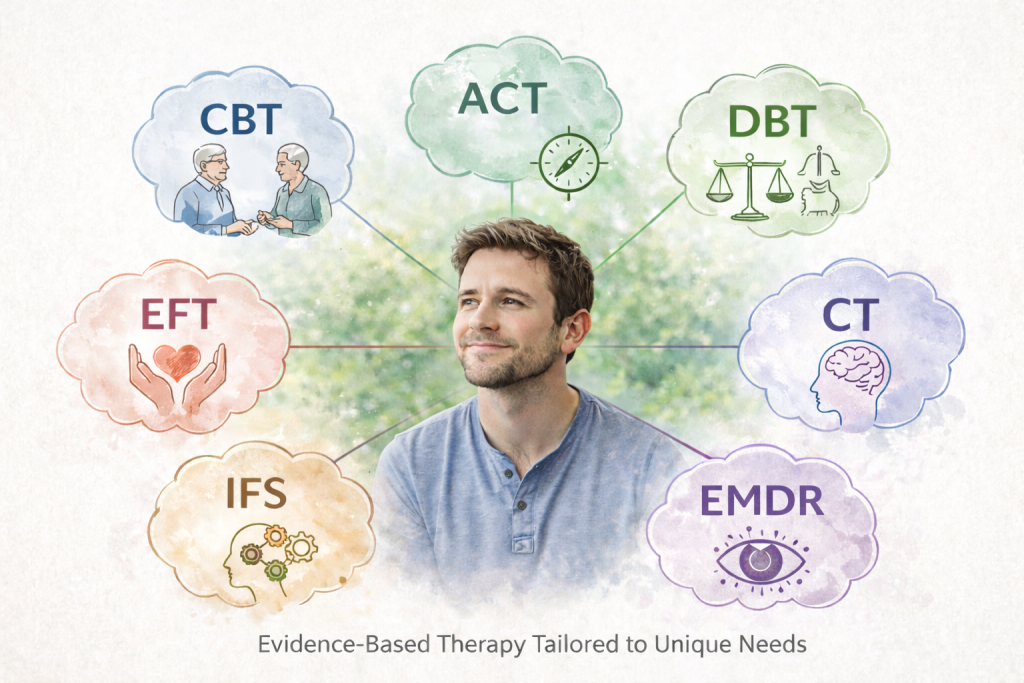
Understanding Evidence-Based Therapeutic Modalities When considering therapy, you might hear the term evidence-based. This means that the approach has been rigorously studied and shown to be effective for particular mental…
We offer ACT therapy in Hamilton and online across Ontario. Our services are led by a PhD Psychologist was over 25 years counselling experience. ACT stands for Acceptance and Commitment…
CBT was developed in the 1960s to help treat mood and anxiety symptoms. CBT is a structured treatment that focuses on the role of thoughts and behaviour on psychological and…
[vc_row][vc_column][vc_column_text css=""]We offer EFT therapy (for individuals & couples) in Hamilton and online across Ontario. Our services are led by a PhD Psychologist was over 25 years counselling experience. EFT…
We offer IFS informed therapy guided by a PhD level psychologist in Hamilton Ontario and online across Ontario. Contact us to set up an appointment. IFS was developed by Dr.…
DBT is another evidence-based psychotherapy that is commonly used to help address distress tolerance difficulties, self-harm behaviours and Borderline Personality characteristics. DBT is sometimes used to help bolster coping skills…
EMDR is a highly specialized therapy that is primarily used to treat trauma and PTSD and work on the restructuring of disruptive core beliefs such as deep-rooted feelings of inadequacy,…