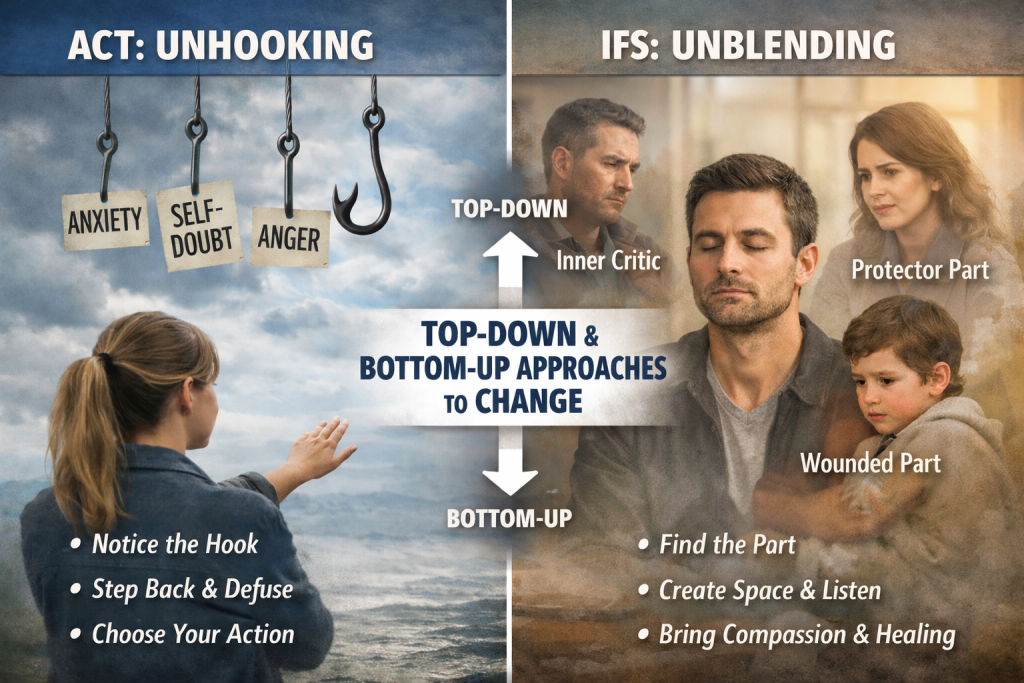
How to achieve deeper change with ACT unhooking and IFS unblending
ACT Hooks and IFS Unblending: Differences, Overlap, and Why Using Both Matters
Many therapeutic models aim to help people change entrenched emotional and behavioural patterns, yet they often approach this goal from different directions. Acceptance and Commitment Therapy (ACT) and Internal Family Systems (IFS) are two such approaches. While they come from distinct theoretical traditions, ACT’s hooks metaphor and IFS’s process of unblending address a remarkably similar human challenge: how people become fused with painful thoughts, emotions, and internal reactions, and how that fusion keeps patterns going.
Understanding both concepts—and knowing how to apply them together—allows therapists and clients to work top down and bottom up at the same time, which is often the most effective route to lasting change.
ACT’s Hooks Metaphor: Seeing How We Get Caught
In ACT, difficult thoughts and feelings are often described using the hooks metaphor. Thoughts, memories, urges, and emotions are imagined as hooks hanging in the environment. Hooks themselves are not the problem; the problem arises when we get caught on them and are pulled away from our values or present-moment living.
Being hooked typically looks like:
• Taking thoughts literally (“This feeling means something is wrong with me”)
• Automatically reacting to internal discomfort
• Narrowing behaviour around avoidance, control, or struggle
ACT does not aim to remove the hooks. Instead, it teaches defusion, acceptance, and mindful awareness so a person can notice when they are hooked and choose how to respond. This is a primarily top-down process: it works through awareness, language, perspective-taking, and intentional choice.
The strength of the hooks metaphor is its simplicity and immediacy. Clients can often recognize, in real time, “I’m hooked right now,” and create just enough distance to act differently.
IFS Unblending: Separating From Parts Without Rejecting Them
IFS theory uses different language but targets a related phenomenon. Rather than hooks, IFS speaks of parts—sub-personalities that carry emotions, beliefs, and protective strategies shaped by life experience. When a part takes over awareness, the person is said to be blended with that part.
Unblending occurs when a person can say, in effect:
“A part of me feels this way,” rather than “This is who I am.”
Unblending is not simply cognitive distancing. It is an experiential process in which the nervous system shifts, allowing the person’s core Self—characterized by calm, clarity, and compassion—to relate to the part rather than be overtaken by it. This makes unblending a more explicitly bottom-up process, engaging emotional memory, somatic experience, and implicit learning.
Where ACT emphasizes stepping back from internal experiences, IFS emphasizes turning toward them, building a relationship that allows those experiences to soften or transform.
Key Similarities: Two Languages for the Same Human Problem
Despite their differences, ACT hooks and IFS unblending share several essential similarities:
• Both recognize that fusion with inner experience drives suffering and rigid patterns
• Both help people move from identification (“I am this”) to observation (“I’m noticing this”)
• Both increase psychological flexibility by restoring choice
• Neither requires eliminating distressing thoughts or feelings for change to occur
In practice, a client who is hooked in ACT terms is often blended in IFS terms. The lived experience is the same: a loss of perspective and freedom.
Key Differences: Direction of Attention and Mechanism of Change
The differences matter clinically.
ACT’s hooks metaphor:
• Emphasizes function over origin
• Works well for interrupting behaviour patterns quickly
• Relies on mindful noticing and values-based action
• Is especially effective when language and cognition are accessible
IFS unblending:
• Explores the meaning and protective role of internal reactions
• Engages emotion, attachment, and body-based memory
• Facilitates deep internal reorganization over time
• Is especially effective for trauma-related or attachment-based patterns
Neither approach is inherently better. They work on different layers of the same system.
Why Using Both Is More Effective Than Either Alone
Lasting change usually requires shifts in both explicit and implicit systems. ACT primarily targets explicit processes—how we relate to thoughts, how we choose actions, how we orient to values. IFS directly targets implicit processes—emotional learning, protective responses, and nervous system patterns shaped by experience.
When only top-down strategies are used, clients may understand their patterns without feeling different. When only bottom-up work is used, insight and daily behavioural change may lag behind emotional shifts.
Using ACT hooks and IFS unblending together allows:
• Awareness to interrupt patterns in the moment (top down)
• Emotional learning to update what the system expects over time (bottom up)
• Behavioural change that is both intentional and internally supported
For example, a client may notice they are hooked by a self-critical thought (ACT), create space from it, and still choose to turn inward with curiosity to the part that fears failure (IFS). The hook loosens, and the part no longer needs to shout to be heard.
Integrating the Approaches in Practice
Clinically, integration does not require blending the models into one. It requires knowing when to step back and when to go in.
ACT skills are particularly useful when:
• A client is overwhelmed and needs immediate grounding
• Behavioural avoidance is maintaining the problem
• Values-based action has stalled
IFS unblending is particularly useful when:
• Reactions feel repetitive, intense, or inexplicable
• Trauma or attachment history is activated
• Cognitive insight has not led to emotional relief
Together, they allow therapists and clients to work with the full complexity of human change.
Conclusion: Flexibility at Every Level
ACT’s hooks metaphor and IFS unblending are not competing ideas; they are complementary lenses on the same human process. One emphasizes stepping back so we can choose differently. The other emphasizes turning toward so the system no longer needs to react the same way.
When people learn how to do both, they gain flexibility not only in how they think and act, but in how they relate to themselves. This combination—top down and bottom up—is often what finally allows entrenched patterns to loosen and new ways of being to take hold.
Contact us to learn more about how both approaches could help you.