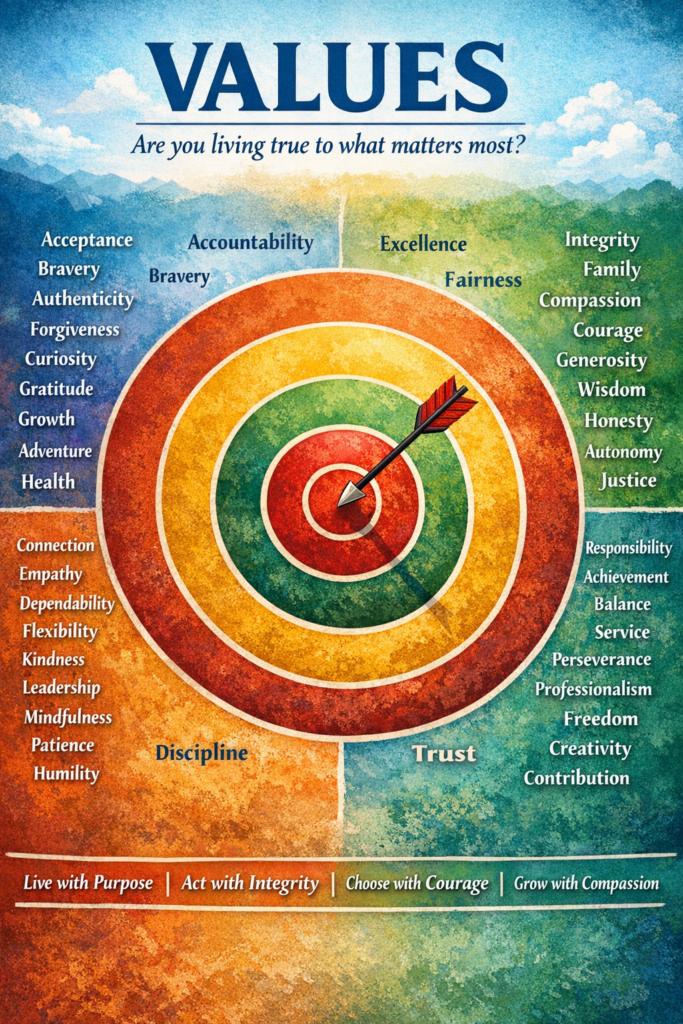
Values are the directional core of psychological flexibility. They answer a deceptively simple question: What kind of person do I want to be, and how do I want to show up in the world?
Unlike goals, which can be completed and checked off, values are ongoing qualities of action. You cannot “finish” being a loving parent, an ethical professional, or a courageous human being.
Values function more like a compass than a destination—they orient behaviour moment by moment.
Within psychological flexibility, values provide the motivational engine for change. Without them, therapeutic work can become symptom-focused and reactive: reducing anxiety, eliminating sadness, solving conflict. While relief is important, symptom reduction alone rarely produces a meaningful life.
Values clarify what makes the discomfort worthwhile. When a client chooses to have a difficult conversation because honesty matters, or tolerates vulnerability because intimacy matters, they are behaving flexibly. They are allowing internal discomfort in the service of something larger than short-term emotional control.
This shift has direct implications for well-being. People suffer most when their lives become organized around avoidance—avoiding failure, avoiding rejection, avoiding distress. Over time, avoidance shrinks behavioural repertoires and narrows identity.
Values reverse this contraction. They expand life outward. Acting consistently with one’s values tends to produce a sense of vitality, coherence, and integrity—even when circumstances remain imperfect or difficult.
Research consistently shows that values-congruent behaviour is associated with greater life satisfaction, resilience, and psychological health because it aligns action with meaning rather than mood.
It is important to clarify what values are not. They are not externally imposed standards, social expectations, or perfectionistic demands. They are chosen qualities of being. Nor are they rigid rules.
Values guide; they do not punish. When individuals treat values as “shoulds,” they lose flexibility and inadvertently recreate shame cycles. Healthy values work is grounded in choice, curiosity, and ownership (self-leadership).
Developing clarity around values requires deliberate reflection. Clinically, this may involve exploring peak experiences, moments of regret, admired qualities in others, or envisioning one’s 80th birthday speech.
In daily life, simple questions can anchor the practice: If I were at my best in this situation, how would I respond? What would matter here if fear were not running the show?
Writing exercises, values card sorts, and behavioural experiments help translate abstract ideals into concrete action. Crucially, values must be operationalised—broken down into small, observable behaviours. “Health” becomes going for a 20-minute walk. “Connection” becomes sending a text or initiating a conversation.
Here is the disciplined truth: values do not eliminate discomfort; they make discomfort purposeful. The work is not to feel motivated first and then act. It is to act in alignment and allow motivation to follow.
Over time, repeated values-based actions build self-trust and psychological strength. You begin to experience yourself as someone who moves toward what matters, even when it is hard.
In psychological flexibility, values are the compass that gives direction to openness, defusion, and self-as-context. Without connect to values, flexibility lacks aim. With connection to values, it becomes a powerful framework for building a life defined not by symptom management, but by meaning.
Self as context is one of the most subtle—and most transformative—processes within psychological flexibility. It refers to the capacity to experience a stable sense of Self that is distinct from…
Committed action is a core process within Acceptance and Commitment Therapy (ACT)—a behavioural commitment to take values-guided steps even when it is uncomfortable to do so. In ACT, change is…
Human beings are always thinking. Our brains evolved to scan for threat, anticipate problems, and remember past pain so we could survive. That negativity bias kept our ancestors alive—but in…