Is Personality Shaped By Genes or Experiences?
Learn how OCEAN personality traits, temperament, unmet needs, and schemas interact to shape how you think, feel, and behave—and how change is possible.
Understanding Core Personality Structure
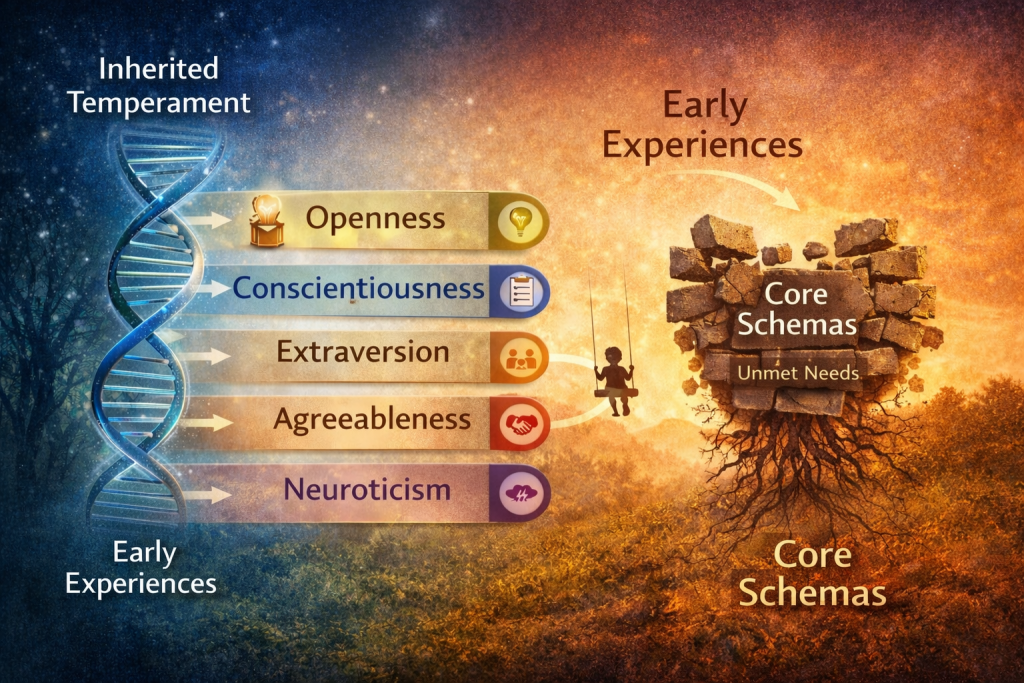
When people ask, “Is this just my personality?” they’re often referring to patterns that feel stable and deeply rooted. Modern personality psychology offers a helpful framework for understanding these patterns: the OCEAN model, also known as the Big Five personality traits. But traits alone do not determine who you become. Personality is shaped through the interaction of temperament, early experiences, unmet needs, and the schemas that develop in response.
The OCEAN Model Explained
The OCEAN model includes five broad personality dimensions:
• Openness to Experience – curiosity, creativity, and willingness to explore new ideas
• Conscientiousness – organization, responsibility, and self-discipline
• Extraversion – sociability, energy, and engagement with the external world
• Agreeableness – warmth, empathy, and cooperation
• Neuroticism – emotional sensitivity and vulnerability to stress
These traits represent foundational tendencies in how we think, feel, and behave. They are not diagnoses. They are not good or bad. They are baseline settings in our personality system.
Want to take a personality inventory to see where you fall on these dimensions?
Temperament and Heritability
Research consistently shows that personality traits are moderately heritable. In simple terms, we are born with a biological temperament that influences our emotional reactivity, sociability, and behavioural tendencies. Some children are naturally more cautious, others more bold. Some are emotionally sensitive, others steady.
Heritability does not mean destiny. It means there is a likely range within which a trait may fall. For example, someone born with lower baseline extraversion may never become highly extroverted—but they can become more socially confident within their natural range. Similarly, a naturally high-neuroticism temperament may always feel emotions deeply, but can learn regulation and resilience.
Think of temperament as setting the boundaries of the continuum, not the exact position on it.
The Role of Early Needs
Temperament interacts immediately with environment. Whether core early needs are met—secure attachment, autonomy, emotional expression, play, and realistic limits—shapes how traits are expressed.
For example:
• A highly sensitive child (higher neuroticism) with secure attachment may grow into an emotionally attuned adult.
• The same child in a chaotic or critical environment may develop anxiety, hypervigilance, or self-doubt.
The trait is the same. The outcome differs because needs were met differently.
How Schemas Develop
When early needs are unmet, the mind forms schemas—deeply held beliefs about self, others, and the world. These schemas influence how we interpret experiences.
For example:
• A naturally introverted child whose need for acceptance is unmet may develop a schema of social rejection and withdraw further.
• A naturally conscientious child raised in a highly critical environment may develop unrelenting standards or perfectionism.
Traits provide the raw material. Schemas shape the interpretation system.
This is how personality structure becomes layered:
Temperament → Need satisfaction or frustration → Schema formation → Patterns of thinking, feeling, and behaving.
Personality Traits Exist on a Continuum
Each OCEAN trait exists along a spectrum.
• Openness ranges from highly imaginative and exploratory to more practical and tradition-oriented.
• Extraversion ranges from highly social and energized by others to more reserved and reflective.
• Agreeableness ranges from highly accommodating to more analytical or direct.
• Conscientiousness ranges from highly structured to more spontaneous.
• Neuroticism ranges from emotionally reactive to emotionally stable.
Genetics influence the likely range. Environment determines where within that range a person settles.
Can Personality Shift?
Yes—within limits.
You cannot rewrite your temperament, but you can certainly influence its expression. Environment continues to shape personality across the lifespan. Later experiences, relationships, and especially therapy can shift where you fall along a continuum.
For example:
• Someone who is naturally cautious can become more open through corrective emotional experiences.
• A person with lower extraversion can build social confidence and feel less inhibited.
• Someone high in neuroticism can develop stronger emotional regulation skills and reduce reactivity.
Therapeutic interventions work because the brain remains malleable. When schemas are challenged and core needs are met experientially, neural pathways shift. Interpretation changes. Emotional responses soften. Behaviour becomes more flexible.
Personality is stable, but it is not fixed.
Integrating Traits and Healing
Understanding your OCEAN profile provides insight into your baseline tendencies.
Understanding your unmet needs and schemas explains why certain traits may feel more extreme, hard to change, or painful.
When we work at the level of needs and schemas, we are not trying to change who you are. We are helping your natural temperament express itself in healthier, more adaptive ways.
You are not your neuroticism. You are not your introversion. You are not your perfectionism. These are traits interacting with experiences. With insight and targeted intervention, you can move toward a version of yourself that feels more balanced and aligned with who you really are or want to be.
If you are curious about your own personality structure and how early experiences may have shaped it, we invite you to contact us today to explore how temperament, needs, and schemas interact in your unique story.
References:
Jang, K. L., Livesley, W. J., & Vernon, P. A. (1996). Heritability of the Big Five personality dimensions and their facets: a twin study. Journal of Personality, 64(3), 577–591.
Luo J, Derringer J, Briley DA, Roberts BW. Genetic and Environmental Pathways Underlying Personality Traits and Perceived Stress: Concurrent and Longitudinal Twin Studies. Eur J Pers. 2017 Dec 14;31(6):614-629.
Sanchez-Roige S, Gray JC, MacKillop J, Chen CH, Palmer AA. The genetics of human personality. Genes Brain Behav. 2018 Mar;17(3):e12439.
Prepared by Dr. Jennifer Barbera, PhD, Registered Psychologist
Dr. Jennifer Barbera PhD, C. Psych is a licensed psychologist with over 25 years of counselling experience. She has extensive clinical expertise supporting individuals and couples with anxiety, trauma, depression, addiction, and relationship challenges. Her work combines evidence-based approaches with practical strategies to help clients build resilience and improve well-being.