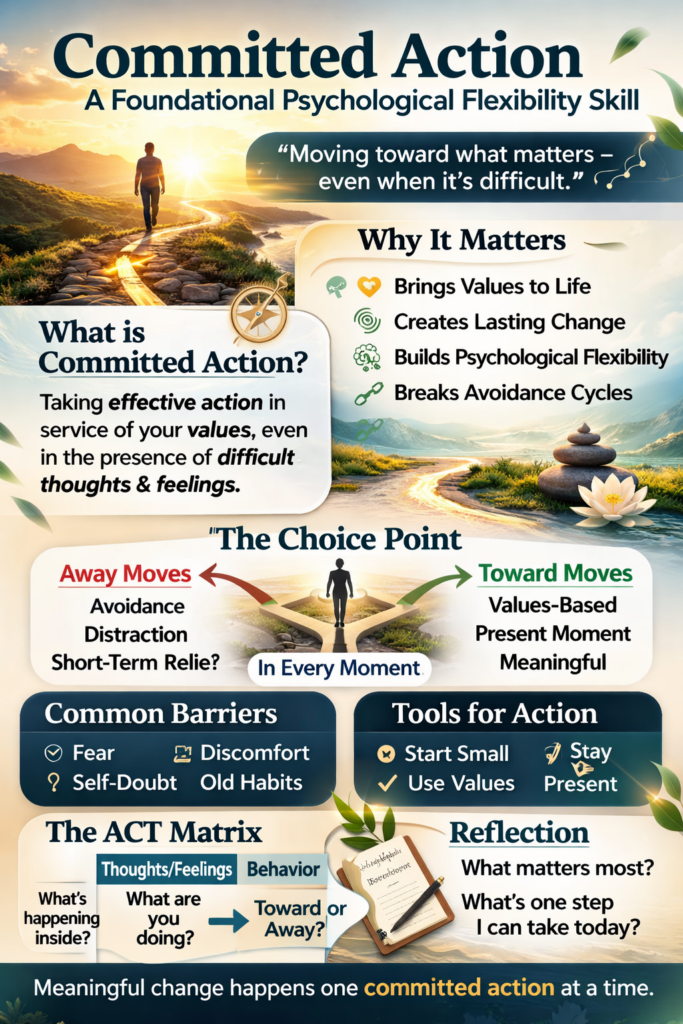
Committed action is a core process within Acceptance and Commitment Therapy (ACT)—a behavioural commitment to take values-guided steps even when it is uncomfortable to do so.
In ACT, change is not driven by eliminating distress, but by increasing psychological flexibility: the capacity to stay present, open, and engaged in actions that matter. Committed action is where insight becomes lived experience. It is the bridge between what we say is important and how we actually behave.
In clinical work, there are many factors that influence therapeutic outcomes: the quality of the therapeutic relationship, client readiness, severity of symptoms, social supports, and access to resources. Yet one of the most powerful predictors of change is what happens outside the therapy room.
Without meaningful actions, patterns tend to remain intact. Insight alone rarely reorganizes a life. Committed action—small, consistent, values-aligned behaviour—is often the decisive factor that determines whether therapy translates into sustainable growth.
Within the framework of Acceptance and Commitment Therapy, committed action is inseparable from values clarification. Values are chosen life directions—how we want to show up as partners, parents, professionals, and human beings. They are not goals that can be completed, but qualities of action we can embody repeatedly.
For example, “being a present parent” is a value; reading one chapter with your child tonight is committed action. “Health” is a value; going for a 20-minute walk despite low motivation is committed action. Over time, these behaviours accumulate into meaningful change.
The concept of the choice point (see video below), developed by Russ Harris, illustrates this process clearly. At any given moment, we are at a fork in the road. We can move toward moves—actions that bring us closer to our values—or away moves—actions driven by avoidance, short-term relief, or fear.
Psychological flexibility does not eliminate uncomfortable thoughts or emotions; it allows us to notice them and still choose a toward move. Committed action is what happens when we repeatedly choose in alignment with our values, even when discomfort shows up.
The ACT Matrix (see video below), introduced by Kevin Polk, further operationalizes this idea. It invites individuals to differentiate between internal experiences (thoughts, feelings, urges) and observable behaviour, and to examine whether their actions are moving them toward or away from what matters.
The matrix makes a simple but profound point: behaviour is the lever of change. Thoughts and feelings may fluctuate, but behaviour is where we exert influence. Committed action is the deliberate shaping of behaviour in service of chosen values.
Take a moment to reflect: What truly matters to you right now? How would you like to see yourself behaving differently in your relationships, your work, your health, or your personal growth? If someone observed you for a week, what behaviours would demonstrate that you are living those values? And just as importantly—what small, concrete actions could you begin today?
Meaningful change rarely comes from dramatic overhaul. It comes from sustained alignment. When we stay connected to what matters and consistently take steps that move us toward it—especially in moments when avoidance feels tempting—we begin to reshape neural pathways, habits, and self-concept. We become someone who acts with integrity to their values rather than someone who waits to feel ready.
If therapy is the place where clarity is cultivated, committed action is where transformation occurs. Without it, insight fades and old patterns quietly resume. With it, even small steps compound into significant change. A valued life is not discovered; it is enacted—one committed action at a time.
Handout Resources:
Open ACT matrix handout
Open Choice Point handout