Life Is Hard: How Radical Acceptance Can Help Us Suffer Less
Life can be deeply meaningful — and deeply frustrating. We do not have to look far to find something our mind labels as “that shouldn’t be.” A delayed flight. A difficult co-worker. An unfair policy. A health scare. A harsh comment replaying in our thoughts. Even our own feelings can seem inconvenient, overwhelming, or distressing.
The truth is simple and sobering: many events, situations, thoughts, and emotions are outside our immediate control. When we fight that reality, our distress often intensifies.
When we learn to work with reality instead of against it, something shifts. The pain may not disappear, but the suffering decreases.
This is where radical acceptance becomes a powerful psychological skill.
Why We Suffer More Than We Need To
There is pain in life — loss, disappointment, injustice, unpredictability. That pain is unfortunately part of the human condition. But suffering often comes from our resistance to what is happening.
Our mind says:
• “This shouldn’t be happening.” • “I can’t handle this.” • “This isn’t fair.” • “I shouldn’t feel this way.”
Notice the word shouldn’t. It signals a battle between reality and our expectations. And reality always wins.
When we resist what is already happening, we add a second layer of distress on top of the first.
We are not only upset about the event; we are upset that the event exists at all. We are angry that we feel angry. We are ashamed that we feel anxious. We are frustrated that systems are imperfect. That internal struggle amplifies emotional intensity.
The event may be outside our control. But how we relate to it is not.
What Is Radical Acceptance?
Radical acceptance does not mean approval. It does not mean liking something. It does not mean giving up on change or that you can’t do anything afterwards.
Radical acceptance means fully acknowledging reality as it is, in this moment, without arguing with it or resisting it in some form.
“This is happening.”
“I accept that”…
“I feel upset.”
“I do not like this. And it is here.”
Acceptance says: I do not have to agree with reality to acknowledge it.
When we accept, we stop fighting facts. That frees up mental and emotional energy that was previously tied up in resistance.
Emotions as Energy: Why Resistance Makes Things Hotter
Emotions are like energy moving through the body. They rise, peak, and fall when allowed to flow. Anger has heat. Fear has electricity. Sadness has weight. All emotions have movement.
When we resist an emotion — suppress it, judge it, fight it, or try to push it away — it is like Adding resistance to the energy and trapping that energy in a closed system. The pressure builds. The temperature rises.
Imagine holding a beach ball underwater. The harder you push it down, the more force it pushes back with. Eventually, it bursts upward with intensity.
Resistance works the same way. When we think, “I shouldn’t feel this,” the emotion does not disappear. It tightens. It intensifies. It gets “hotter.”
Acceptance, on the other hand, opens space. When we say, “This is anger,” or “This is grief,” without judgement, we allow that energy to move. The emotion may still be uncomfortable, but it becomes less explosive. It runs its course more naturally.
We can either amplify unpleasant emotions through resistance or reduce how hot they get through acceptance.
That choice is powerful.
The Illusion of Control
Many life events are outside our immediate control:
• Economic shifts
• Imperfect healthcare systems
• Workplace politics
• Other people’s behaviour
• Past experiences
• Sudden losses
• Even the initial arrival of a feeling
We often cannot control what happens. We cannot control the first wave of emotion. We cannot control every thought that appears in our mind.
But we can influence how we respond.
Radical acceptance shifts us from “Why is this happening?” to “Given that this is happening, how do I want to respond?”
That shift reduces suffering.
Practising Acceptance Instead of Reacting
Here is the hard truth: acceptance does not happen automatically.
Our default pattern is resistance. It is fast. It is habitual. It feels protective. Our nervous system is wired to detect threat and push against discomfort.
**Learning to notice moments of resistance — and then choosing acceptance instead — takes practice.
It begins with awareness:
• Notice when you are thinking “shouldn’t.”
• Notice when your body tightens.
• Notice when your mind starts arguing with reality.
Then gently pause and try:
• “I accept this is what is happening.” • “I do not like this, and it is here.” • “I can handle feeling this.”
This is a skill. And like any skill — playing an instrument, learning a language, building strength — repetition matters. In fact, acceptance skills are a key component of psychological flexibility, which is an important buffer against mood and anxiety symptoms.
Everyday Opportunities to Practise
Do not wait for a major crisis to practise acceptance. Each day offers small opportunities:
• Traffic that is slower than expected.
• A plan that changes unexpectedly.
• A critical email.
• A wave of anxiety before a meeting.
• A system that feels unfair.
These moments are training ground.
When we apply acceptance to smaller frustrations, we strengthen the neural pathways that allow us to stay regulated during larger upheavals.
Over time, the intensity of emotional spikes decreases. The duration of distress shortens. We recover more quickly.
Navigating upsetting life events — including dealing with imperfect systems and highly distressing realities — becomes less painful. Not because life is suddenly easy, but because we are no longer fighting what is already real.
Acceptance Is Not Weakness — It Is Strength
Some people fear that acceptance means passivity. It does not.
Acceptance allows more clear purposeful action.
When we are consumed by resistance, we react impulsively. When we accept reality, our thinking becomes more flexible. We can decide what is within our control and act there.
Acceptance clears the fog. It reduces emotional overheating. It helps us respond rather than react.
That is strength.
Getting Better Over Time
At first, acceptance may feel unnatural. Your mind may argue. That is normal.
The key is consistency.
Look at each day as practice. Notice resistance. Apply acceptance. Repeat.
You may still feel anger, sadness, fear, or frustration — because you are human. But those emotions will move through you with less internal combustion.
Life will still be imperfect. Systems will still be flawed. People will still disappoint. But you will suffer less.
And that is a very meaningful and powerful shift. Don’t miss out on this!
Reducing Suffering Through Acceptance
Life can be hard. We do not have to look far to find something our mind insists “shouldn’t be.” But fighting reality adds unnecessary suffering. When we practise radical acceptance, we allow emotional energy to move instead of boil.
This skill is not about eliminating pain. It is about reducing avoidable suffering.
If you are struggling with intense emotions, ongoing stress, or distress connected to circumstances beyond your control, learning acceptance-based strategies can make a profound difference — and we invite you to contact us today to explore how these tools can help you build resilience and emotional steadiness in the face of life’s challenges.
You cannot control everything that happens. But you can learn to relate to it differently. And that changes everything.
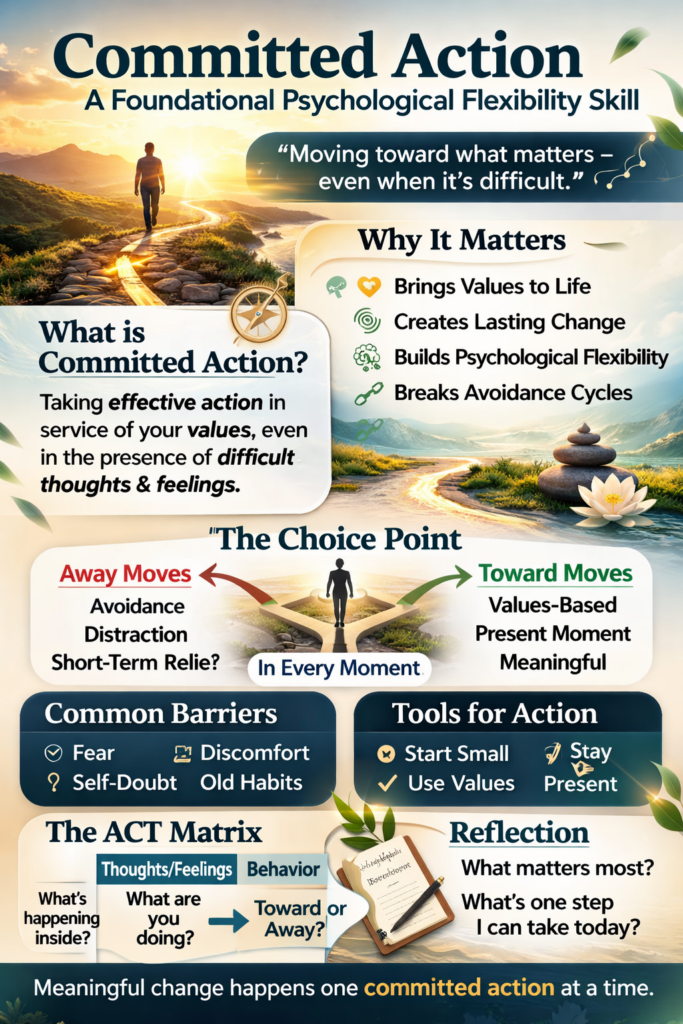
[vc_row][vc_column][vc_column_text css=""]Committed action is a core process within Acceptance and Commitment Therapy (ACT)—a behavioural commitment to take values-guided steps even when it is uncomfortable to do so. In ACT, change…
Human beings are always thinking. Our brains evolved to scan for threat, anticipate problems, and remember past pain so we could survive. That negativity bias kept our ancestors alive—but in…
Mindfulness is the practice of intentionally paying attention to your present-moment experience with openness and without judgment. Mindfulness involves noticing what is happening right now—your thoughts, emotions, body sensations, and…