When Symptoms Make Sense: Coherence Therapy Explained
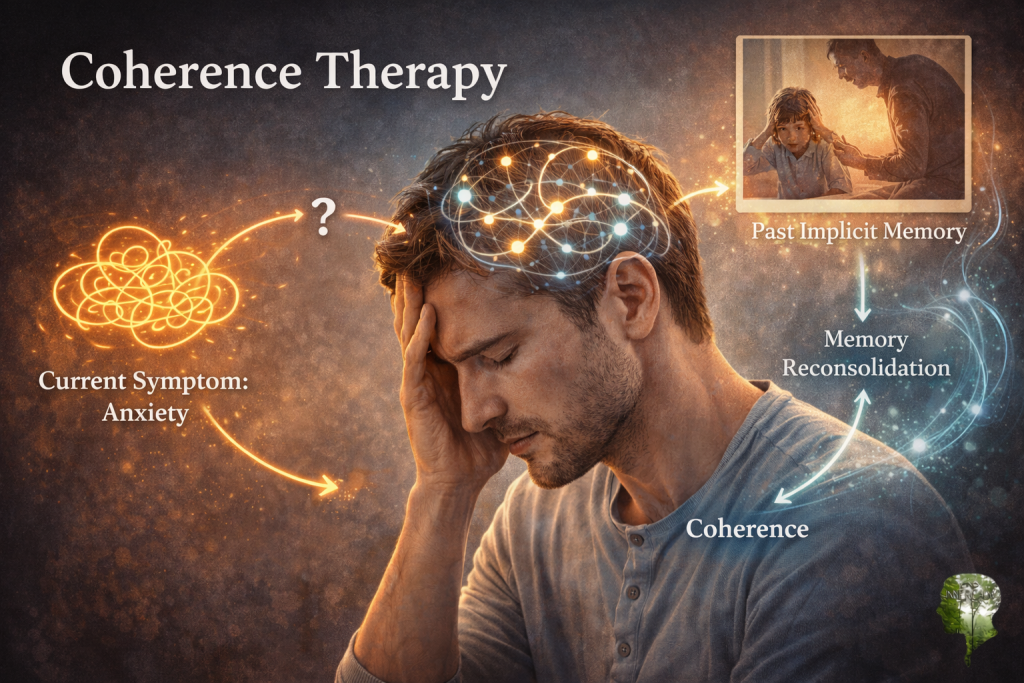
Coherence Therapy explains why symptoms persist by uncovering their emotional logic and shows how experiential therapy enables lasting change through memory reconsolidation.
Why Many Symptoms Persist Despite Insight and Effort
People often arrive in therapy frustrated: “I know why I do this, so why can’t I stop?” From a coherence therapy perspective (and IFS), symptoms are not random, defective, or merely habits gone wrong. They are purposeful responses that once solved a real emotional problem. The reason they persist is precisely because, at an emotional level, they still make sense.
Coherence Therapy starts from a radical but deeply respectful assumption: every persistent symptom is coherent with the person’s emotional learning history.
Anxiety, self-criticism, avoidance, emotional numbing, relationship patterns, or chronic shame often arise from implicit emotional learnings that once protected connection, safety, or survival. Until that underlying coherence is identified and transformed, the brain continues to run the pattern because it believes it is necessary.
What “Coherence” Really Means in Therapy
In this context, coherence refers to the internal logic of a symptom. A problematic pattern continues not because someone lacks willpower, motivation, or insight, but because there is an underlying emotional imperative that says, “This is how things must be for me to somehow stay safe, valued, or intact.”
These imperatives are rarely conscious. They live in implicit memory systems formed through lived experience, often early in life. The symptom is not the problem—it is the solution the nervous system learned long ago.
This perspective aligns closely with trauma-informed models, including those described by Bruce Perry and Oprah Winfrey in What Happened to You?, which emphasize that behaviour and symptoms are best understood through the lens of experience rather than pathology.
Neuroplasticity and the Need for Specific Activation
A core principle of modern neuroscience is that change in the brain is not global—it is precise. “A key principle of neuroplasticity is specificity. In order to change any part of the brain, that specific part of the brain must be activated” (Perry & Winfrey, 2021).
This has profound implications for therapy. Cognitive insight alone—talking about an issue—often activates reflective, verbal systems, but leaves the emotional learning that drives the symptom untouched. If the emotional knowing that requires the symptom is not activated, it cannot be changed.
This is why understanding the underlying emotional coherence behind a symptom is essential. And it is also why therapy must go beyond explanation into experience.
Why Experiential Knowing Matters More Than Intellectual Insight
In coherence therapy, clients are encouraged to speak from their experience, not just about it. This subtle shift is critical. Speaking from experience activates the emotional and somatic systems where implicit learning is stored.
For example, instead of analysing why someone fears conflict, therapy invites the client to inhabit the emotional truth of what conflict means to them—what it predicts, what it threatens, and what feels necessary in that moment. This experiential activation allows the therapist and client to identify the schema, emotional rule, or imperative that makes the symptom feel necessary.
Without this activation, therapy may remain insightful but ineffective. With it, change becomes possible.
Memory Reconsolidation: How Deep Change Actually Happens
Research on memory reconsolidation has shown that emotional learnings are not fixed forever. Under specific conditions, old emotional knowing can be reactivated, destabilized, and updated with new learning.
Two conditions are especially important:
First, the emotional learning that drives the symptom must be experientially activated. The client must feel it, not merely describe it.
Second, while that learning is active, the brain must encounter a contradiction—an experience that disconfirms the prediction made by the old knowing. When the nervous system discovers, “What I believed had to be true is not actually true anymore,” the learning can be revised at its source.
This is not suppression, coping, or management. It is transformation.
From Symptom Management to Lasting Change
Coherence Therapy does not aim to fight symptoms into submission. Instead, it seeks to understand them deeply, respectfully, and precisely—until their original necessity dissolves.
When the emotional coherence behind a symptom is fully known and experientially transformed, the symptom often falls away without force.
For many people, this approach finally explains why previous efforts felt exhausting or temporary—and why lasting change requires working with the brain’s emotional logic, not against it.
If you are tired of managing symptoms and ready to understand what they are trying to accomplish, there is another way forward—and in that spirit of meaningful or deeper change, we invite you to contact us today to explore whether an experiential, coherence-based approach is right for you.
References:
Perry, B., & Winfrey, O. (2021): What Happened to You. Flatiron Books.