Personality Disorders
Understanding Personality Disorders: Types, Symptoms, and Treatment
Personality disorders are mental health conditions involving long-standing patterns of thinking, feeling, and behaving that are inflexible, persistent, and often disruptive to relationships, work, and daily life. While everyone has moments of emotional difficulty, personality disorders are defined by enduring patterns that consistently interfere with functioning.
Many people recognize traits in others that feel difficult to manage—such as emotional volatility, rigid thinking, or interpersonal conflict. The key question is: when do these patterns move beyond personality traits and meet criteria for a personality disorder?
In this article, we explain what a personality disorder is, outline the main types of personality disorders, describe common symptoms and signs, review how personality disorders are assessed, and discuss evidence-based treatment options. A follow-up post will explore specific conditions in more detail, including Borderline Personality Disorder (BPD).
What Is a Personality Disorder?
A personality disorder is a mental health condition characterized by enduring patterns of thoughts, emotions, and behaviours that deviate from cultural expectations, are rigid and pervasive, and lead to significant distress or impairment in areas such as relationships, work, and social functioning. These patterns typically begin in adolescence or early adulthood and remain relatively stable over time.
Key Features of Personality Disorders:
- Enduring Traits: Patterns emerge in adolescence or early adulthood and persist over time.
- Inflexibility: Behaviors and thoughts are rigid and maladaptive.
- Distress or Impairment: Patterns create personal or interpersonal difficulties.
- Cultural Context: Behavior significantly deviates from cultural expectations.
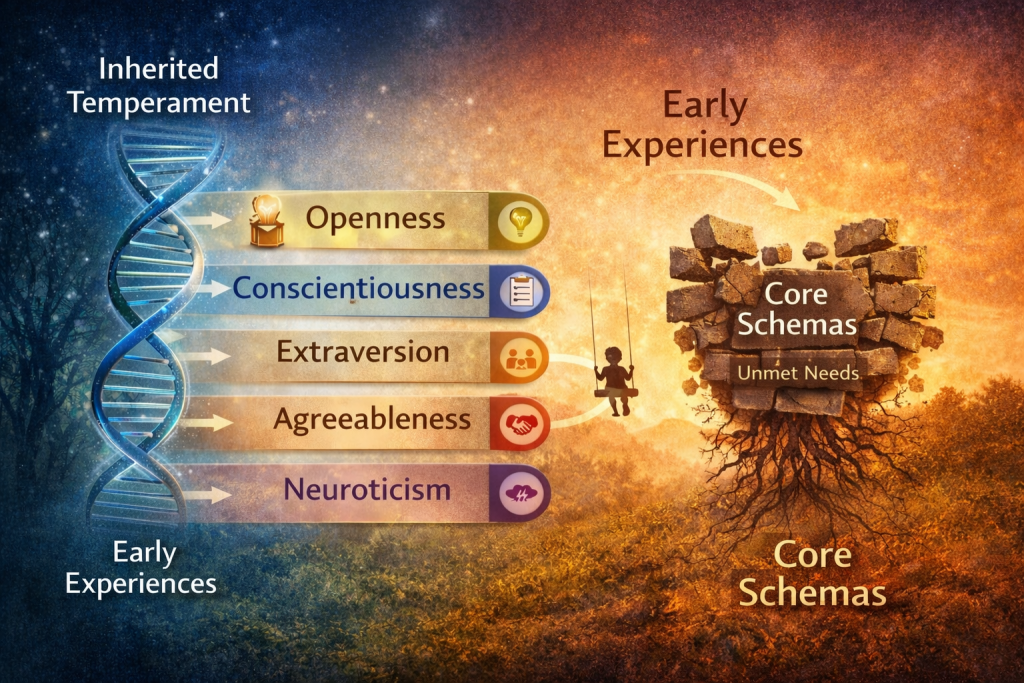
Personality disorders are not a sign that someone is “broken.” They often arise from developmental challenges, trauma, or unmet emotional needs, sometimes compounded by genetic traits like agreeableness or conscientiousness.
Signs Someone May Have a Personality Disorder:
- Pervasive Patterns: Persistent behaviors, thoughts, or emotions that deviate from social norms.
- Interpersonal Difficulties: Problems maintaining healthy relationships due to mistrust, dependency, or impulsivity.
- Distress or Impairment: Struggles in personal, social, or occupational life.
- Inflexibility: Difficulty adapting to change or resolving conflict.
- Early Onset: Patterns typically start by adolescence or early adulthood.
Types of Personality Disorders:
The DSM-5-TR categorizes personality disorders into three clusters:
Cluster A – Odd or Eccentric
Cluster B – Dramatic, Emotional, or Erratic
- Antisocial Personality Disorder (ASPD) – Disregard for rules, impulsivity, aggression, lack of remorse.
- Borderline Personality Disorder (BPD) – Emotional instability, fear of abandonment, impulsivity, unstable relationships.
- Histrionic Personality Disorder (HPD) – Attention-seeking, dramatic behavior, shallow emotional expression.
- Narcissistic Personality Disorder (NPD) – Grandiosity, need for admiration, lack of empathy, fragile self-esteem.
Cluster C – Anxious or Fearful
How Personality Disorders Are Diagnosed:
• The clinician conducts a detailed interview to understand the person’s history, personality traits, and current concerns.
• This may include questions about relationships, work, self-image, and emotional regulation.
2. Behavioral Observation:
• The clinician observes how the person interacts and communicates during the interview.
• The clinician uses standardized criteria from the DSM-5-TR or ICD-11 to evaluate if the individual meets the requirements for a personality disorder.
4. Psychological Testing (Optional):
• Tools such as personality assessments (e.g., MMPI-2 or the PAI) may be used to gather additional information.
5. Rule Out Other Conditions:
• The clinician ensures that symptoms are not better explained by another mental health disorder, medical condition, or substance use.
Important Considerations:
• Cultural Context: Behavior must deviate from societal norms within the person’s cultural framework.
• Self-Awareness: People with personality disorders may not recognize that their behavior is problematic, which can make diagnosis and treatment more challenging.
Personality disorders may result from a combination of factors, including:
• Genetics: A family history of mental health conditions may make some people more vulnerable to developing a personality disorder.
• Environment: Early childhood experiences, such as trauma, neglect, or unstable relationships. In fact, in one study up to 85% of people with a personality disorder reported childhood abuse (Mohler, 2022).
• Brain Chemistry: Imbalances in neurotransmitters or brain structure are implicated in some personality disorders (Jiang et. al., 2017).
While personality disorders can be challenging to treat, therapies such as psychotherapy (e.g., cognitive-behavioral therapy, dialectical behavior therapy) and sometimes medication (to address specific symptoms) can help individuals manage their symptoms and improve their quality of life.
Recent research on recovery from personality disorders (PDs) indicates that while these conditions are typically considered chronic, significant improvements are possible, especially with early intervention and consistent, appropriate treatment. There is a growing body of evidence supporting the idea that recovery from personality disorders can be achieved, though it may look different for each individual. Recovery is not necessarily about “curing” the disorder, but about managing symptoms, improving functioning, and enhancing quality of life.
Key Findings from Recent Research:
1. Long-Term Treatment and Outcomes:
• Studies show that long-term psychotherapy, especially approaches like Dialectical Behavior Therapy (DBT), Cognitive Behavioral Therapy (CBT), and Schema Therapy, can lead to meaningful changes in personality traits, behavior patterns, and emotional regulation. These therapies help individuals with personality disorders manage symptoms and develop healthier coping mechanisms (Evershed, 2011).
• Research has indicated that people with certain personality disorders, such as borderline personality disorder (BPD), often experience symptom reduction over time. A study published in The Journal of Clinical Psychiatry (cited in Parish, 2004) found that many individuals with BPD see improvements in their symptoms after 5-10 years, especially if they engage in therapy.
2. Recovery as Symptom Management:
• Instead of complete “cure,” recent research emphasizes recovery as symptom management. For many individuals with personality disorders, treatment focuses on reducing the intensity of the disorder’s symptoms (e.g., impulsivity, emotional dysregulation, and interpersonal difficulties) to improve daily functioning.
• For instance, individuals with antisocial personality disorder (ASPD) may experience a reduction in behaviours like aggression and impulsivity as they age, especially with therapeutic interventions.
3. The Role of Social Support and Environment:
• Research has highlighted the importance of a supportive environment in the recovery process. Social support from family, friends, and mental health professionals can play a critical role in improving outcomes, as individuals with personality disorders often struggle with interpersonal relationships.
• Interventions that focus on social skills training, relationship building, and emotional regulation have shown promise in helping individuals develop healthier relationships and navigate social challenges more effectively.
4. Neurobiological and Genetic Insights:
• Advances in neuroscience and genetics are beginning to shed light on the biological underpinnings of personality disorders. Research suggests that genetic predispositions and brain structure abnormalities can influence the development of certain personality traits, like impulsivity or emotional dysregulation. However, there is also growing evidence that psychotherapy can lead to neuroplastic changes in the brain, improving emotional regulation and interpersonal functioning.
• For example, studies using neuroimaging have shown that DBT can lead to changes in areas of the brain associated with emotional processing and regulation, offering a promising avenue for recovery from disorders like BPD.
5. Early Intervention and Prevention:
• Research increasingly supports the idea that early intervention is key to improving outcomes for individuals with personality disorders. Treating personality disorders during adolescence or early adulthood, before the patterns become deeply ingrained, can help prevent long-term dysfunction.
• Preventive interventions in high-risk populations, such as children of parents with personality disorders, are being studied to see if they can reduce the risk of developing a full-blown personality disorder later in life.
6. Impact of Co-occurring Mental Health Conditions:
• Many individuals with personality disorders also experience comorbid conditions, such as depression, anxiety, or substance use disorders. Recent research emphasizes the importance of treating these co-occurring conditions simultaneously to improve overall recovery. Integrated treatments that address both personality disorder symptoms and any comorbid conditions tend to have better outcomes.
• For example, a person with obsessive-compulsive personality disorder (OCPD) who also has depression may benefit from treatments that address both the rigid, perfectionistic thinking of OCPD and the negative thought patterns of depression.
7. Recovery is Possible but Challenging:
• A significant body of research acknowledges that recovery from personality disorders is challenging due to the deeply ingrained nature of personality traits. However, gradual improvement is possible, particularly with the right treatment and support (Parish, 2004). Research indicates that people can achieve substantial reductions in distress, improved functioning, and better interpersonal relationships over time.
8. Shift Toward Personalized and Holistic Treatment:
• Recent trends in research suggest that a personalized, holistic approach to treatment, considering the individual’s specific personality traits, life circumstances, and co-occurring conditions, may be more effective than a one-size-fits-all model.
• Incorporating a variety of treatment modalities, including psychotherapy, medication (if needed), social support, and lifestyle adjustments, can increase the likelihood of recovery.
While personality disorders can be chronic, recent research suggests that recovery—defined as symptom management, improved functioning, and enhanced well-being—is not only possible but achievable. Effective, long-term psychotherapy (such as DBT, CBT, IFS or Schema Therapy), early intervention, social support, and addressing comorbid conditions are all key factors in promoting recovery.
The concept of recovery in the context of personality disorders has evolved to focus on improvement over time, with many individuals experiencing substantial symptom reduction and a better quality of life.
Evershed S. Advances in psychiatric treatment (2011), vol. 17, 206–213
Jiang W, Shi F, Liu H, Li G, Ding Z, Shen H, Shen C, Lee SW, Hu D, Wang W, Shen D.
Reduced White Matter Integrity in Antisocial Personality Disorder: A Diffusion Tensor Imaging Study. Sci Rep. 2017 Feb 22;7:43002. doi: 10.1038/srep43002. PMID: 28223713; PMCID: PMC5320449.
Möhler E. Personality Disorders and Development. Brain Sci. 2022 Jul 26;12(8):983.
Parish, J. Personality Disorders Over Time: Implications for Psychotherapy. American Journal Of Psychotherapy, Vol. 5 8 , No. 4 , 2 0 0 4
Prepared by Dr. Jennifer Barbera, PhD, Registered Psychologist
Dr. Jennifer Barbera PhD, C. Psych is a licensed psychologist with over 25 years of counselling experience. She has extensive clinical expertise supporting individuals and couples with anxiety, trauma, depression, addiction, and relationship challenges. Her work combines evidence-based approaches with practical strategies to help clients build resilience and improve well-being.