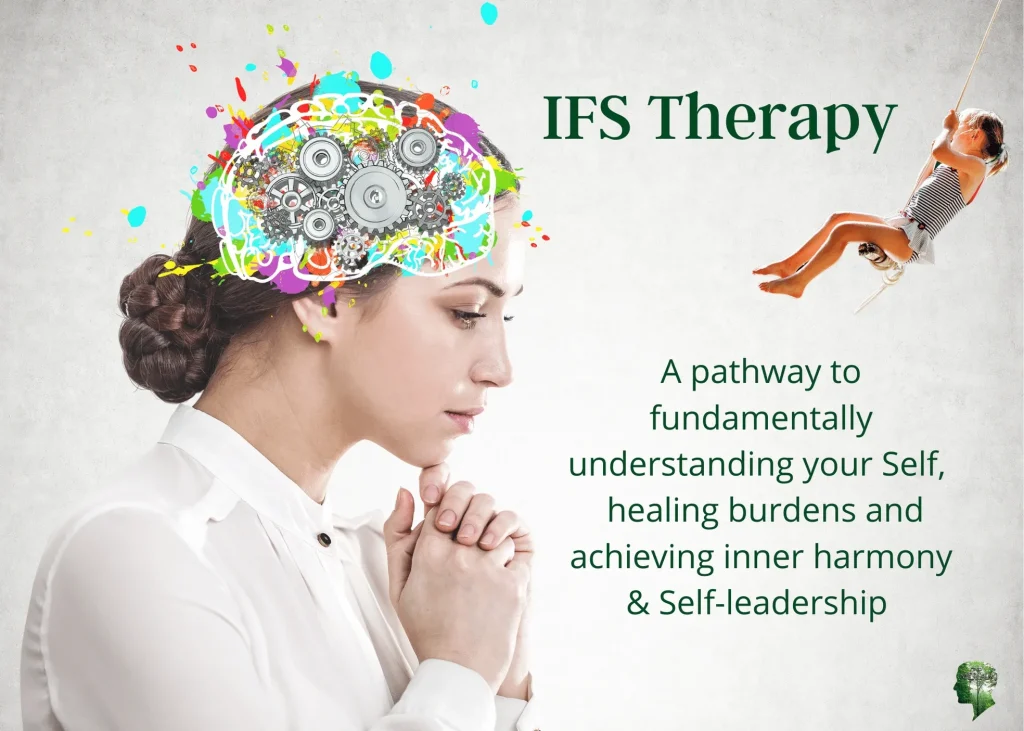
We offer IFS informed therapy guided by a PhD level psychologist in Hamilton Ontario and online across Ontario. Contact us to set up an appointment.
IFS was developed by Dr. Richard Swartz in the 1990s and is quickly becoming a modality of choice by an increasing number of psychologists, psychotherapists, and counsellors because of its holistic nature, transformative qualities and applicability to most mental health concerns, including depression, anxiety, self-harm, trauma and PTSD, eating disorders, personality disorders and more.
Ever notice that you can often feel as if one part of you wants to do something when faced with a decision, while another part of you does not? For example, part of me wants to read this right now while part of me wants to be doing something else. Or, part of me wants to look for a new job while part of me does not want to.
Ever have the experience of suddenly feeling or acting in a way that doesnt feel like your usual self? Ever notice that when you enter certain contexts you feel sort of like another person or even a different age? For example, you may feel serious and confident in one context while feeling playful and young in another context.
IFS is based on the premise that our psychological and emotional system is complex and multilayered and that our personality is made up of various modes that allow us to adapt to different roles or situations more easily. These varying modes or parts of the personality structure can help to explain why someone may be prone to characteristics such as worrying, quick to anger, avoidant of intimacy, a workaholic, alcohol or substance use, self-harm etc.
A key idea of IFS is that we are born with an underlying ‘Self’ that has universal qualities such as ‘calm’, ‘curious’ and ‘compassionate’. Then, as we encounter challenges and adversity in our life (especially ones involving painful core emotions such as deep sadness, fear or shame), we develop ‘parts’ to our system to help defend or sheild us from those painful emotions and experiences (which are exiled or pushed out of day-to-day awareness).
Another key idea of IFS is that all symptoms have an underlying function that made sense at the time and within the context in which the part of self or characteristic (e.g., anxiety, hypervigilance, panic, numbing, critic etc) developed.
IFS techniques are used to help explore and uncover this function, and heal the painful core emotions that were experienced and taken on in one’s system as a ‘burden’. Healing the impact of past events is important because ‘burdens’ (even when largely out of awareness) often continue to trigger and/or drive part activation when exiled parts of self (parts that took on emotional pain and were pushed out of awareness) are triggered.
Examples of ‘parts’:
Anxiety (nervousness, uneasiness, tension)
Hypervigilance (always on guard, watching for what could go wrong)
Panic (full-on bodily activation)
Inner critic (catching every perceived mistake or shortcoming)
Task Master (always busy, doing, uncomfortable to slow down)
Perfectionist (high standards must be set or why bother)
Controller (must always be in control no matter what)
OCD (thoughts affect outcomes)
Joker (make jokes when something feels too serious)
Withdrawer (don’t get emotionally close to others)
Number (alcohol, drugs, food, gambling, shopping)
Body pain (this is the only way to get you to slow down or focus on you)
Self-harmer (hurt self to shift focus to physical body away from exile or other part)
SI (suicide fantasy to protect from other parts or exiles)
Examples of exiles:
Younger part of self that felt powerless or helpless
Younger part of self that felt fear and/or horror
Younger part of self that felt ashamed (not good enough, not desirable)
Younger part of self that suffered loss (intense sadness or emptiness)
Some key goals of IFS include:
*Access ‘Self’ energy (a calm, curious, compassionate state) by easing back parts
*Uncover the protective function of parts and bring into full awareness.
*Reduce inner conflict or polarity between parts (this frees up energy, helps parts ease back and reduces tension and inner turmoil).
*Reduce phobia or fear or underlying painful core emotions (e.g., fear, intense sadness, shame held by ‘exiled’ parts of self etc. ) in order to clear space for accessing what remains ‘stuck’.
*Bring compassion to one’s inner suffering.
*Release emotional burdens and/or heal exiled parts of self so that protective parts no longer have to fulfil their rigid or stuck function.
If you are finding it difficult to change your feelings, thoughts and behaviours no matter what you know or try to tell yourself, Contact us and consider trying an IFS informed approach to work on the underlying mechanisms for why you feel how you feel and do what you do.
[/vc_column_text]
Videos to learn more about IFS:
[/vc_column][/vc_row]