ACT: A Therapeutic approach to help us live more fulfilled lives
How many people do you actually know who have never felt anxious, down or stressed in their lives in some way?
Sure, some idealized person that always seems to have it all together may come to mind, but in actuality I bet you are hard-pressed to think of someone. Finding a true literal example is challenging. This is because it is difficult to live a rich and valued life without encountering hardship, upset, or emotional suffering at some point.
Most people experience disruptions in their mood and anxiety symptoms from time-to-time. Furthermore, many people, regardless of background (including therapists and psychologists), attend therapy as they navigate life’s many challenges.
People also vary widely in how they respond to stressful life circumstances and adversity. Studying how people overcome adversity is very informative and is the underpining of Positive Psychology. Overcoming adversity and even growing from stressful or traumatic experiences is known as ‘resilience’ (Horner, 2016).
More and more in the field of psychology and in therapy practices like ours, we look to concepts such as ‘resiliency’ to help those who struggle with stress and mood and anxiety symptoms.
ACT can is used to help people build resiliency and ease suffering:
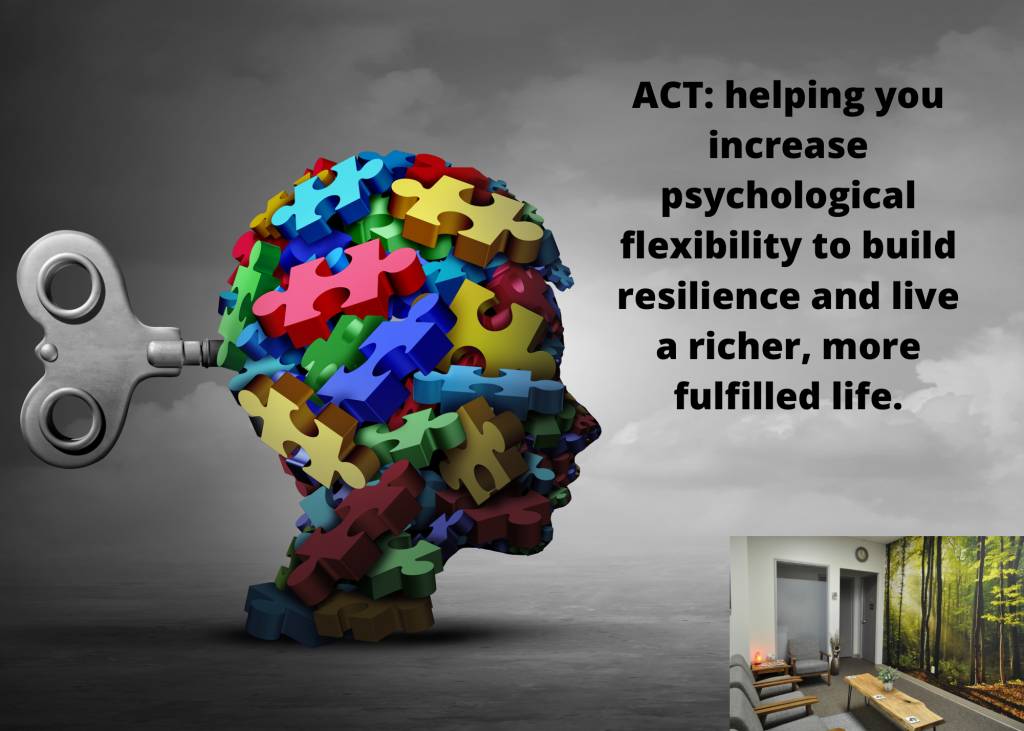
Inspired by positive psychology, Acceptance and Commitment Therapy, otherwise known as ACT, draws together a rich base of knowledge to help reduce human suffering.
As a therapeutic modality ACT helps therapists and psychologists guide clients to focus on pursuing what matters most to them. This helps people experience increased life satisfaction, despite what problems show up in their lives (Harris, 2006).
ACT, a mindfulness-based behavioural therapy, focuses on how people respond to stress and adversity. ACT is an empirically validated psychotherapy approach (A-Tjak et al., 2015) that aims to help people build resilience and enhance their capacity to cope with challenging life circumstances and difficulties.
ACT is an approach that places a particular focus on how people respond to uncomfortable or upsetting feelings. For example, as recognized by other therapeutic modalities such as DBT (dialectical behaviour therapy), many people fight or struggle against their own emotional pain. Fighting VS accepting one’s painful or uncomfortable emotions and experiences has important implications for the intensity of one’s suffering.
This is so important because the specific ways that a person copes with adverse experiences and distressing feelings have a direct impact on the extent to which they are likely to struggle with various mental health concerns (Horner, 2016). These concerns include anxiety, depression, PTSD, substance and alcohol use and anger.
ACT can be applied to many issues and symptoms because ACT aims to address concerns that people can have through 3 vital processes:
1) Teach people how to accept their emotions and be present
2) Help people chose a valued direction
3) Increase people’s capacity to take action even in the face of difficulty
Other key principles of an ACT-based approach:
Anxiety, low mood and painful or uncomfortable emotions are universal human experiences. These experiences may not be best accounted for by medical models that pathologize many common forms of human suffering (Harris, 2006).
Compared to other animals, human beings have a propensity for increased emotional suffering. We are more vulnerable to emotional suffering in large part because we think, evaluate, judge, criticize and ruminate on our difficulties. This universal human tendency to think using language in the form thoughts has a very significant impact on the extent to which humans suffer.
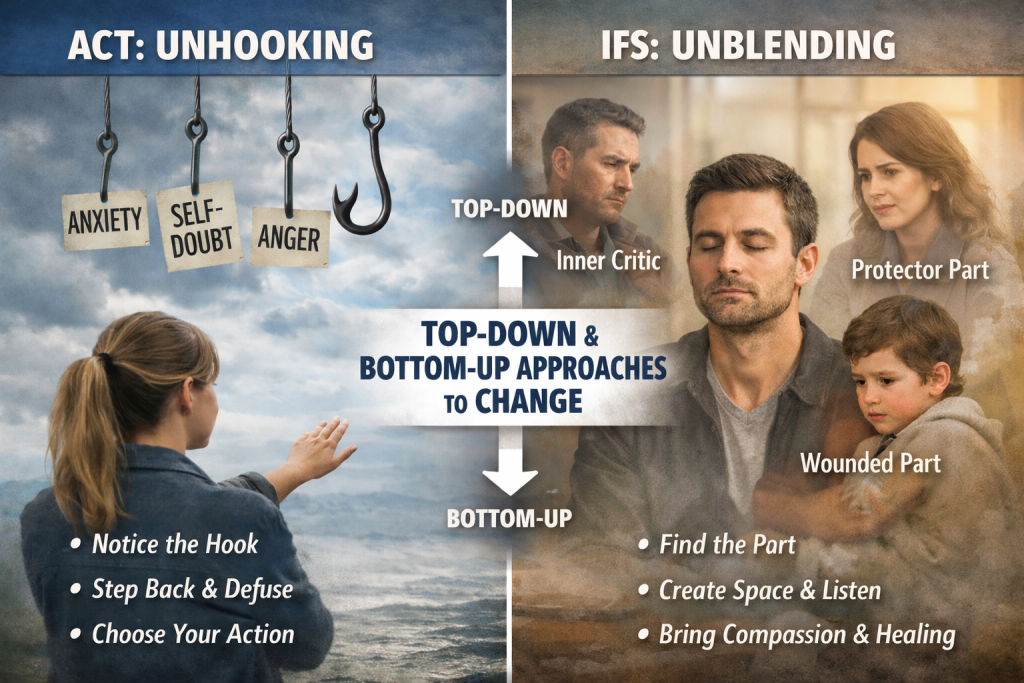
The content of our negative, biased or unhelpful thinking is not necessarily the problem. It is the relationship that we have with our negative thoughts and internal dialogue that leads us to increased suffering. In other words, it is not so much what exactly our mind tells us that is the primary issue. The core issue is the extent to how fused we are with our thinking mind.
When we can observe, notice and step back from what our mind tells us, we will find that negative thoughts have much less emotional impact. This means that looking ‘at’ our thinking instead of ‘from’ our thinking allows us to hold our mind’s narrative more lightly. Increasing our ability to tap into our observing self through mindfulness is a valuable way to help ease human suffering and is a key component of ACT.
In addition to our ability to use mindfulness or tap into an observing self, there are other specific characteristics across people that can either help or hinder our ability to cope with adversity. ACT is built on the premise that these particular characteristics can be identified, developed, and enhanced to help improve emotional and psychological well-being and resilience.
These individual characteristics are collectively known as ‘psychological flexibility’ (Luoma, Hayes & Walser, 2007). Just like people can develop muscle tone through exercise, through practice, over time, people can develop and enhance characteristics that increase emotional and psychological resilience.
Increasing psychological flexibility skills reduces our vulnerability to mental health issues such as anxiety, depression, low self-esteem, alcohol or substance use disorders and other mental health concerns.
Psychological flexibility refers to a person’s characteristics in the following 6 core areas:
The extent to which we can accept VS avoid and resist
The extent to which we can use mindfulness VS being focused on the past or future
The extent to which we can use cognitive defusion VS being fused with our thoughts
The extent to which we can consider context when viewing ourselves VS having a rigid view of ourselves that ignores context
The extent to which we have a clear connection to our values and purpose VS being unclear about our values or what is important to us
The extent to which we commit to valued actions VS avoiding actions that move us in the direction of what is most important to us
ACT is an empowering, non-pathologizing, therapeutic modality that teaches about these concepts, and more importantly, guides people to develop their skills in these core areas of psychological flexibility.
Most of us use ACT as a core model. Contact us to learn more or set up an appointment.
Be sure to see part 2 of this article to read more about each specific aspect of psychological flexibility.
By Dr. Jennifer Barbera PhD