Sleep is one of the most essential foundations of mental health and overall well-being. During sleep, the brain and body carry out critical restorative processes that support emotional regulation, cognitive functioning, immune health, and physical recovery. Adequate sleep helps regulate stress hormones, consolidate memories, and strengthen the brain networks responsible for attention, decision-making, and resilience.
When sleep is consistently disrupted, people often notice increased irritability, lower frustration tolerance, difficulty concentrating, and greater vulnerability to anxiety and depression. In this way, sleep is not simply “rest”; it is an active biological process that allows the mind and body to reset so that we can function effectively during the day.
Insomnia is a common sleep disorder characterized by persistent difficulty falling asleep, staying asleep, or waking earlier than desired, despite having the opportunity to sleep. Importantly, insomnia also involves daytime impairment, such as fatigue, poor concentration, mood changes, or reduced functioning at work or home.
Many people assume insomnia is purely a nighttime problem, but research shows that it is often maintained by patterns that develop during the day and evening. Worrying about sleep, spending excessive time in bed trying to force sleep, irregular sleep schedules, and using wakeful activities in bed (such as working, watching television, or scrolling on a phone) can all inadvertently train the brain to associate the bed with wakefulness rather than sleep.
Cognitive Behavioural Therapy for Insomnia (CBT-I) is considered a gold-standard, evidence-based treatment for chronic insomnia. Rather than relying on medication, CBT-I focuses on retraining the brain’s natural sleep system.
One key principle is stimulus control, which involves strengthening the association between bed and sleep. This means going to bed only when sleepy, getting out of bed if unable to sleep after about 15–20 minutes, and reserving the bed for sleep and intimacy only.
Another central principle is sleep scheduling, sometimes called sleep restriction or sleep consolidation. This approach temporarily limits time in bed to match the amount of sleep a person is actually getting, which helps rebuild sleep pressure and gradually improves sleep efficiency.
CBT-I also emphasizes consistent sleep–wake timing, including waking at the same time every day regardless of how the night went. This helps stabilize the body’s circadian rhythm.
In addition, its important to utilize cognitive strategies address unhelpful beliefs and worries about sleep, such as catastrophic thinking about the consequences of a poor night’s rest.
Finally, sleep hygiene practices—such as limiting caffeine late in the day, creating a comfortable sleep environment, reducing evening screen exposure, and developing a calming wind-down routine—support the biological conditions needed for sleep. When these principles are applied consistently, many individuals experience meaningful and lasting improvements in both sleep quality and overall mental health.
ACTION:
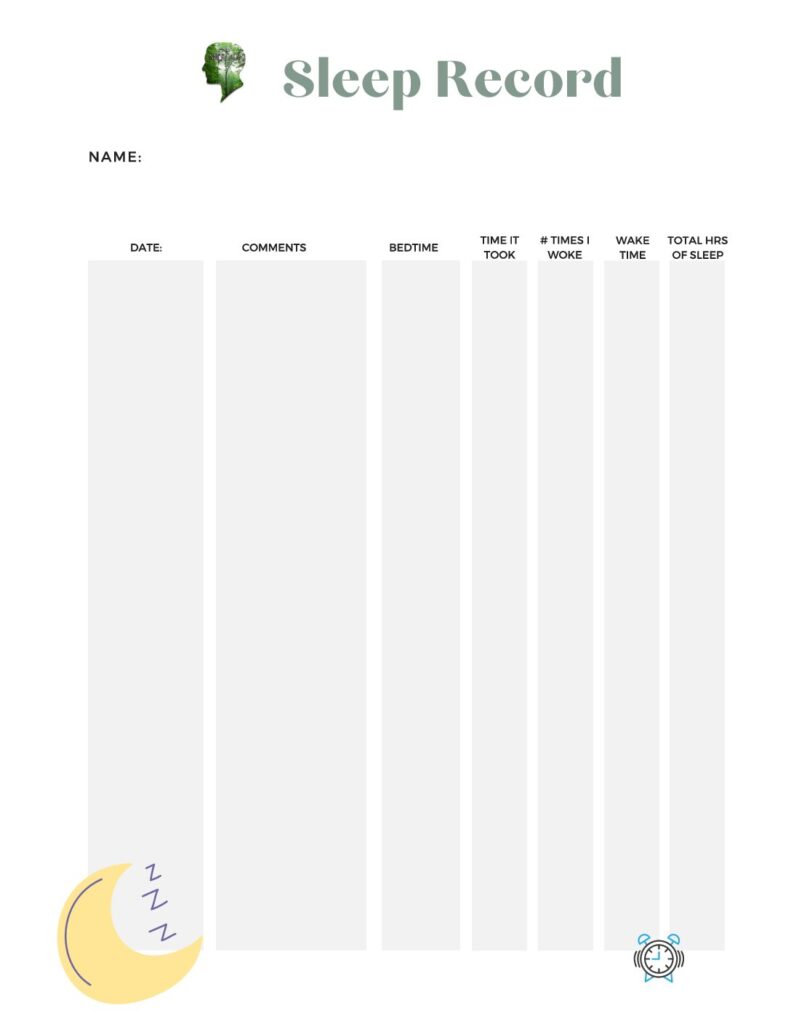
1) utilize the sleep log below to track your sleep for at least 1 week.
The sleep log should be completed each morning shortly after waking, based on your best estimate of the previous night. Each day you record when you went to bed, approximately how long it took to fall asleep, how many times you woke during the night and for how long, the time of your final awakening, and the time you actually got out of bed. It is also helpful to record naps, caffeine use, and general sleep quality. The log should be completed for at least 7–14 consecutive days in order to identify patterns.
2) Once several days of data are collected, calculate the average total sleep time across the week.
This is done by estimating how many hours you were actually asleep each night (not simply how long you were in bed) and averaging those numbers. For example, if someone spends eight hours in bed but only sleeps about six hours on average, their current total sleep time is approximately six hours. In CBT-I, the initial target sleep window is usually set close to the average sleep time, often with a minimum of about five hours to maintain safety and functioning.
Next, choose a fixed wake-up time that can be maintained every day of the week, including weekends. The wake time is the most important anchor for regulating the circadian rhythm.
Your target wake up time should be realistic based on work, family, and daily responsibilities. Once the wake time is set, the target bedtime is calculated by counting backwards from the wake time using the determined sleep window. For example, if the wake time is 7:00 a.m. and the target sleep window is six hours, the target bedtime would be 1:00 a.m.
It is important to keep the wake-up time consistent, even after a poor night of sleep. This helps rebuild natural sleep pressure so that sleep becomes deeper and more consolidated over time. As sleep efficiency improves—meaning most of the time in bed is spent sleeping—the sleep window can gradually be expanded by about 15–30 minutes at a time, allowing for longer sleep while maintaining strong sleep quality.
Do not nap during the day!
3) Follow the above described principles for conditioning yourself to associate being in bed with sleep. If you are awake for more than 15-20 minutes- be sure to go to another restful area (e.g., some people call this a “sleep nook”) like a couch or another bed and do something restful until you are nodding off- then return to bed.
4) You can also try some of the videos below to help you fall asleep more quickly.
5) If anxiety or worry is keeping you awake, be sure to practice a guided relaxation (see videos below) and utilize strategies for worry (e.g., setting worry time) and develop your defusion skills.
Psychological flexibility: The key towards enhancing emotional and psychological well-being Psychological flexibility is the capacity to fully contact the present moment and all of one’s experiences—including thoughts, emotions, and bodily…
Values are the directional core of psychological flexibility. They answer a deceptively simple question: What kind of person do I want to be, and how do I want to show…
Self as context is one of the most subtle—and most transformative—processes within psychological flexibility. It refers to the capacity to experience a stable sense of Self that is distinct from…