How Early Schemas Persist, Even When Our Situation Changes
How Cognitive Schemas and Core Beliefs Shape Our Thoughts and Behaviour
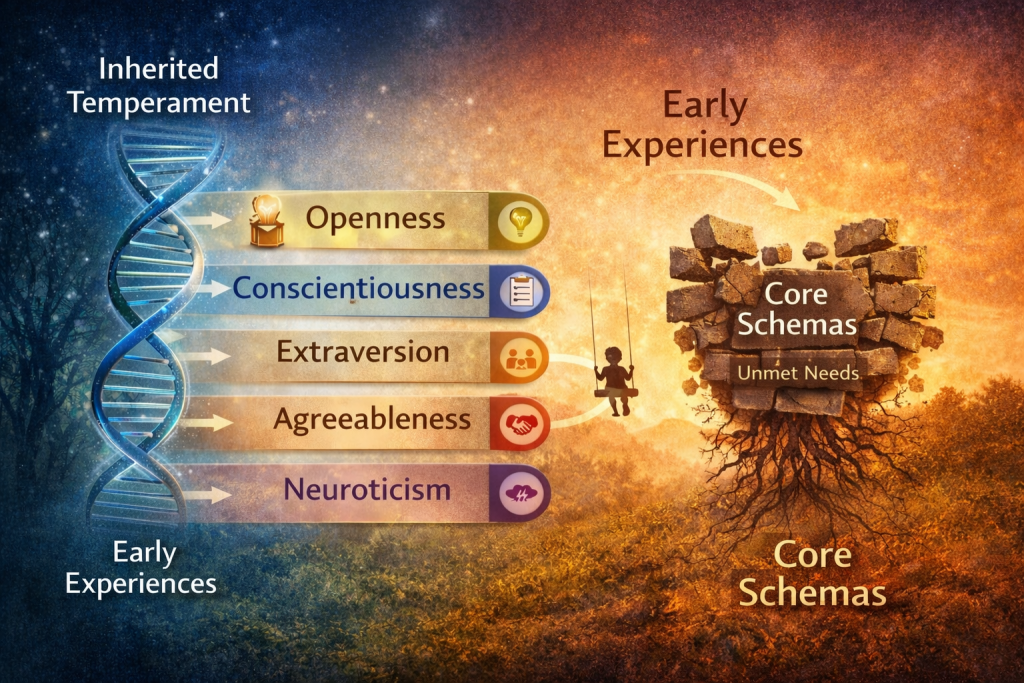
Our psychological system is remarkably adaptive. From early experiences, especially those involving unmet needs or emotional pain, our minds form core beliefs, also known as schemas. These mental frameworks act as predictive programs, helping us anticipate challenges and protect ourselves from future distress.
The Formation of Schemas and Core Beliefs
When we experience emotional pain or unmet needs in childhood, our brains create schemas—mental programs designed to guard us against similar situations in the future. These core belief systems serve as survival mechanisms, shaped by the conditions of our early environment. While these schemas may have been adaptive at the time, they often remain active even when our current context has changed.
The result is a persistent disconnect between what we know logically and how we feel or react emotionally. Understanding and working with these psychological patterns is a key aspect of therapy and mental health work, helping individuals break free from outdated schemas and build healthier, more adaptive ways of thinking and relating.
The Historical Context of Early Living Groups
Historically, the environments into which humans were born—the primary living groups—changed little over time. This relative stability allowed our brains to form and rely on predictable schemas that freed up cognitive resources. Our midbrain, wired by evolutionary pressures, developed these programs to maximize efficiency, allowing us to focus on other essential tasks.
In modern life, however, the situation is far more complex. The contexts we navigate today—ranging from evolving relationships to dynamic work environments—often bear little resemblance to the static settings of our early years. Despite these changes, the psychological programs that were hardwired into us remain, sometimes leading to outdated reactions that no longer serve our best interests.
The Inheritance of Unmet Needs
Another critical aspect of our psychological makeup is the influence of our parents’ struggles. As children, we are not equipped to understand the complex inner workings of our caregivers. When our parents grapple with their own unmet needs and maladaptive programs, their behaviours inevitably affect us.
Lacking the cognitive maturity as children to process these dynamics, we often internalize these experiences as a reflection of our own self-worth. It can become a deeply ingrained belief that “if my parent struggled, it must be something about me,” even when this interpretation is far removed from reality.
Bridging the Gap Between Past and Present
Understanding that these schemas were once protective offers a pathway toward change. Recognizing the dissonance between outdated beliefs and current realities is the first step in consciously updating our inner programs. By becoming aware of how our past continues to influence our present, we can begin to adopt new strategies that align more closely with today’s complex world.
Our psychological systems are a testament to both our evolutionary heritage and the dynamic nature of our personal histories. By exploring and understanding these deep-seated programs, we can pave the way for personal growth and more adaptive ways of relating to ourselves and the world around us.
How Do We Heal or Change Schemas?
Many therapeutic modalities recognize that core beliefs or schemas play a pivotal role in well-being and mental health. This is because schemas often underlie the problematic behaviours or feelings that cause distress or disruption.
Different therapies approach schema work in various ways:
Cognitive Behavioral Therapy (CBT): Focuses on identifying and challenging maladaptive thoughts and beliefs.
Acceptance and Commitment Therapy (ACT): Emphasizes defusion techniques and committing to opposite actions to create new experiences.
Eye Movement Desensitization and Reprocessing (EMDR): Aims to neutralize distressing memories that led to schema formation and shift the felt sense of beliefs.
Internal Family Systems (IFS): Works on healing painful core emotions that led to schema or part formation and updating the protective parts of the self.
Coherence Therapy: Brings the schema into conscious awareness and evokes an emotional experience that challenges the original schema, prompting adaptation.
Schema Therapy: Uses a structured way to assess core schemas in order to identify what schemas to focus on using experiential approaches such as inner child work and imagination re-scripting.
What Are the Main Ways to Shift or Change Schemas?
Identify Your Core Schemas:
We cannot change what we do not recognize. Bringing schemas into explicit conscious awareness is crucial. This can be done through discussion, parts dialogue, floatbacks (activating a core emotion and tracing it back to early experiences), and sentence completion exercises.
Notice When Schemas Are Activated:
We need to identify “choice points” where old schemas take over. Recognizing moments when we instinctively follow an old pattern allows us to choose a different response. Using frameworks like the ACT matrix (identifying schemas as “hooks” that lead to avoidance) or noticing part activation in IFS can help in this process.
Change How You Respond to the Schema (Internally & Externally):
Neurons that fire together wire together—so changing responses is key. Instead of struggling against a schema or judging it, work on acceptance. Responding with self-compassion rather than resistance can lead to greater easing back of the schema.
Steps include:
Validating the intent of the schema or part.
Updating the schema with present-moment reality.
Inviting the schema or part of self to “ease back” or “rest.”
Externally, respond in ways that counter the schema-driven behaviours. If a schema leads to avoidance, practice opposite action (approaching rather than avoiding). Testing the schema’s predictions in real life helps update it over time.
Use Acceptance & Compassion When Change Is Difficult:
Some schemas shift easily, while others are deeply entrenched. Notice when a schema resists change and use therapy to process earlier experiences that reinforce it. Techniques like IFS or EMDR can help reprocess deeply held beliefs that logic alone cannot override.
Address Fear of Processing Past Experiences:
If revisiting past experiences feels overwhelming, start with emotion regulation techniques to expand your window of tolerance (e.g., defusion, self-compassion, and grounding exercises). If necessary, work with a therapist who can help you with treating the fear of memories first through trauma-focused therapy like EMDR or IFS.
Change takes time and persistence. If you continue reinforcing old patterns, they remain unchanged. However, if you commit to small, consistent shifts, your psychological system will adapt—allowing for healing and greater emotional flexibility in the present.
If you are interested on shifting your internal core beliefs or schemas, Contact us.
This was Part 2 of 2 of a blog series on schemas.
References
Roelofs J, Onckels L, Muris P. Attachment Quality and Psychopathological Symptoms in Clinically Referred Adolescents: The Mediating Role of Early Maladaptive Schema. J Child Fam Stud. 2013 Apr;22(3):377-385.
Prepared by Dr. Jennifer Barbera, PhD, Registered Psychologist
Dr. Jennifer Barbera PhD, C. Psych is a licensed psychologist with over 25 years of counselling experience. She has extensive clinical expertise supporting individuals and couples with anxiety, trauma, depression, addiction, and relationship challenges. Her work combines evidence-based approaches with practical strategies to help clients build resilience and improve well-being.