
ACT (Acceptance & Commitment Therapy)
We offer ACT therapy in Hamilton and online across Ontario. Our services are led by a PhD Psychologist was over 25 years counselling experience. ACT stands for Acceptance and Commitment…

Understanding Evidence-Based Therapeutic Modalities
When considering therapy, you might hear the term evidence-based. This means that the approach has been rigorously studied and shown to be effective for particular mental health concerns.
Evidence-based therapies provide a structured, research-supported way to address emotional, behavioural, and relational challenges. Using these approaches increases the likelihood of meaningful, lasting change.
Here’s a closer look at evidence-based therapies that we use:
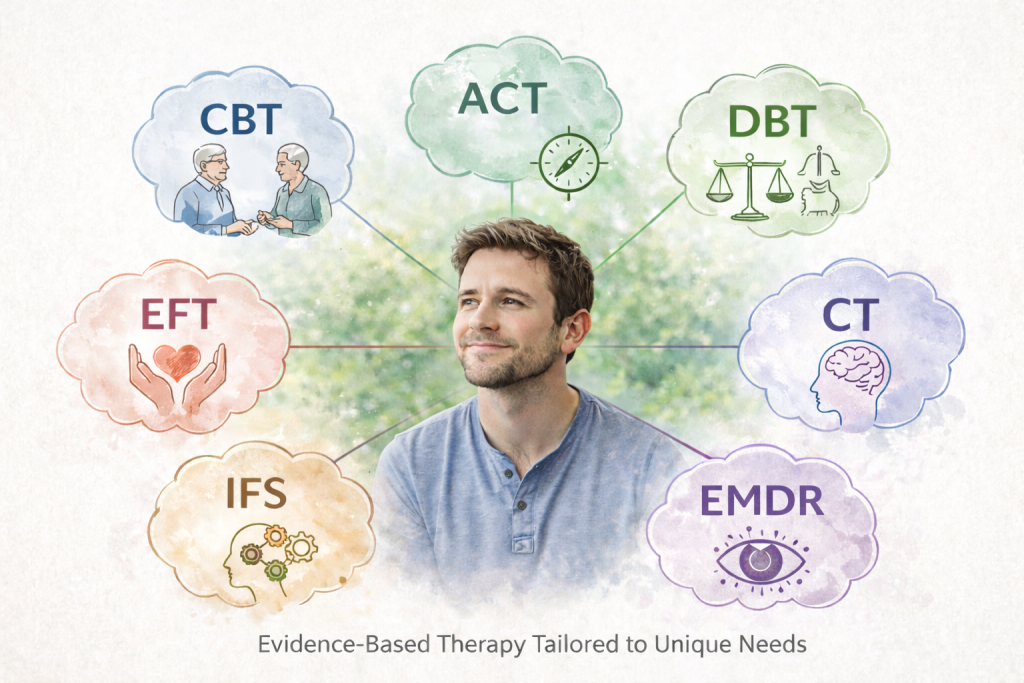
Cognitive Behavioural Therapy (CBT): CBT focuses on the connection between thoughts, feelings, and behaviours. By identifying unhelpful thought patterns and replacing them with more balanced thinking, clients can change behaviours and reduce distress. CBT is often used for anxiety, depression, OCD, and other mood or stress-related conditions.
Acceptance and Commitment Therapy (ACT): ACT emphasizes accepting difficult emotions rather than avoiding them, clarifying personal values, and committing to actions that align with those values. It helps people develop psychological flexibility and can be especially helpful for anxiety, depression, chronic pain, and life transitions.
Dialectical Behaviour Therapy (DBT): Originally developed for individuals with intense emotions and self-destructive behaviours, DBT combines CBT principles with mindfulness, distress tolerance, emotion regulation, and interpersonal effectiveness skills. It’s often used for borderline personality traits, self-harm behaviours, and severe emotional dysregulation.
Emotion-Focused Therapy (EFT): EFT helps individuals access, understand, and transform their emotions to promote healing and stronger connections. It is often used in individual and couples therapy to improve emotional awareness, processing, and relational bonds.
Internal Family Systems (IFS): IFS views the mind as made up of different “parts” that hold emotions, beliefs, and experiences. Therapy focuses on building a compassionate relationship with these parts, resolving internal conflicts, and fostering self-leadership. IFS is particularly effective for trauma, anxiety, and identity-related concerns.
Eye Movement Desensitization and Reprocessing (EMDR): EMDR is primarily used to help process traumatic memories. Through guided eye movements or other bilateral stimulation, clients can reprocess distressing experiences so they are less emotionally overwhelming. EMDR has strong evidence for PTSD, trauma, and related anxiety.
Evidence-based therapy doesn’t mean every session follows a rigid protocol. As skilled therapists we often integrate multiple approaches to tailor treatment to each person’s needs. This ensures that therapy is both scientifically grounded and flexible enough to support individual growth and healing suited to each person.
Questions? Want to set up an appointment? Reach out today.