
Proven Strategies for Managing Stress
Stress is a normal part of everyday life. However, when stress becomes chronic or unmanaged, it can significantly impact both mental and physical health. Learning how to manage stress effectively…

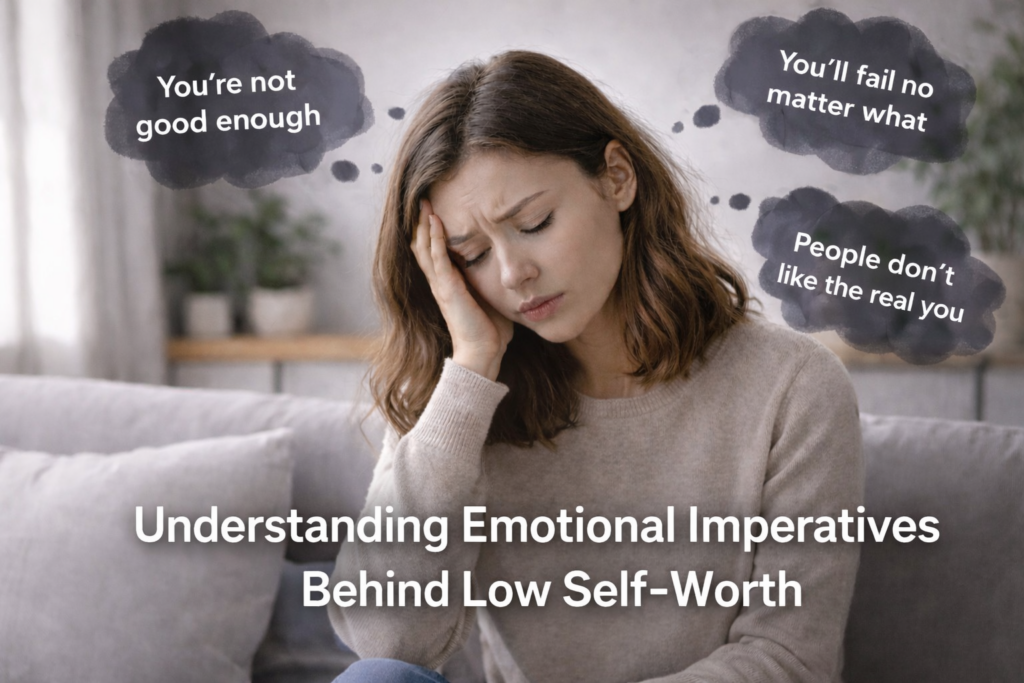
Do you frequently get upset with yourself or put yourself down?
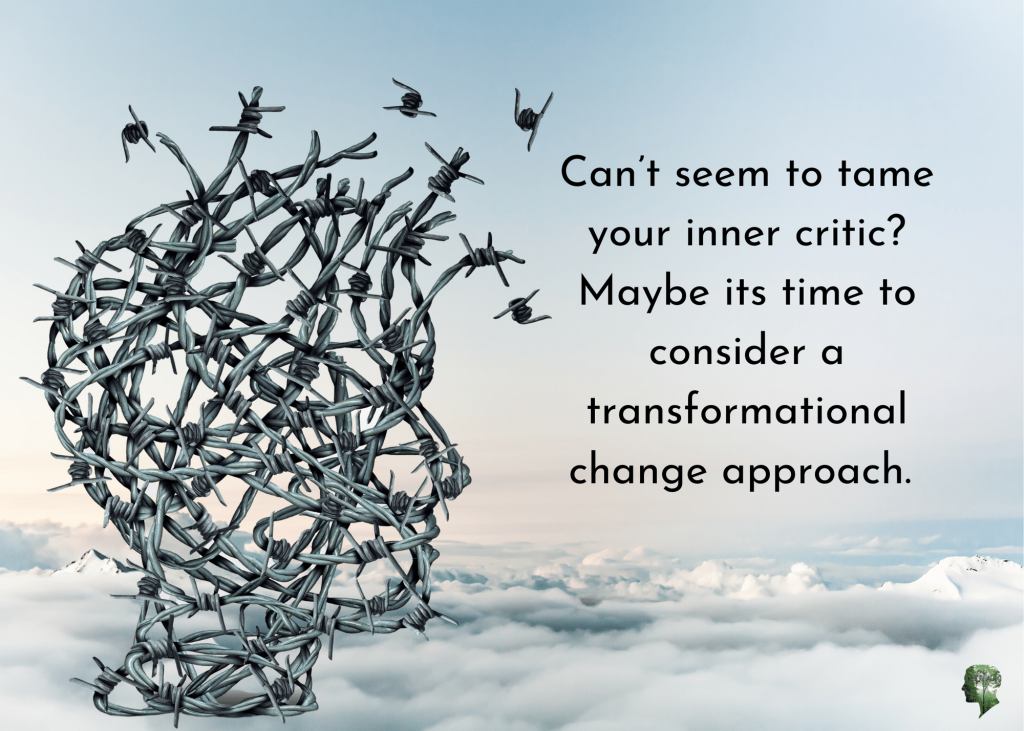
Does your inner critic feel relentless—constantly judging, doubting, or telling you that you’re not good enough?
If you’re experiencing ongoing anxiety, low mood, or emotional distress that doesn’t seem to improve, your inner critic may be playing a larger role than you realize.
An inner critic refers to the harsh, self-critical inner voice many people experience. It shows up as negative self-talk, unrealistic expectations, and persistent self-judgement—and over time, it can significantly affect mental health, self-esteem, and overall well-being.
If this sounds familiar, it’s important to know: you are not alone.
Research suggests that nearly 70% of people hold themselves to much harsher standards than they hold others to (Neff, 2015). In other words, many of us are quick to criticize ourselves, minimize our strengths, and internalize blame—often without realizing the emotional cost.
Living with an active inner critic can feel like having an emotionally abusive voice with you all day long, constantly whispering criticism and doubt. Over time, this can erode confidence, increase anxiety and depression, and make healing feel out of reach.
Have you ever paused to consider the impact your inner critic may be having on your mental health—and what it might be like to finally heal that relationship with yourself?
Now before you go hating on your inner critic, it’s essential to keep reading because what you resist tends to persist. Hating your inner critic may only add fuel to the fire.
Psychologist Dr. Jennifer Barbera often works with individuals who have an active inner critic or struggle with using more positive self-talk.
Self-criticism and negative self-talk are related to depression and anxiety symptoms:
Often the same people who endorse having an active inner-critic are the same people who present with more severe mood and anxiety symptoms.
A tendency to be self-critical tends to go hand in hand with lower mood and increased anxiety, as well as issues with anger, poor body image, disordered eating and several other concerns.
Because of the strong link between self-criticism and emotional suffering, in therapy or treatment, we often focus on working with a person’s inner critic.
In this way, we help to address an important barrier to more positive self-talk and increased self-compassion, both of which are correlated with improved well-being and recovery from mood and anxiety symptoms (Neff, 2011).
Working on reducing self-critical self-talk and self-limiting beliefs is often essential to effectively treating depression, anxiety and other concerns because an active inner-critic can be an underlying cause or contributor to ongoing mood and anxiety symptoms.
We also observe that people who struggle to improve in their self-talk and beliefs about themselves tend to take longer to recover from their symptoms.
They may also report feeling ‘stuck,’ which can lead to increased self-criticism and then further depressed mood. This creates a vicious cycle that is challenging to break.
To help break this cycle, in therapy, we use various approaches to assisting with negative self-talk. To help shift an inner critic and associated negative self-talk, we have a variety of options.
Corrective change approaches:
To start, we can use approaches such as CBT or ACT, which help to counter-balance negative self-talk. These approaches involve interventions such as teaching about the role of unhelpful thinking, automatic thoughts and how to do thought monitoring, or using thought defusion strategies.
Thought monitoring involves actively noticing negative or unhelpful thoughts and directly challenging the thoughts with disconfirming evidence.
People are also taught how to label the type of bias in their thoughts. For example, people are taught to identify styles of thinking such as overgeneralizing, catastrophizing and discounting the positives. All of these types of thinking tend to intensify negative emotion.
Thought defusion, on the other hand, does not focus on the content of thoughts or on challenging thoughts. Though defusion focuses instead on using mindfulness and acceptance strategies to help change the relationship that people have with their negative thoughts.
People may be taught to see their thoughts as background noise. They may also be taught how to use visual metaphors for breaking up or shifting negative thoughts.
People are also taught how to tap into their observing self, so that they are less fused with the thoughts and can instead just notice the thoughts as background noise. The background noise is a part of their mind that does not necessarily need to be listened to or engaged with. This can help people not to be as affected by negative thoughts.
Positive affirmations may also be used to help counter negative thoughts. The use of affirmations is where people develop habits of focusing on positive qualities or aspects of themselves to help balance out their negative thinking.
Self-compassion training is also an effective option for helping to shift towards more positive thinking and overall treatment of oneself.
Although the above approaches can be very helpful for people, we find that most people benefit most when we extend beyond corrective strategies by also incorporating transformational change approaches.
Transformational change approaches:
Transformational change approaches include: internal family systems (IFS), emotion-focused therapy (EFT), coherence therapy, and eye-movement desensitization and reprocessing therapy (EMDR). These approaches focus on identifying the original cause of an active inner-critic and shifting or healing the original learning that led to one’s inner critic.
The original learning that created an active inner critic is thought of as the emotional imperative that drives self-criticism. This imperative is similar to an emotional program that was created during a pivotal experience or from ongoing painful experiences.
Old programs are held in the emotional, and largely unconscious, part of the brain and tend to keep replaying unless somehow counter-balanced or resolved. An example might be “i must be vigilant about every possible mistake I make and put myself down because otherwise I will screw up somehow, appear foolish and be rejected or humiliated again. Putting extensive pressure on myself to not make mistakes is the only way to try and prevent this”.
Resolving the original cause of a tendency to be self-critical is important for long-term change because sometimes, no matter what people rationally know, they can’t help but feel and act as if the thoughts are true or the action is necessary.
People commonly report a discrepancy between what they know to be reasonable or true and how they feel. This is largely because negative self-talk may trace back to earlier trauma or painful experiences, where at the time, negative thinking serviced a purpose for the person and then the negative thinking persists, despite changes in the person’s life.
As an example, consider that children with very negative and punitive parents often internalize negative self-treatment because this can serve to help maintain their attachment to their parents and increase feelings of control.
For instance, “if I’m bad, then I can just strive to be better, and things will improve.” This helps to protect from feelings of helplessness and terror, as well as sadness over not getting the kind of nurturing or parenting that one should have gotten.
To maintain attachment, or to increase feelings of control, the child will unconsciously take on the part of themselves that acts as an inner critic to try and help prevent future mistreatment or humiliation from others.
This process commonly arises during experiences of bullying and painful peer rejection. People may or may not realize and be fully in touch with the impact of past experiences on their tendency to be self-critical.
Without being fully conscious of it, people can take on an inner critic within their emotional system, which serves to try and somehow prevent further rejection, judgement, embarrassment or humiliation.
Unfortunately, the strategy is usually not helpful in current contexts. A person’s inner critic may also interfere with attempts to increase positive self-talk when using corrective approaches such as CBT or ACT, and therefore must sometimes be worked with more directly for longer-lasting change to occur.
To work with a persistent inner critic more directly, we use transformational change approaches. This means working at an emotional level from the ‘bottom-up.’ This is in contrast to working from the ‘top-down’ or at a cognitive or behavioural level.
With IFS, for example, people explore and come to understand the function of their inner critic. They also work towards increasing understanding and self-compassion by tapping into a ‘Self’ state where they can observe their suffering from a new perspective.
A ‘Self’ state is where one feels free of their defences, and is in touch with their core sense of self. This is the state of being that many people strive for during meditation.
When in a Self-state, people naturally feel calmer. They also have greater clarity, feel curious and more compassionate about their suffering, and feel more courage to get to know and heal the parts of them that are suffering.
In a Self-state, it is possible to heal past experiences that led to one’s inner critic developing, without the usual defences of avoiding, minimizing, denying, distraction, projecting etc.
When in a Self-state, people also usually have much less fear and concern about being overwhelmed by one’s painful emotions.
In addition to working directly on processing and healing emotions carried from past painful experiences, people are taught how to:
1) notice their inner critic (by noticing negative self-talk),
2) validate their critic’s original functioning and continued protective intent,
3) update their critic with new information and help it become unstuck from the past and its automatic and rigid role, and
4) ask the inner critic to ease back in the system so that the negative thoughts subside. When one’s inner critic eases back or ‘unblends,’ the person can very quickly view things from a different perspective without so much effort.
IFS can be a valuable approach to changing painful internal habits, especially when other approaches haven’t led to change.
EMDR and EFT are other transformational change approaches that can also be effectively used to change previously persistent negative feelings, thoughts and beliefs.
10 approaches that can help ease your inner critic:
Regardless of the exact approach taken, here is a break down of some of the more common strategies we use in therapy to help decrease negative self-talk and increase positive self-talk:
1) label and let go of negative thoughts as they arise by being familiar with negative thinking styles and labeling thoughts as they occur.
2) point out disconfirming evidence for recurrent negative thoughts and work towards more balanced or helpful thinking patterns.
3) use defusion strategies such as picturing a negative thought in a silly voice, or picturing the thought being shot up into the sky or picturing the thought as background noise that can be tuned our or turned down.
4) using affirmations such as “a thought is just a thought is just a thought” or “I am doing the best I can, and that is enough.”
5) reminding ourselves that other people suffer too, in very similar ways, and developing greater self-compassion to ease suffering.
6) learning how to ‘level the playing field’ by applying the same expectations and standards to ourselves as we would with others we care for.
7) becoming more mindful of the thinking mind and noticing thoughts as they arise in the moment.
8) reminding ourselves that we don’t have to be ‘hooked’ by our thoughts, but can let them go if we chose to.
9) when noticing a negative thought (and activation of one’s inner critic), validating the concern or intent of that critical part of ourselves. Then asking our inner critic to ease back, rest or give space so that it doesn’t have to work as hard.
10) Using an IFS ‘self-therapy’ manual, or with a therapist- explore what the inner critic is trying to protect you from (its function). Then work towards entering a Self-state (the state we automatically enter when we can get other parts of us to ease back) and go to more vulnerable parts of ourselves.
Vulnerable parts are the parts of us that contained and still carry the painful core emotions from the past. These vulnerable parts can then be witnessed fully so that they can then let go of or release the emotional burdens they have been carrying.
Ultimately, regardless of what approach is taken, it can be helpful to work towards healing or unburdening painful core emotions that were taken on at some point in time and continue to trigger one’s inner-critic into replaying an old program that no longer serves the person.
Healing past wounds or releasing emotional burdens leads to your inner critic no longer being needed in the same way. This frees up that part of yourself to do other things instead, such as supporting and motivating you. This way, you can finally be free of that tendency to beat yourself up.
References:
Neff, K. (2015). Self-compassion: The Proven Power of Being Kind to Yourself. New York: Guilford Press.
Neff, K. (2011). Self-compassion, Self-esteem and Well-being. Social and Personality Psychology Compass. 5 (1)
By Clinical Psychologist Dr. Jennifer Barbera PhD, C. Psych