
Proven Strategies for Managing Stress
Stress is a normal part of everyday life. However, when stress becomes chronic or unmanaged, it can significantly impact both mental and physical health. Learning how to manage stress effectively…

Part one of this topic (see previous post) introduced the ACT (Acceptance & Commitment Therapy) model and how it teaches people to change the way they react to their thoughts and feelings. One way that people can change the way they respond to their difficult thoughts and feelings is by developing their “psychological flexibility” skills.
Just like people can develop stronger muscles through exercise, people can develop and enhance characteristics that build emotional and psychological resilience (Luoma, Hayes & Walser, 2007).
Increasing psychological flexibility skills helps to reduce vulnerability to mental health concerns. This means reducing the likelihood of developing or experiencing depression, anxiety, low self-esteem, alcohol or substance use disorders and other mental health concerns.
Psychological flexibility refers to a person’s characteristics in the following 6 core areas:
1) Defining valued directions VS lack of value clarity
Values are the qualities that underlie living in a purposeful and meaningful way. Values indicate what is important to a person. Values are different than goals. In particular, values are a life-long striving that drives the direction of behaviour, while goals are achievements that can be worked towards and then completed (Luoma, Hayes & Walser, 2007).
Rather than just focusing on goals, ACT aims to help people uncover and realign with their primary values in life. Being in greater touch with your values can help provide a more meaningful direction to one’s life. A meaningful direction in life is thought to be an antidote to feeling lost, confused, depressed and/or dissatisfied.
ACT aims to help people identify and clarify their most fundamental values. ACT also involves helping people to stay in touch with their values in an ongoing way, which leads to more purposeful and satisfying living. As a way of assisting people in clarifying values, ACT often encourages people to reflect on questions such as: what they want their life to stand for and what kind of person/friend/partner/parent they truly want to be.
2) Acceptance VS experiential avoidance & resistance
People often respond to painful thoughts or emotions by trying to control, fight, deny or avoid their suffering. This common human tendency to resist, fight or push away painful feelings or disturbing thoughts plays a key role in human suffering. Fighting how we feel increases suffering because humans enviably experience difficult emotions at some points in time and there is not a viable sustained way to avoid pain entirely (Luoma, Hayes & Walser, 2007).
In fact, trying to fight or control emotions often backfires for people as they enter a “self-amplifying loop, which creates additional suffering” (Luoma, Hayes & Walser, 2007, p. 23). This means that when someone starts to feel upset and they respond by resisting, judging, denying or controlling their painful feelings, the emotions tend to intensify and this leads to increased suffering.
In recognition of how resisting emotions amplifies their intensity, ACT aims to teach people the importance of reducing resistance through acceptance-based strategies. Acceptance does not mean giving in, agreeing, or liking one’s thoughts or feelings. Acceptance is simply about acknowledging reality and allowing what already is in that moment. Increasing openness to “what is” means that valuable energy is not wasted on trying to change what already is.
3) Mindfulness VS dominance of the conceptualized past and future
Mindfulness refers to how much a person focuses on the present moment versus focusing on things that have already occurred or have not yet occurred. Mindfulness also relates to a person being able to just notice and observe their thoughts and feelings without judgement.
The fact that we can reflect on the past and contemplate the future makes humans special and is a unique resource. At the same time, these cognitive abilities can create significant problems (Harris, 2006). The ability to ponder or reflect can be problematic because being excessively focused on the past or future causes us to lose contact with the present moment. Losing sight of the very moment that we are in can make things feel more overwhelming and increases suffering.
To help ease suffering, mindfulness aims to help us develop an ability to stay anchored in present moment awareness. ACT uses many experiential moment-to-moment in-session awareness exercises to help train mindfulness skills. Through practice, people increase their ability to tap into their observing self. Experiencing life more often through the observing self helps us reduce judgment and rumination on memories and hypothetical future scenarios.
4) Cognitive defusion VS cognitive fusion:
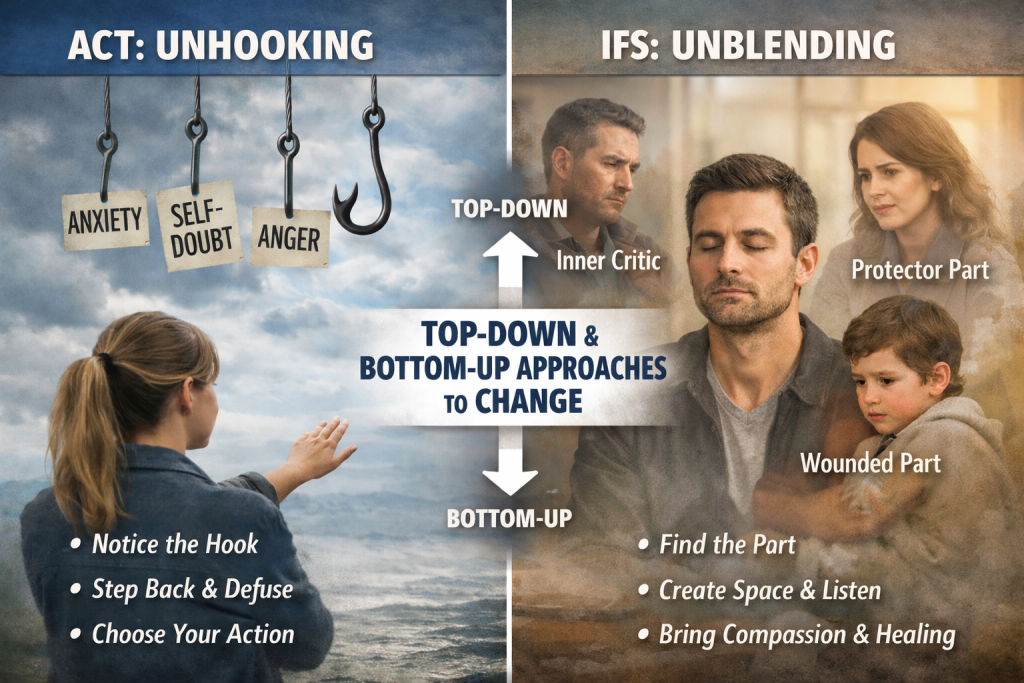
Cognitive fusion relates to the extent to which a person is blended with the content of their thinking. In contrast, cognitive defusion is the extent to which someone can observe and notice their thoughts as they occur.
People who are very fused with their thinking are not as aware that they are having the thoughts they are having. This leads people to automatically think and perceive things as if their thought is actual reality or the only viewpoint, rather than a ‘lens’ through which they perceive things.
When someone notices their own thoughts, it becomes much easier to separate from the thought. In essence, by noticing each thought as it occurs, a person can tap into an observing part of themselves and is no longer fused with only their thinking mind. This leads to thoughts having much less emotional impact. ACT teaches people to have increased mindfulness of their thoughts and teaches other ways of defusing thoughts and beliefs through cognitive defusion strategies.
5) Self as context VS attachment to the conceptualized self
The ‘conceptualized self’ is a concept that refers to the self-referencing perspectives and beliefs that a person has. Aside from automatic thoughts, people have an underlying view or narrative about themselves. A self-narrative refers to how a person might answer the question, “who are you?”
The extent to which a person’s narrative is flexible and self-supporting varies widely across people. When people become attached to a conceptualized self (e.g., ‘I am not good enough’ or ‘nothing I try really works out’), it can make it more difficult for a person to make desired changes in their life. The person loses flexibility in who they are or who they can become.
ACT helps people differentiate between a stable enduring sense of self and more fleeting thoughts, feelings, sensations and memories. If one is lower in self-as-context skills, thoughts, feelings, sensations and memories can become more easily attached to one’s view of self, thereby reducing flexibility.
ACT strives to help people become more aware of the timeless, interconnected sense of self so that it becomes easier to distinguish this sense of self from any particular context (Luoma, Hayes & Walser, 2007). This can help reduce the limiting nature of difficult life experiences and their impacts on people’s sense of self.
6) Committed action VS avoidance & inaction.
Another fundamental component of psychological flexibility is the extent to which someone persists with intentional action in the face of difficulty instead of withdrawing or giving up. Commonly known across therapeutic models (e.g., CBT, DBT)- Avoidance and inactivity tend to increase depression and anxiety over the long-run.
This is concerning because we often shut down and become inactive when faced with difficult emotions and stressful circumstances. People also tend to pull back from essential relationships and leisure activities. Particularly with depression and anxiety, people often start to withdraw from their life and avoid people, situations and activities.
To counterbalance these concerns, ACT places a particular focus on helping people choose differently and commit to action. ACT teaches people ways to take valued action, even in the face of adversity or emotional difficulty. Enhancing the range of psychological flexibility skills helps people more easily choose valued actions, despite what difficult feelings and negative or self-defeating thoughts, or narratives, show up.
All of the clinicians or therapists at Dr. Barbera C. Psych’s practice are trained in the use of ACT. To find out more information or book an appointment contact us.
References:
A-Tjak, J.G; Davis, ML; Morina, N; Powers, MB; Smith, JA; Emmelkamp, PM (2015). “A meta-analysis of the efficacy of acceptance and commitment therapy for clinically relevant mental and physical health problems.” Psychotherapy and Psychosomatics. 84 (1): 6-30.
Harris, Russ (August 2006). “Embracing your demons: an overview of Acceptance and Commitment Therapy.” Psychotherapy in Australia. 12(4): 2-8.
Horner, G. (2016). Resilience. Journal of Pediatric Health Care. 31(3): 384-390.
Luoma, J.B., Hayes, S.C., & Walser., Robyn, D. Learning ACT. An Acceptance & Commitment Therapy Skills-Training Manual for Therapists. New Harbinger Publications, Inc. (2007).
Resources:
To learn more about ACT, visit the Association for Contextual Behavioural Science